
The rise of China’s biotech industry
October 28, 2026
Since the COVID pandemic, China’s biotech industry has made a remarkable turn from producing generic drugs to designing genuine innovations
In a US Senate Committee hearing in April, US Health Secretary Robert F. Kennedy Jr did not mince words as he warned of America’s loosening grip on biotechnology innovation: “China is now eating our lunch,” he told politicians. The frank admission contrasts with US leadership at the height of the COVID-19 pandemic five years ago, when state-of-the-art mRNA-based vaccines from US drugmakers Moderna and Pfizer came to the rescue—except in China, which relied on traditional inoculations that proved less effective.
The pandemic marked a turning point for Chinese biotechs, which have honed an ability to design and engineer complex biological systems—including next-generation drugs in complex therapeutic areas such as oncology and immunology. “Last year 50% of the new drugs that were approved were from China, they went from 3% of clinical trials to 30%,” said Kennedy Jr.
China’s arrival as a source of emerging biotech has been long in the making, according to Damien Ng, a senior research analyst at Swiss wealth management group Julius Bär. “Over the past decade, many Chinese companies progressed from producing generics and biosimilars to conducting original drug discovery,” says Ng, who specializes in longevity, demographics and the future of health.
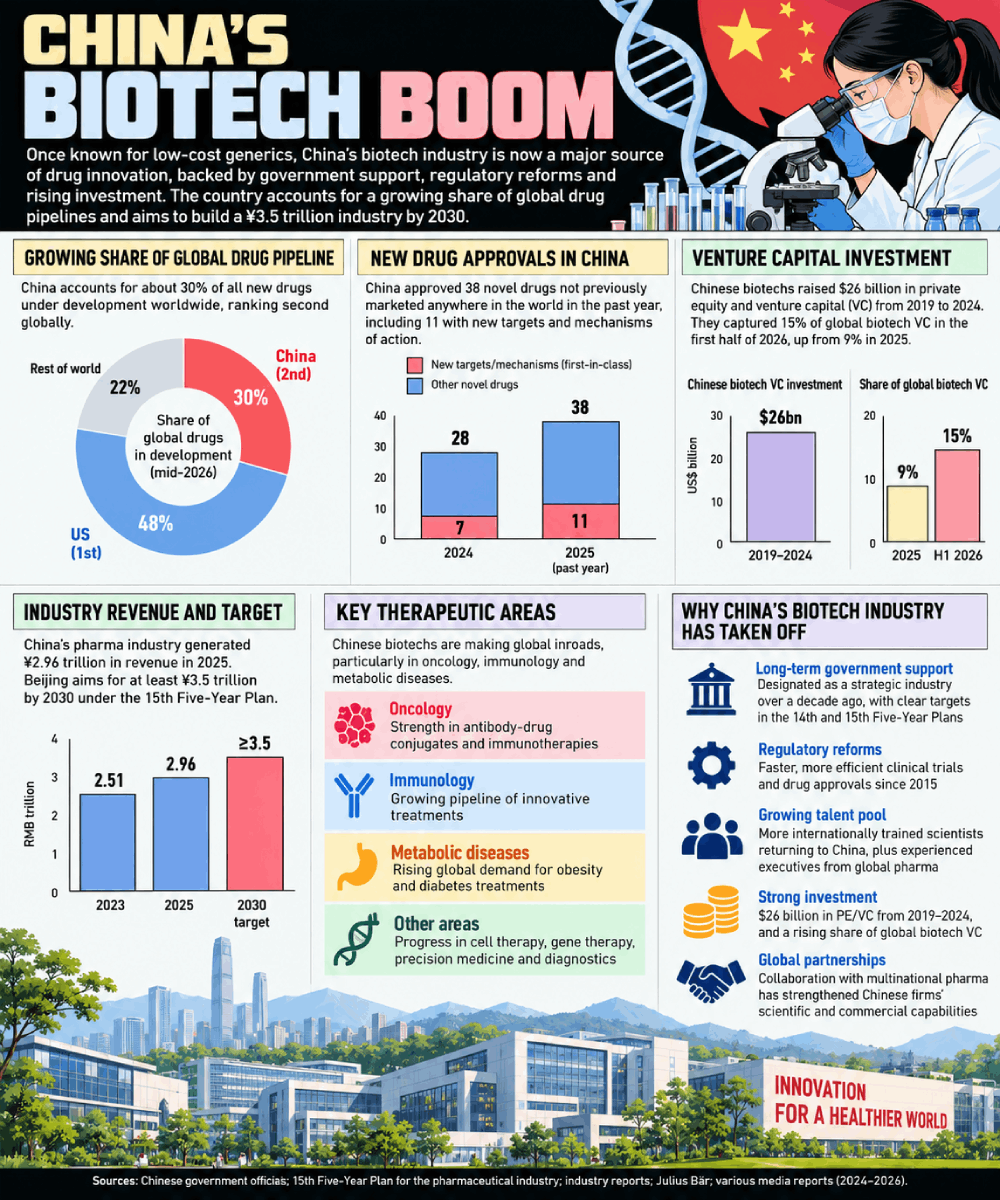
Beijing designated biotech as a crucial strategic emerging industry more than a decade ago, before solidifying its importance in the early 2020s through the introduction of the 14th Five-Year Plan (FYP) for Bioeconomy Development. The 15th FYP now calls for industrial biotech companies to generate combined revenue of at least ¥3.5 trillion ($522 billion) by 2030—an achievable target given they earned ¥2.96 trillion last year.
Stronger, faster, smarter
Virtually all drug development in China used to be generics—low-cost copies of brand-name drugs—Companies like Abogen and Innovent Biologics are moving upstream to compete in the most lucrative space for pharmaceuticals, namely innovating new medicines and bringing them to market through clinical testing.
Several factors converged to accelerate China’s biotech sector this decade. Sustained investment in education and scientific research alongside biomedical infrastructure established a strong foundation. Regulatory reforms that began in earnest in 2015 to integrate with global standards then paved the way for more efficient clinical trials and drug approval pathways.
Investment capital has also supported the growth of ambitious biotech startups, with Chinese companies raising $26 billion in private equity and venture capital (VC) from 2019 to 2024. This has extended to this year as Chinese biotechs captured 15% of global biotech VC in the first six months (H1), up from 9% in all of 2025, while US peers held a 58% share that was down from 64% in 2025.
A growing number of internationally trained scientists returned to China and brought global expertise with them, while many senior executives and founders gained experience at global pharma companies before launching their own ventures. “Experience gained through partnerships with pharma multinationals strengthened scientific capabilities. These developments created an ecosystem capable of generating globally competitive therapies in areas such as oncology, immunology, and metabolic disease,” says Ng.
From factory to lab
China accounted for about 30% of all new drugs presently under development worldwide as of mid-2026, ranking second globally, while 38 novel drugs not previously marketed anywhere were given the green light for market launch, a regulatory official said in July. Beijing wants to up China’s global share of these first-in-class drugs to 25% by the end of this decade under the 15th FYP for pharma.
China’s nascent emergence as the go-to destination for innovative medicine has been concentrated in oncology, immunology and metabolic diseases—unsurprising, given the country has the largest diabetic population, accounts for one-quarter of the global cancer burden, and is fighting rising rates of autoimmune disease.
“China has established particular strength in oncology, where companies have developed expertise in antibody-drug conjugates and immunotherapy platforms. Metabolic diseases have emerged as another important area, driven by global demand for obesity and diabetes treatments,” says Ng, noting that Chinese firms have also made significant progress in cell therapy, gene therapy, precision medicine and advanced diagnostics.
“The country’s biotechnology sector has demonstrated an ability to adopt and scale emerging scientific modalities with impressive speed. While the US maintains leadership across many frontier technologies, China has become an increasingly important source of innovative therapeutic candidates entering global development pipelines,” Ng says.
One of the key differentiators positioning China as a leading global early innovation engine is research and development (R&D) velocity. The cycle from early discovery to investigational new drug can be 50-70% faster in China than the rest of the world. In late development, trial recruitment can run two to five times faster than US and EU benchmarks thanks to large and concentrated patient pools from the 1.4 billion population and lower labor costs.
Phase I studies in China cost roughly one-third of those in the US and are completed much more quickly, providing decision-ready data early, according to expert testimony for a hearing of the US-China Economic and Security Review Commission in 2025.
The cost-speed advantages mean China has become one of the world’s most active clinical research environments—19% of all clinical trials launched globally in 2025 utilized at least one site in China, up from 9% in 2019, while North America’s share remained unchanged at 20% and Europe’s dropped 33% to 27%.
“China’s clinical treatment for rare diseases possesses unique advantages, particularly regarding the speed of clinical progress,” says James Li, president of San Francisco-based GondolaBio. “I believe that China can advance clinical work efficiently while ensuring high medical quality—this is a distinct strength of the domestic industry.”
Big Pharma buying Chinese innovation
Global drugmakers are now increasingly licensing China-developed medicines and has become an important contributor to global pharma pipelines. Their interest in taking on Chinese medicines is compounded by growing pressure to replace revenues from products approaching patent expiry—more than $500 billion of projected drug sales are at risk of losing patent protection by 2033.
“For multinational pharma firms, licensing offers a way to access promising therapies without absorbing the full expense and risk associated with early-stage discovery programs. As a result, China has become an increasingly attractive partner in global drug development,” says Li.
The licensing boom by global pharma has become a gold rush for Chinese IP. Partners from markets including the US, UK, France and Italy snapped up rights to Chinese-developed drugs in 81 out-licensing deals worth $110 billion in H1 2026, a record high and matching 80% of 2025’s full-year total.
While impressive, the blockbuster figure’s potential total value is contingent on drugs reaching commercialization successfully. Separate industry data suggests upfront payments to Chinese biotechs amounted to just $5 billion in H1 2026.
Among the tie-ups were a partnership between CSPC Pharmaceutical Group and AstraZeneca that will pay the Shijiazhuang-based company $1.2 billion upfront, and an agreement between Hengrui Medicine and Bristol Myers Squibb for $600 million upfront.
Building a biotech boom
China’s dynamic biotech ecosystem is founded on several structural advantages that include policy, talent, capital, infrastructure and market scale.
Central government backing gave local governments the green light to support biotech intensively, and they responded by creating biotech clusters and providing funding and infrastructure to attract companies. Consequently, the Zhangjiang Biotech and Pharmaceutical Industrial Base in Shanghai—China’s original ‘pharma valley’—has been joined by regional hubs in Suzhou, Beijing and the Greater Bay Area.
“Strong connections among hospitals, research institutions, manufacturers, and investors help create an integrated environment that can support rapid development from laboratory discovery through clinical testing,” says Ng.
Talent and capital have also played a major role too. The country has built a substantial scientific workforce and continues to expand its pool of highly trained researchers—many of who are trained in molecular biology, medicine, chemistry and related fields. This strong base of human capital has been complemented by widespread use of AI, helping to cut R&D costs below those of many Western markets and improving capital efficiency.
At the same time flagship initiatives such as the Thousand Talents Program and its below age 40-focused counterpart have lured elite scientists and experts to China to continue their work.
Access to large patient populations can accelerate recruitment for clinical studies, particularly in therapeutic areas with significant unmet medical need. Many biotech companies are entrepreneurial and capable of making decisions quickly.
American muscle
While America’s decades-long run as a premier innovation hub is being challenged, the US remains the global standard for pharma innovation and regulatory rigor, leading in grassroots, ‘zero-to-one’ basic science and academic discovery on the back of decades of federal government grants and university research ecosystems.
American institutions continue to top university rankings for life sciences and medicine, while the San Francisco Bay Area and Greater Boston remain the world’s leading life sciences and biotech innovation hubs. Of the top 50 largest publicly traded drugmakers by market capitalization in October 2026, 20 were from the US compared with China’s four.
“The US retains substantial advantages in venture capital, elite research institutions, entrepreneurial culture, and frontier scientific research,” says Ng. “It continues to hold an advantage in breakthrough basic research and the creation of entirely new scientific platforms.”
Challenges for China
China’s pharma push is running into challenges though. Competition within China can be intense, with many companies pursuing similar targets and therapeutic strategies, while international commercialization capabilities also remain less developed than those of established global pharma firms.
Chinese biotech is also less than two years removed from a ‘capital winter’ due to a combination of healthcare reimbursement cuts, drug centralized procurement and a sluggish market for initial public offerings. The funding cooldown rocked industry confidence and sent companies scrambling for license-outs to plug funding gaps.
Even as global pharma eyes Chinese biotechs as a source of new therapies, the fact remains that there are inherent risks in drug development and many experimental therapies ultimately fail. This came into view in October when US-based ArriVent BioPharma disclosed that a lung cancer treatment it licensed from Shanghai Allist Pharmaceuticals five years ago failed a late-stage trial, performing no better than chemotherapy.
Biotech has also emerged as a defining aspect of great-power competition unfolding between the US and China. At the end of 2025 US President Donald Trump signed into law the BIOSECURE Act to ban government agencies and recipients of government grants from contracting with “biotechnology companies of concern” in adversarial countries. The act has affected Chinese investors’ access to the US and the ability of Chinese biotech firms’ ability to gain Contract Development and Manufacturing Organization partnerships in the US.
Safety and trust
Clinical trial quality and data integrity in China have improved significantly since a scandal a decade ago in which 80% of clinical data reviewed by regulators was found to be substandard or fraudulent. But questions have continued to be raised over the credibility of data produced in a hyper-competitive ecosystem—in 2025 for instance, doctors in China voiced alarm over large amounts of identical data in generic drug evaluations.
More recently the industry has reckoned with the previously undisclosed deaths of three patients in highly experimental gene-editing and cell-therapy studies. The patient fatalities, while tragic, reflect how “scientific research and clinical trials inherently involve unknown risks”, according to Li from GondolaBio.
Dual epicenters
The US has led in biotech since at least the 1970s but China’s surge underlines how the landscape is rapidly changing. Still, overtaking the US across the entire biotech value chain would be difficult. With deep capital markets, a strong foundation in basic research and best-in-class pharma commercialization, the US will likely endure as the best place for biotech discovery, invention and entrepreneurship.
But there is plenty of scope for Chinese innovation to complement US leadership. Ng believes that rather than replacing the US, China is likely to become an indispensable contributor to the global biotech ecosystem, shaping everything from early-stage research to clinical development. That could open the door for some Chinese businesses to fulfil Beijing’s ambition of building globally transformative biotech companies.
“A likely outcome is the emergence of a dual-center global biotech industry in which the United States remains the leader in foundational innovation while China becomes an equally important source of drug discovery,” says Ng.
Enjoying what you’re reading?
Article Subscribe (1)
CKGSB Report





Our Programs

Emerging Tech Management Week: Silicon Valley
Global Unicorn Program Series
In partnership with UC Berkeley College of Engineering
A technology management program for leaders looking to turn emerging technologies into business opportunities.
Combining proven strategies and cutting-edge research, the program helps participants fuel innovation, seize opportunities in emerging technologies, and catalyze transformation within their organizations. Designed for managers, start-up leaders, and technology investors, it includes visits to venture capital firms and technology companies, alongside mentored group projects.
LocationUC Berkeley, California, United States
Date01 - 06 Nov, 2026
LanguageEnglish
Stanford & Silicon Valley Immersion Program
Global Unicorn Program Series
In partnership with Stanford Engineering Center for Global & Online Education
A Silicon Valley immersion for entrepreneurs, intrapreneurs, and investors leading and scaling AI-driven companies.
The program combines academic learning with visits to AI and robotics labs and Silicon Valley companies, giving participants direct exposure to emerging technologies and the businesses developing and applying them.
LocationStanford University Campus, California, United States
Date06 - 11 Dec, 2026
LanguageEnglish with Chinese Translation

Emerging Markets: Innovation and Scaling for Exponential Growth – ASEAN
A China-focused innovation program for ASEAN executives and business owners responding to the impact of AI on their industries.
Gain insights from leading Chese thinkers in Jakarta, with an optional immersion in China and opportunities to connect with the business leaders driving innovation. The program offers a closer look at how developments in China could affect your industry and business.
LocationJakarta, Indonesia
Date23–26 March 2027
LanguageEnglish (with Chinese translation)
Asia Start: AI + Digital Ecosystem China Expedition
An immersive program for entrepreneurs and executives looking to understand China's AI and digital economy firsthand.
Gain the latest trends and insights, strategies, and connections to overcome challenges and support future business growth in Asia and beyond.
LocationChina (Beijing, Shanghai, Hangzhou & optional Shenzhen)
DateApril 19–24, 2027
LanguageEnglish

Intelligent China: AI, EVs & Smart Manufacturing
A three-part program examining China’s advances in AI, electric vehicles, and smart manufacturing.
Through faculty-led sessions, company visits, and exchanges with industry leaders, gain practical insights for your organization's strategy, partnerships, and investment decisions. Join an individual four-day program or complete the full 12-day series.
LocationBeijing, Shenzhen, Shanghai, and Hangzhou
DateSummer – Winter 2027 (three 4-day programs)
LanguageEnglish