
Powering the AI race: How China’s solar surplus could turbocharge Its ambitions
September 30, 2026
As China’s solar panel industry deals with overcapacity, could the surplus fuel the country’s AI ambitions?
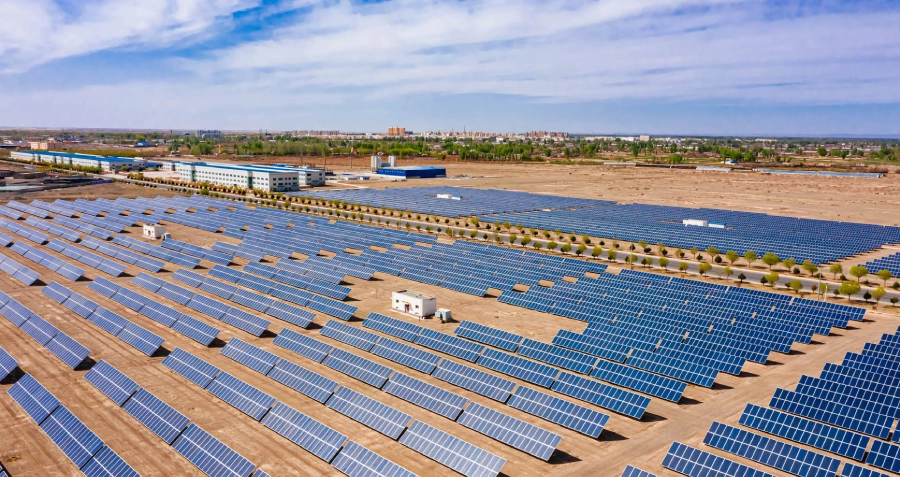
China’s solar industry currently has the ability to produce nearly twice as many panels as the world installs annually, giving rise to intense price wars within the industry.
Yet beneath the immediate pain of industrial overcapacity, a quiet structural shift is underway: the collapse in solar hardware costs is turning into an emerging tailwind, helping to fuel the build-out of massive computing clusters in energy-rich western regions like Qinghai, Ningxia, and Inner Mongolia.
As power consumption becomes a primary bottleneck for next-generation technology around the world, could this massive green surplus ultimately end up serving as a strategic advantage for China in the global AI race rather than just a chronic economic headache?
Solar titan
China has spent more than a decade building the world’s largest solar manufacturing ecosystem through aggressive state investment and industrial planning. This long-term bet has recently hit a major milestone: solar power has overtaken coal as China’s largest source of installed power generation capacity for the first time.
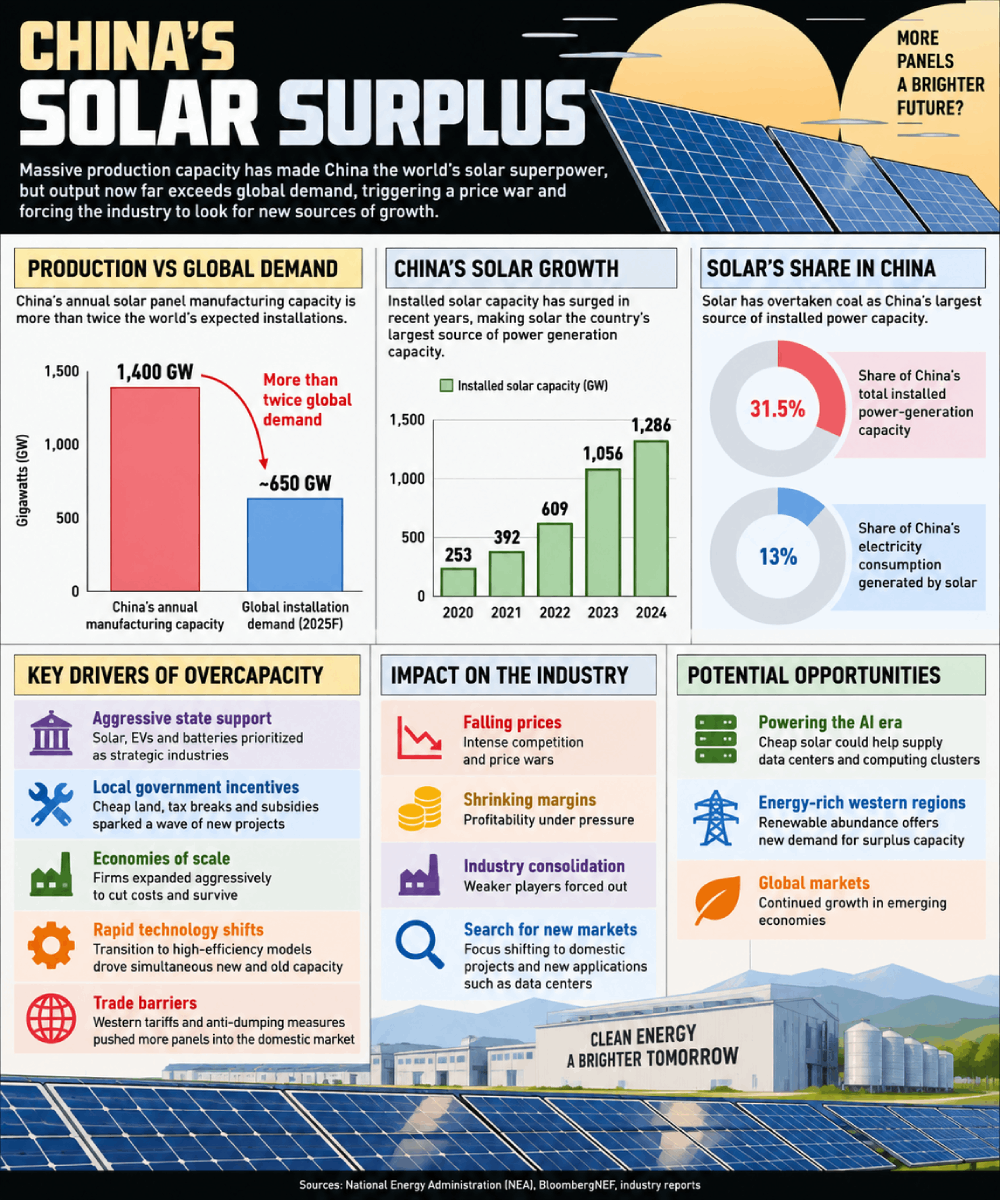
According to the National Energy Administration (NEA), China’s installed photovoltaic capacity reached 1,286 gigawatts, accounting for 31.5% of the total, marking a signature achievement in the country’s low-carbon energy transition. Solar now accounts for 13% of total electricity consumption nationwide, meaning more than one out of every eight kilowatt-hours consumed in China is now generated directly by the sun.
Today, Chinese companies dominate the global production of polysilicon, wafers, cells and finished solar panels. However, manufacturing capacity has expanded far faster than global demand, leading to severe oversupply, crashing prices and declining profit margins.
Driven by relentless manufacturing expansion, Chinese factories currently have the capacity to churn out roughly 1,400 gigawatts of solar panels annually–nearly double the global installation demand of roughly 650 gigawatts projected by BloombergNEF this year.
Paradoxically, even as manufacturers struggle with profitability, China has become the world’s most aggressive installer of renewable energy, deploying record-shattering amounts of solar capacity annually, led by giants like LONGi and JinkoSolar navigating turbulent market conditions.
A colossal surplus
The roots of China’s solar overcapacity lie in a potent convergence of industrial policy, local government incentives, and aggressive corporate expansion.
“High-prosperity expansions, coupled with rapid technological iterations, fierce market share battles, and China’s unique local government and capital market drivers, jointly caused the recent overcapacity, while overseas anti-dumping and trade barriers served merely as amplifiers,” says Liu Qiujun, a stock analyst at a Shenzhen-based capital management firm.
This structural imbalance was driven by the sheer velocity of capital deployment. For years, Beijing prioritized the “New Three” green industries–solar, electric vehicles and lithium batteries–as core drivers for achieving carbon peaking and neutrality goals.
This national push collided with local government GDP incentives, as municipalities viewed massive solar manufacturing projects as premier economic anchors. Regions competed fiercely through cheap land, tax breaks, low-interest loans, and direct subsidies, triggering a geometric influx of capital.
Furthermore, the solar supply chain features extreme economies of scale, where larger footprints drive down unit costs. To survive, firms had to continually expand via aggressive financing. Compounding this, the industry underwent a chaotic structural pivot from the traditional models to high-efficiency technologies. Companies were forced into a cycle of simultaneously scrapping old lines and building new ones, inadvertently driving total nominal capacity even higher.
During the peak expansion years of 2021 and 2022, capacity deployment outpaced demand growth by a factor of four to five, says Liu.
“This massive velocity gap laid the direct foundation for the subsequent vicious price war, with China acting as the primary engine behind the build-out,” she says.
Meanwhile, external trade pressures acted as a bottleneck. As Western economies deployed sweeping tariffs, anti-dumping probes and strict supply-chain screening, immense volumes of export-bound products were forced back into the domestic market, severely exacerbating local oversupply and price cannibalization.
While market pressures and collapsing profit margins have forced a painful shakeout, industry consolidation has increasingly relied on administrative guidance rather than pure market forces.
In July 2025, the Ministry of Industry and Information Technology (MIIT) convened a symposium specifically targeting chaotic low-price competition, pushing for the orderly exit of outdated capacity–a policy pivot that subsequently helped polysilicon spot prices rebound.
“The formation of this cycle relied on a tripartite synergy of government, capital, and enterprises, and its clearing phase similarly cannot bypass the visible hand of the state–which is an inherent feature of China’s industrial cycles,” says Liu.
A blessing in disguise?
While traditional economists view solar overcapacity as a severe economic drag, a quiet transition is already taking shape across China’s data centers.
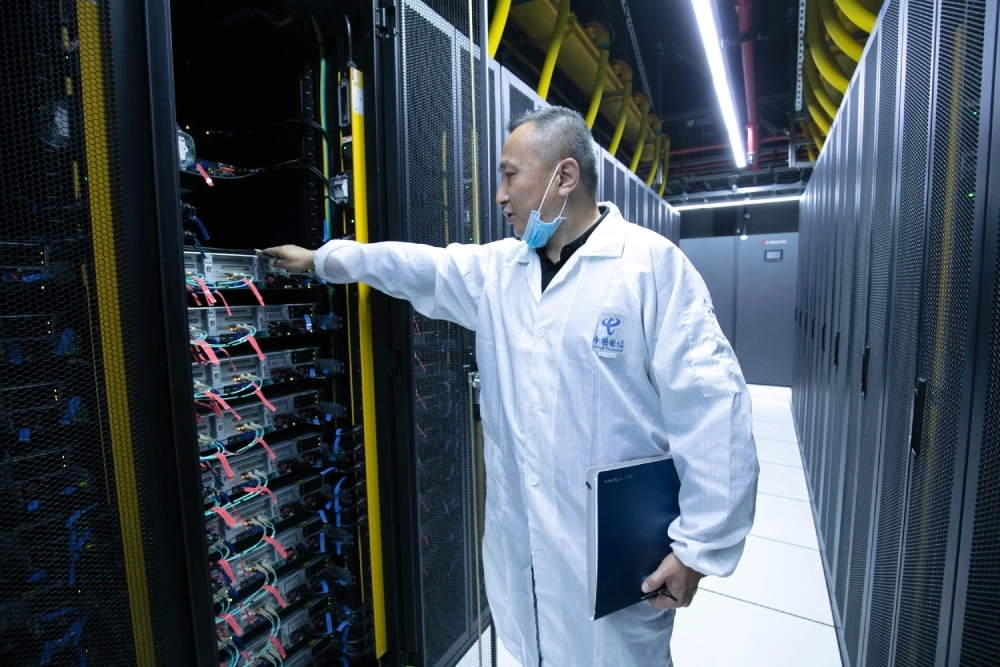
China already operates more than 13.7 million standard racks in computing facilities nationwide as of the end of 2025 and is increasingly moving new capacity toward eight national computing hubs and ten major data-center clusters. More than 80% of the country’s AI computing capacity is now concentrated within these hubs, including energy-rich western regions such as Inner Mongolia, Ningxia, Gansu and Guizhou, where abundant renewable power, cheaper land and cooler climates can substantially reduce the cost of running power-hungry facilities.
Under the “East Data, West Computing” strategy, energy-intensive workloads that are less sensitive to delays—including AI model training and large-scale data processing—can increasingly be handled in the western regions, while latency-sensitive applications such as finance and industrial control remain closer to the major population and business centers of eastern China.
In Ulanqab, Inner Mongolia, leveraging abundant wind and solar resources, local authorities have attracted over 84 data center projects with total investments exceeding RMB 500 billion, drawing tech giants like Huawei, Alibaba, Apple, and Kuaishou to establish operations backed by 132,000 Petaflops of computing capacity.
Hohhot’s Horinger New Area and Xinjiang’s Karamay have seen cumulative installed capacities approach 10 gigawatts. Industry data indicates that pairing localized green energy with data centers can cut computing energy costs by 30% to 50% while drastically shrinking carbon footprints.
As artificial intelligence models demand unprecedented computational firepower, electricity consumption by data centers has skyrocketed, making reliable and cheap energy an increasingly critical source of competitiveness in the AI era. This dynamic bridges clean-tech manufacturing and digital infrastructure in a novel way.
“For the photovoltaic industry, a brand-new growth pole is emerging: the massive electricity demand driven by artificial intelligence and the computing power revolution,” says Xing Guoqiang, Chief technology officer of green energy specialist Tongwei Group.
“As solar technology continues to cut costs and energy storage system costs drop rapidly, ‘solar-plus-storage’ has become the most economical energy form in multiple regions worldwide. Its levelized cost advantage over traditional fossil fuels will continue to expand, which will drive an accelerated global energy transition from the foundational logic of economics,” he says.
The explosive growth of global data centers and computing infrastructure will inevitably trigger a surge in power demand, and solar-plus-storage–thanks to its green, economical and distributed deployment characteristics–will undoubtedly be one of the primary energy sources to fill this new demand gap, according to Xing.
“This not only opens up entirely new application scenarios for ‘solar-plus’ models but could also further raise the long-term ceiling for photovoltaic development.”
Challenges exist
“Extra solar capacity can give China an advantage in the AI race, but only if we distinguish between excess solar-panel manufacturing capacity and excess electricity,” says Xu Tianchen, senior economist at the Economist Intelligence Unit. “Cheap panels matter indirectly, and the real advantage comes from turning them into very low-cost power for data centers.”
Yet, translating that cheap solar hardware into a structural macroeconomic advantage is far from straightforward.
“Cheap modules do not mean that end-user electricity prices will drop proportionally,” Liu says. “As the share of solar power rises, the power system requires increased investment in energy storage, grid transmission, demand response and peak-regulation capabilities.
“Therefore, the solar overcapacity has not eliminated energy costs; rather, it has shifted their structure: while generation and fuel costs drop, the importance of grid, storage, and system-balancing costs increases. China’s true advantage lies in ultimately transforming cheap solar into round-the-clock, dispatchable low-cost power,” Liu says.
There are also practical limits to how closely data-center expansion can be tied to western China’s solar build-out. Computing facilities require reliable power around the clock, whereas solar generation is concentrated during daylight hours, making storage, grid connections and complementary sources such as wind essential—and potentially eroding some of the cost advantage provided by cheap panels.
The geography presents further complications: desert locations can require expensive roads, transmission and fiber infrastructure, while dust, water scarcity and extreme temperatures can raise construction and cooling costs. Nor can all computing simply migrate westward. Latency-sensitive services must remain relatively close to the population and commercial centers of eastern China, leaving western facilities better suited to workloads such as AI training and large-scale data processing. Ultimately, cheap renewable electricity is only useful if there is sufficient demand for the computing capacity it supports—and, particularly for AI, sufficient access to advanced chips to keep those racks occupied.
Ultimately though, if China successfully couples its solar hardware surplus with massive grid modernization, ultra-high-voltage transmission lines, and large-scale battery storage, the implications will stretch far beyond renewable energy, experts say.
While renewable energy could heavily propel China’s position in the global AI race, Liu points out that the US and China face fundamentally contrasting strategic bottlenecks.
“The US lacks electricity, and its bottlenecks are engineering and manufacturing constraints–with gas turbine delivery cycles stretching five to seven years, which is fundamentally a matter of time; China lacks chips, and its bottleneck is a technological blockade with no definite timeline. Therefore, the power advantage serves as a temporal window rather than a permanent moat,” Liu says.
This competitive edge does not stem from clean energy in isolation, but rather from the fact that China has emerged as the sole major AI power capable of meeting three simultaneous conditions: expanding its electricity supply at low cost, in massive abundance, and with an increasingly dispatchable grid, she adds.
The Temporal Window
While China’s solar sector is frequently cast as a cautionary tale of industrial overexpansion, history may ultimately view its overcapacity through a far more strategic lens. By converting an acute domestic surplus into a steady stream of low-cost clean energy, the country has forged a vital buffer to support its technology ambitions amid tightening global energy constraints.
“China’s investment in renewable energy will become one of its most critical competitive advantages in the AI era,” Liu says, not merely because electricity is cheap, but that in a world where power is rapidly becoming a scarce input for AI, “China stands alone as the major power capable of turning electricity from a rigid constraint into a flexible variable.”
However, this strategic edge comes with a strict expiration date, as this advantage depends entirely on whether grid system capabilities can keep pace with capacity growth, Liu cautions, whether manufacturing players can survive the consolidation shakeout and whether the semiconductor gap can be narrowed within the temporal window bought by cheap power.
“Renewable energy merely grants China the qualification not to fall behind; actual leadership will still depend on the chips,” says Liu.
Enjoying what you’re reading?
Article Subscribe (1)
CKGSB Report




Related Articles
Our Programs

Emerging Tech Management Week: Silicon Valley
Global Unicorn Program Series
In partnership with UC Berkeley College of Engineering
A technology management program for leaders looking to turn emerging technologies into business opportunities.
Combining proven strategies and cutting-edge research, the program helps participants fuel innovation, seize opportunities in emerging technologies, and catalyze transformation within their organizations. Designed for managers, start-up leaders, and technology investors, it includes visits to venture capital firms and technology companies, alongside mentored group projects.
LocationUC Berkeley, California, United States
Date01 - 06 Nov, 2026
LanguageEnglish

Intelligent China: AI, EVs & Smart Manufacturing
A three-part program examining China’s advances in AI, electric vehicles, and smart manufacturing.
Through faculty-led sessions, company visits, and exchanges with industry leaders, gain practical insights for your organization's strategy, partnerships, and investment decisions. Join an individual four-day program or complete the full 12-day series.
LocationBeijing, Shenzhen, Shanghai, and Hangzhou
Date December 2026 – July 2027 (three 4-day programs)
LanguageEnglish

Emerging Markets: Innovation and Scaling for Exponential Growth – ASEAN
A China-focused innovation program for ASEAN executives and business owners responding to the impact of AI on their industries.
Gain insights from leading Chese thinkers in Jakarta, with an optional immersion in China and opportunities to connect with the business leaders driving innovation. The program offers a closer look at how developments in China could affect your industry and business.
LocationJakarta, Indonesia
Date2–4 December 2026
LanguageEnglish (with Chinese translation)

Stanford & Silicon Valley Immersion Program
Global Unicorn Program Series
In partnership with Stanford Engineering Center for Global & Online Education
A Silicon Valley immersion for entrepreneurs, intrapreneurs, and investors leading and scaling AI-driven companies.
The program combines academic learning with visits to AI and robotics labs and Silicon Valley companies, giving participants direct exposure to emerging technologies and the businesses developing and applying them.
LocationStanford University Campus, California, United States
Date06 - 11 Dec, 2026
LanguageEnglish with Chinese Translation
Asia Start: AI + Digital China Expedition
An immersive program for entrepreneurs and executives looking to understand China's AI and digital economy firsthand.
Gain the latest trends and insights, strategies, and connections to overcome challenges and support future business growth in Asia and beyond.
LocationChina (Beijing, Shanghai, Hangzhou & optional Shenzhen)
DateApril 19–24, 2027
LanguageEnglish