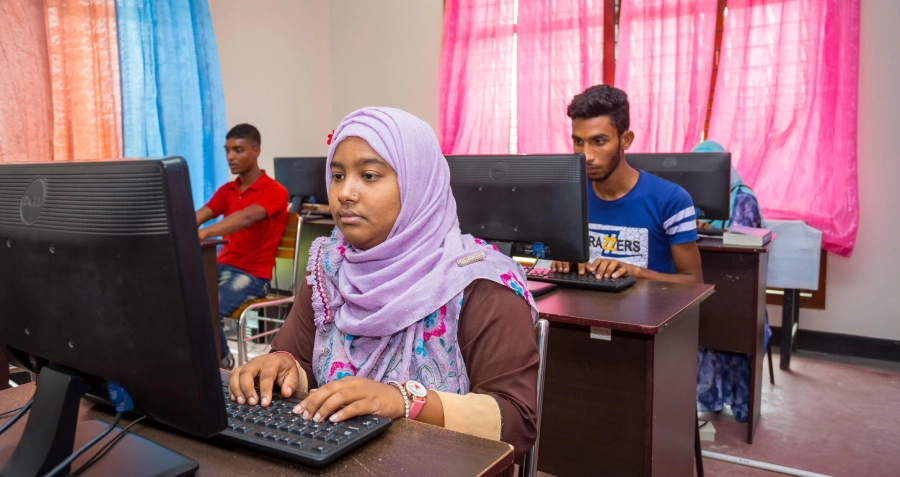

China’s AI push to the Global South
November 25, 2026
China is using affordable, open-weight AI to expand its influence across the Global South, but can it turn adoption into lasting influence?
At the BRICS summit in September 2026, Chinese President Xi Jinping proposed establishing an artificial intelligence open-source community to promote cooperation on large language models (LLMs), applications and technical training.
The announcement was another step in Beijing’s efforts to position China as a leading force in the development and governance of AI. It also highlighted an emerging dimension of the technological rivalry between China and the United States.
While much of the competition has centered on advanced semiconductors, computing infrastructure and increasingly powerful AI models, another contest is taking shape over which countries will provide the technologies underpinning AI adoption across the developing world.
“China wants to be seen as a global leader in AI, not just technologically but also in AI governance,” says Kyle Chan, a fellow at the Brookings Institution’s John L. Thornton China Center. “China sees itself as playing a particularly important role in sharing and diffusing the benefits of AI with the Global South.”
For countries seeking to build domestic AI capabilities without the enormous costs of developing frontier models, China’s affordable, open-weight systems present an increasingly attractive alternative. For Beijing, they offer an opportunity to expand its technological reach while deepening economic and diplomatic relationships. But exporting competitive models is not the same as establishing a durable AI ecosystem abroad, and China’s experience at home offers an important test of that distinction.
An alternative AI ecosystem
The global technology industry has historically been dominated by American companies, and AI has largely followed that pattern. US firms retain considerable advantages in advanced semiconductor design, cloud infrastructure, research capabilities and access to capital.
Developing frontier AI models requires substantial financial investment, specialized engineering expertise, sophisticated computing infrastructure and large volumes of high-quality data. These requirements create considerable barriers for developing economies hoping to establish independent AI industries.
China’s emergence as a major AI developer has begun to change the equation. The international breakthrough of DeepSeek in early 2025 demonstrated that Chinese companies could develop highly capable AI systems at competitive costs. Other developers, including Alibaba, Moonshot AI and Tencent, have subsequently expanded the availability of models that can be downloaded, adapted and deployed by third parties.
These developments have coincided with Beijing’s growing emphasis on international AI cooperation. At the World Artificial Intelligence Conference in Shanghai in July 2026, China promoted plans for a World AI Cooperation Organization, building on its efforts to establish a greater role in international AI governance.
The subsequent BRICS initiative offered a more structured framework for cooperation with emerging economies. An important distinction is that many Chinese models described as open-source are more precisely classified as open-weight. Their trained parameters are publicly available, allowing developers to operate or modify the models, but their underlying training data and development processes are not necessarily disclosed.
This differs from the proprietary approach traditionally favored by leading American AI companies, which primarily provide access to their most advanced systems through paid subscriptions and application programming interfaces (APIs).
Open-weight models can offer users greater flexibility over costs, customization and data storage, particularly when deployed on infrastructure they control.
“Chinese open-source models offer users across the Global South powerful, affordable models that they can adapt to their own particular needs,” says Chan.
The growing international footprint of these models is evident in developer activity. By September 2026, Alibaba’s Qwen family had reportedly generated more than 150,000 derivative models on the Hugging Face platform, where developers share and adapt machine-learning systems.
Such derivatives indicate that developers are using the original models as foundations for new applications, rather than simply downloading them for experimentation. However, the number of downloads, adaptations or API requests does not necessarily translate into paying customers or sustained commercial adoption.
The figures suggest that Chinese models are gaining international traction. Whether that activity will translate into a self-reinforcing ecosystem, however, is a different question.
China has already developed many of the components of a domestic AI ecosystem, from cloud platforms and model developers to enterprise applications and semiconductor companies. But the presence of competitive products does not necessarily mean that these components form a mature, self-reinforcing technology stack. Historically, platforms such as Windows and Android have benefited from extensive networks of developers, complementary products and established business practices that make switching costly.
China’s AI market remains divided among competing model providers, while its developers continue to draw on international research and seek access to advanced foreign computing hardware. The emergence of a competitive domestic AI industry is therefore not necessarily evidence that an integrated Chinese technology stack has become the preferred choice across the domestic market.
China does not need to achieve complete technological self-sufficiency before its companies can succeed overseas. But the extent to which domestic developers and businesses organize themselves around Chinese AI platforms may offer an indication of whether those platforms can establish similarly durable relationships abroad.
Building local capabilities
For developing countries, the immediate attraction of Chinese AI is affordability.
AI has potential applications across education, healthcare, public administration, manufacturing and agriculture. But developing advanced models independently can be prohibitively expensive, particularly in economies with limited computing resources and technical expertise.
Open-weight systems allow local developers to build applications on existing models without reproducing the costly research and training processes behind them.
They can also be fine-tuned using local datasets to address linguistic, institutional and commercial requirements that may be poorly served by models designed primarily for wealthy Western markets.
In Uganda, for example, the Sunflower LLM project has used Alibaba’s Qwen architecture to develop AI capabilities across 31 local languages, illustrating how internationally developed models can support locally relevant applications.
Smaller, more efficient models can also reduce the computing requirements for deployment, making AI more accessible to universities, smaller businesses and public institutions.
However, access to a model is only one component of technological independence.
“The strongest case for open weights is defence,” says Winston Ma, adjunct professor and executive director of the Global Public Investment Funds Forum at New York University School of Law, and author of Who Owns AI?
Ma points to an incident in which Hugging Face reportedly used the Chinese open-weight model GLM for security analysis after encountering difficulties obtaining assistance from proprietary AI providers. “That is the real value of open weights: a defensive AI under your own control,” he says. “But it only counts as sovereign if a country also has the compute and the people to run it. Otherwise, it trades software dependence for infrastructure dependence.”
This distinction is particularly important for developing economies where reliable electricity, broadband connectivity, data centers and skilled technical workers remain in short supply.
The longer-term opportunity is therefore not simply to import Chinese AI, but to use it as a foundation for domestic expertise, businesses and applications.
What does China gain?
Making powerful AI models freely available might appear commercially counterintuitive. However, distributing models without charging for access does not necessarily mean abandoning the opportunity to generate revenue.
Open-weight models can encourage developers to build applications around particular architectures, creating demand for associated services, infrastructure and technical support.
Chinese technology companies such as Alibaba and Huawei have extensive cloud computing, enterprise technology and infrastructure businesses that could benefit as adoption increases.
The commercial opportunity is therefore not limited to the model itself, but extends to the wider technological ecosystem surrounding it. For Beijing, these relationships also carry strategic value.
China has spent more than a decade expanding its international digital presence through telecommunications networks, cloud services, data centers and other infrastructure projects associated with the Digital Silk Road. AI could represent the next stage of that expansion, allowing Chinese companies to move from providing digital infrastructure into more sophisticated services.
Ma argues that sovereign investment funds could play an important role in connecting China’s domestic AI ambitions with overseas expansion. “It is both, and sovereign capital connects the two,” he says of the commercial and policy motivations behind China’s outreach. “Every country will use its own sovereign fund to invest in its own sovereign AI, and for Chinese companies entering those markets, that fund may be the best partner.”
By combining technology provision with investment, training and institutional partnerships, China could strengthen its position in emerging digital markets while building relationships with governments seeking alternatives to American technology providers.
Widespread adoption could also give Beijing greater influence in discussions about AI standards, regulation and governance.
However, the commercial and geopolitical benefits of open-weight distribution are not guaranteed. The same flexibility that makes these models attractive also limits the ability of their developers to retain users. Businesses may build applications around Chinese models without purchasing Chinese cloud services or committing to a particular provider. More durable commercial relationships would depend on the quality of complementary services, technical support and integration into business workflows, rather than model adoption alone.
Different countries, different priorities
China’s approach faces another challenge: the Global South is far from a homogeneous market.
Countries differ considerably in their technological capabilities, infrastructure, financial resources and relationships with Beijing and Washington.
Ma identifies the Gulf states and Southeast Asia as particularly well positioned to benefit from competition between Chinese and American AI providers. “The UAE, Saudi Arabia, Malaysia and Indonesia run American and Chinese infrastructure, capital and technology at the same time,” he says. “They have the sovereign capital and the power to host data centers for both sides.”
These countries can potentially combine Chinese models with American computing infrastructure while developing their own domestic capabilities.
For Southeast Asian economies, opportunities extend across manufacturing, logistics, e-commerce and services. Gulf states, meanwhile, possess substantial investment resources and ambitions to establish themselves as international AI hubs.
Countries such as India and Brazil have established technology sectors and may seek to incorporate Chinese models into their domestic ecosystems while retaining greater independence.
Lower-income African economies may prioritize affordable applications, local-language support and technical training. However, countries lacking basic infrastructure face more fundamental obstacles.
“Countries without baseline electricity and broadband would gain the least,” says Ma. “Energy alone is not enough either: talent and education, what I call Layer 0 of the AI stack, decide whether a country only runs AI or owns it.”
China’s success will therefore depend partly on its ability to accommodate different national priorities rather than promote a uniform model of technological development.
The American response
China’s expanding international AI presence has not gone unnoticed by American competitors. Although leading US companies such as OpenAI and Anthropic have traditionally concentrated on proprietary models, the competitive landscape is changing.
“At the same time, American AI model providers are shifting to compete with Chinese models in two areas,” says Chan. “First, leading American AI companies such as OpenAI and Anthropic are now offering cheaper versions of their models. Second, a new crop of American open-source models is challenging the dominance of Chinese models in this category.”
Western alternatives, including Meta’s Llama, Google’s Gemma and models developed by Europe’s Mistral AI, also compete for international developer adoption. This complicates the distinction between China’s open approach and America’s proprietary ecosystem.
Furthermore, American companies retain considerable advantages in the infrastructure underpinning AI development and deployment. Even when developers adopt Chinese models, they may operate them using American-designed semiconductors or cloud computing services.
The global AI landscape is therefore unlikely to divide neatly into Chinese and American spheres. As in China itself, developing economies may combine models, infrastructure and investment from multiple providers. Widespread adoption of Chinese models does not guarantee that Chinese companies will capture the associated economic benefits.
The limits of openness
Beyond commercial competition, Chinese AI developers must overcome concerns surrounding trust, transparency and technological dependence. Governments and businesses adopting foreign AI systems must consider data privacy, cybersecurity, reliability and the extent to which models can be independently evaluated.
Chinese models may also face scrutiny over censorship, political bias and safety standards, particularly when deployed in sensitive public-sector or commercial applications. Open-weight distribution can provide greater control over how a model is operated, but does not automatically make its development processes transparent or eliminate risks associated with its training data.
Moreover, even countries capable of hosting models independently may remain dependent on foreign semiconductor suppliers, cloud infrastructure, technical support and software ecosystems.
The distinction between exporting models and exporting an ecosystem is ultimately central to China’s ambitions. Its companies may succeed in making AI more accessible across the developing world without establishing lasting dependence on Chinese technology. Whether they can build enduring networks of developers, businesses and infrastructure providers, both at home and abroad, will help determine how much commercial and geopolitical influence follows.
“Chinese open-source models have certainly earned goodwill across the Global South,” says Chan. “What remains uncertain is whether this will necessarily result in lasting global influence, particularly given the ability of AI users to switch and build on different models.”
Enjoying what you’re reading?
Article Subscribe (1)
CKGSB Report







Our Programs

Stanford & Silicon Valley Immersion Program
Global Unicorn Program Series
In partnership with Stanford Engineering Center for Global & Online Education
Visit Silicon Valley tech companies and AI and robotics labs to explore how US firms apply AI and how their approach compares with China’s.
LocationStanford University Campus, California, United States
Date6–11 Dec 2026 / 5–10 Dec 2027
LanguageEnglish with Chinese Translation

Emerging Markets: Innovation and Scaling for Exponential Growth – ASEAN
How is China’s progress in AI changing industries, and what does it mean for companies growing in ASEAN?
LocationJakarta, Indonesia
Date23–26 March 2027
LanguageEnglish (with Chinese translation)

Asia Start: AI + Digital Ecosystem China Expedition
Visit Chinese tech innovators, hear from experts, and meet the founders and engineers behind China’s AI and digital economy.
LocationChina (Beijing, Shanghai, Hangzhou & optional Shenzhen)
DateApril 19–24, 2027
LanguageEnglish

Intelligent China: AI, EVs & Smart Manufacturing
See China’s advances in AI, electric vehicles, and smart manufacturing through faculty sessions, factory visits, and meetings with industry leaders.
LocationBeijing, Shenzhen, Shanghai, and Hangzhou
DateSummer – Winter 2027 (three 4-day programs)
LanguageEnglish

Scaling Innovation: AI and Digital Strategies for Business Transformation
Global Unicorn Program Series
In partnership with Columbia Engineering
Learn from CKGSB and Columbia Engineering faculty how to apply AI and lead digital business transformation.
LocationNew York, USA
Date26 Sep - 01 Oct, 2027
LanguageEnglish

Emerging Tech Management Week: Silicon Valley
Global Unicorn Program Series
In partnership with UC Berkeley College of Engineering
Explore emerging technologies through classes, company visits, and meetings with Silicon Valley innovators to uncover new business opportunities.
LocationUC Berkeley, California, United States
Date31 Oct - 05 Nov, 2027
LanguageEnglish