
Brewing up a storm: China’s coffee wars
September 29, 2026
The rise of domestic coffee chains in China has seen the brew move from a premium product to an everyday necessity, but is the market at risk of over saturation?
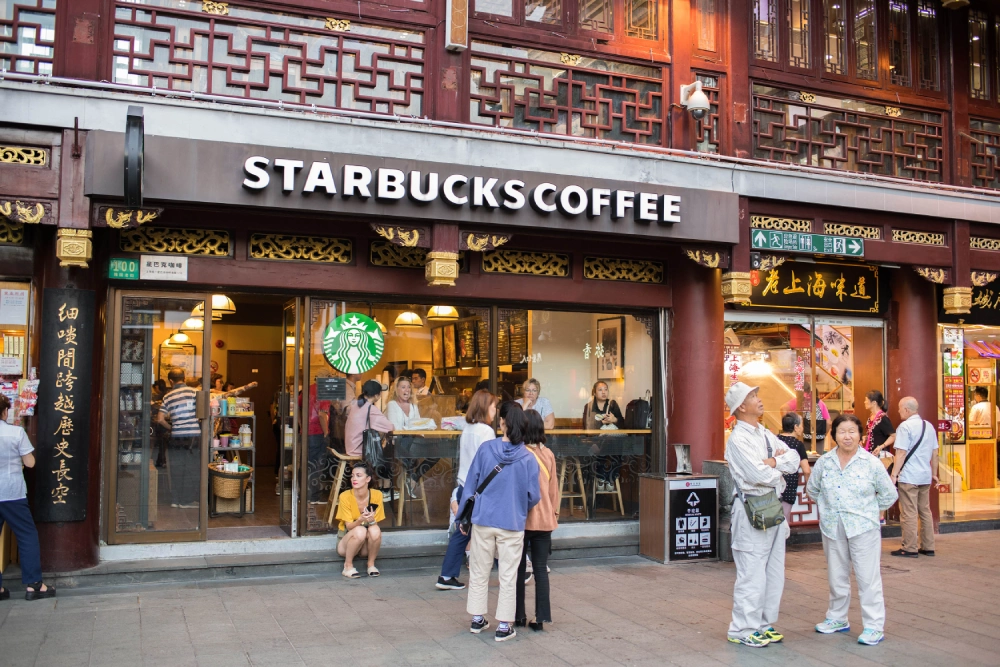
For years, Starbucks was synonymous with coffee in China. Its spacious stores, comfortable chairs and relatively high prices helped transform a drink with little history of mass consumption in the country into an aspirational urban experience.
But for Vanessa Wang, a 35-year-old in Shanghai, paying more than RMB 30 ($4.20) for a coffee no longer makes much sense. “I just need to get a coffee on the go as I rush to the office in the morning. With Luckin Coffee, I pre-order on the app and then pick it up… I don’t need to pay the premium of Starbucks when I won’t even sit in the store anyway.”
That shift is playing out across China. Domestic chains are opening stores at breakneck speed, offering beverages for a fraction of traditional premium prices and releasing new flavors regularly. The result is a market increasingly divided between coffee as an inexpensive everyday drink and coffee as an experience worth paying a premium for.
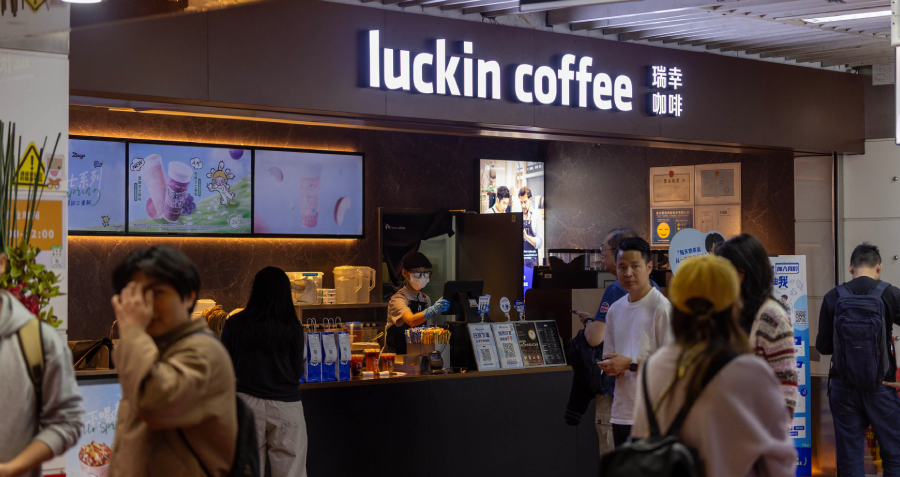
And Luckin Coffee is at the center of that shift. Founded only in 2017, Luckin ended the second quarter of 2026 with 36,310 stores globally, overwhelmingly in China, after opening more than 2,700 net new locations in just three months. Its average monthly transacting customers reached 112.7 million, up 22.9% year-on-year.
But Luckin is no longer alone. Cotti Coffee, Manner Coffee and Mixue Group’s Lucky Cup are among a growing collection of domestic brands competing for different parts of the market. The battle is no longer simply about which company can sell the most cups, but more about testing whether the premium coffeehouse model that helped create China’s modern coffee culture can hold its ground against a generation of digital, fast-moving and much cheaper competitors.
From aspiration to everyday habit
When Starbucks entered mainland China in 1999, coffee consumption remained low and unfamiliar to much of the population. The company helped sell not only coffee but the idea of the coffee shop itself: a comfortable “third place” between home and work where customers could meet, work or socialize.
“For Starbucks, their approach is to be that third place,” says Ed Sander, a China digital retail analyst and publisher of China Digital Retail Report. “You have very spacious stores, mostly in expensive locations… lots of tables, a cozy atmosphere [and] comfortable couches.”
When Luckin came along, it did the exact opposite. Many of its stores have little or no seating and are designed primarily for pickup and delivery. From the beginning, ordering was centered on its app, allowing Luckin to distribute coupons, collect customer data and adjust promotions rapidly. It also made coffee dramatically cheaper.
“Most of the time, you wouldn’t pay more than like RMB 10 for a cup of Luckin coffee, whereas of course Starbucks, their pricing was at least RMB 30,” says Sander.
Low prices reduced the barrier to trying coffee, while sweetened lattes, fruit flavors and other products adapted the drink to local tastes. Sanders says that this combination helped “educate” a new generation of consumers who might never have developed a coffee habit when the market was dominated by more expensive foreign chains.
Olivia Plotnick, founder of China-focused social media agency Wai Social, sees the transformation as part of a broader change in Chinese consumption.
“The explosion of cheap coffee chains has made coffee more accessible to the masses, expanding coffee habits across a wider range of demographics,” she says. “As more people incorporate coffee as part of their daily habit, the market for cheap, daily coffee grows.”
That has fundamentally changed the role coffee plays. While Starbucks helped establish coffee as an aspirational lifestyle purchase, Luckin has helped cement it as a routine caffeine hit picked up on the way to work.
Meet the contenders
Luckin’s greatest strength has been combining low prices with scale, digitalization and relentless product development. Its RMB 15.9 billion ($2.34 billion) in second-quarter revenue was up 28.5% year-on-year, while its store network grew by 2,714 locations during the quarter.
“Luckin made coffee cheap, accessible and dynamic,” says Plotnick. “Through the Luckin app, the brand is able to quickly adapt pricing and flavors and deliver to customers within an incredibly short window.”
Product innovation has been another crucial weapon. Sander says Luckin routinely launches several new products each month while using collaborations with entertainment franchises and other brands to generate social-media attention. Signature products sit alongside a constantly changing selection designed to give customers a reason to return.
“Customers are very curious to try out all of these new products,” he says.
Cotti has adopted many of the same tactics. Established by former Luckin executives, including its former chairman Charles Lu, the chain has used compact stores, aggressive pricing and a heavily franchise-based expansion strategy to rapidly build its footprint.
The similarities have intensified competition for locations. Sander says Luckin has expanded particularly aggressively in some markets partly to secure attractive sites before Cotti franchisees can take them. The battle has increasingly moved beyond Beijing, Shanghai and other wealthy cities into third- and fourth-tier cities and even counties.
Lucky Cup is pushing further toward the mass market, and especially to smaller tier cities and counties. Backed by Mixue Group, whose enormous franchise network has made inexpensive ice cream and tea drinks ubiquitous across smaller Chinese cities, the chain is attempting to apply a similar formula to coffee.
American Alex Rhea, who works at a university in Xining, in western China’s Qinghai province, almost exclusively drinks Lucky Cup. “I used to drink Starbucks and Luckin, but since Lucky Cup came along, it’s just so much cheaper, it tastes good, and the service is very fast,” he says, pointing out that as salaries in Xining are much lower than in east coast cities, so coffee has to be affordable if people are going to drink it.
Manner, meanwhile, demonstrates that Chinese competition is not solely about selling the cheapest possible cup. Emerging from Shanghai’s highly developed café culture, it has targeted urban professionals with small stores and a greater emphasis on coffee quality, occupying space between the discount chains and Starbucks.
Vanessa Wang says that while Luckin is her go-to for a quick caffeine hit on the way to work, if she is having a business meeting, she will generally choose Manner. “I like the balance between the environment and coffee quality, and the price,” she says.
The rise of these competitors has turned what was once a relatively straightforward contest into a fragmented market in which price, convenience, quality and experience can all support different business models.
Where does this leave Starbucks?
Yet Starbucks remains strong. It had 7,991 stores in China at the end of its fiscal second quarter of 2026, and Chinese store sales edged up 0.5% in 2025, with transactions increasing 2.1% even as average spending per customer declined 1.6%.
But the company has been forced to adapt to a market that has been dramatically impacted by its domestic competitors. Online ordering and delivery have become more important, pickup-focused formats have appeared, and Starbucks supercharged its marketing.
“You couldn’t order online when Luckin came to the market. You couldn’t order online in Starbucks. That’s now possible as well,” Sander says. “They have also started to do more in the area of product innovation and product launches.”
As Plotnick points out though for different customers, they fulfill different needs.
“Luckin and Starbucks should not be viewed as competitors,” she says. “For the majority of people in China, Starbucks is not going to be the everyday on-the-go coffee; it’s for the business meeting or weekend outing.”
That distinction could ultimately protect Starbucks. As Chinese consumers become more cautious about spending, Plotnick says that brands caught in the middle face the greatest danger. Consumers increasingly demand either clear value or a sufficiently distinctive premium experience.
“Quality has become much more important, if not the most important consideration, in a purchase decision,” she says. “Businesses that relied heavily on brand prestige without the product quality to back up high prices have faced a reckoning.”
Yet, Plotnick says, premium consumption has not disappeared. Spending on physical goods is no longer the only way consumers signal taste; where they spend their time can be equally important.
“Posting photos from the trendiest café sipping a pistachio dirty demonstrates that not only can you afford a RMB 40 coffee, but that you also have the luxury of leisure time,” she says.
For Starbucks and for China’s growing collection of boutique cafés, the challenge is therefore to make the experience sufficiently distinctive that consumers still consider it worth paying for.
Too much coffee?
The speed of expansion also raises the question of how many coffee shops does China actually need?
Luckin alone added 2,668 stores in China, including Hong Kong, during the second quarter of 2026. Despite that expansion, same-store sales at its self-operated locations declined 5.3% year-on-year, although the company attributed the fall primarily to unusually high food-delivery platform subsidies in the comparison period.
Sander says oversupply is already evident in some cities. As prime markets such as Shanghai become saturated, chains are increasingly moving into smaller cities. But expansion can also become defensive, with competitors opening stores partly to deny rivals attractive locations.
“There’s definitely in many places too many coffee stores for the demand,” he says. “Something will have to give because it’s just definitely an oversupply in certain cities.”
The franchise model adds another vulnerability. Sander points particularly to Cotti franchisees that struggle to turn a profit after investing in stores, especially when another outlet opens nearby.
“I think cheap coffee chains like Luckin, Cotti, Lucky Cup… will not be able to sustain rock-bottom prices,” Plotnick says. “There will be consolidation among those players.”
That means the next stage of China’s coffee war may be less about who can open stores fastest than who can make those stores profitable. Luckin’s second-quarter results demonstrate that scale and low prices are not necessarily incompatible with profitability: the company reported RMB 2.12 billion in operating income and a 13.4% operating margin.
For weaker competitors, however, maintaining discounts while paying for rapid expansion could prove harder.
A wider consumer battle
In the land of tea, the past few years have seen coffee establish a firm presence. Starbucks is no longer alone, and domestic companies have become increasingly sophisticated at combining digital marketing, supply chains, customer data, localized products and rapid experimentation. For foreign brands, the implication is that international recognition alone is no longer enough.
“Foreign brands in China should always be wary of competition,” says Plotnick. “It is almost guaranteed there will be a cheaper, faster and more accessible version of your product.”
That does not necessarily mean foreign brands must win a race to the bottom. Instead, they need a clear reason for consumers to pay more.
“If another brand can create something more or less equivalent and at a cheaper price, why should consumers choose your product?” Plotnick says.
Sander feels the same. He says that foreign chains have generally emphasized product quality and the café environment, while Chinese competitors have focused more aggressively on scale, price, digitalization and a continuous stream of new products. But increasingly price-conscious consumers can switch between brands easily, making loyalty difficult to maintain.
That leaves China’s coffee chains facing a delicate balancing act. Low prices helped turn coffee from an occasional luxury into an everyday purchase, but price wars cannot indefinitely substitute for profitable stores, distinctive products and loyal customers.
Enjoying what you’re reading?
Article Subscribe (1)
CKGSB Report






Related Articles

Our Programs

Emerging Tech Management Week: Silicon Valley
Global Unicorn Program Series
In partnership with UC Berkeley College of Engineering
A technology management program for leaders looking to turn emerging technologies into business opportunities.
Combining proven strategies and cutting-edge research, the program helps participants fuel innovation, seize opportunities in emerging technologies, and catalyze transformation within their organizations. Designed for managers, start-up leaders, and technology investors, it includes visits to venture capital firms and technology companies, alongside mentored group projects.
LocationUC Berkeley, California, United States
Date01 - 06 Nov, 2026
LanguageEnglish

Stanford & Silicon Valley Immersion Program
Global Unicorn Program Series
In partnership with Stanford Engineering Center for Global & Online Education
A Silicon Valley immersion for entrepreneurs, intrapreneurs, and investors leading and scaling AI-driven companies.
The program combines academic learning with visits to AI and robotics labs and Silicon Valley companies, giving participants direct exposure to emerging technologies and the businesses developing and applying them.
LocationStanford University Campus, California, United States
Date06 - 11 Dec, 2026
LanguageEnglish with Chinese Translation

Emerging Markets: Innovation and Scaling for Exponential Growth – ASEAN
A China-focused innovation program for ASEAN executives and business owners responding to the impact of AI on their industries.
Gain insights from leading Chese thinkers in Jakarta, with an optional immersion in China and opportunities to connect with the business leaders driving innovation. The program offers a closer look at how developments in China could affect your industry and business.
LocationJakarta, Indonesia
Date23–26 March 2027
LanguageEnglish (with Chinese translation)

Asia Start: AI + Digital Ecosystem China Expedition
An immersive program for entrepreneurs and executives looking to understand China's AI and digital economy firsthand.
Gain the latest trends and insights, strategies, and connections to overcome challenges and support future business growth in Asia and beyond.
LocationChina (Beijing, Shanghai, Hangzhou & optional Shenzhen)
DateApril 19–24, 2027
LanguageEnglish

Intelligent China: AI, EVs & Smart Manufacturing
A three-part program examining China’s advances in AI, electric vehicles, and smart manufacturing.
Through faculty-led sessions, company visits, and exchanges with industry leaders, gain practical insights for your organization's strategy, partnerships, and investment decisions. Join an individual four-day program or complete the full 12-day series.
LocationBeijing, Shenzhen, Shanghai, and Hangzhou
DateSummer – Winter 2027 (three 4-day programs)
LanguageEnglish