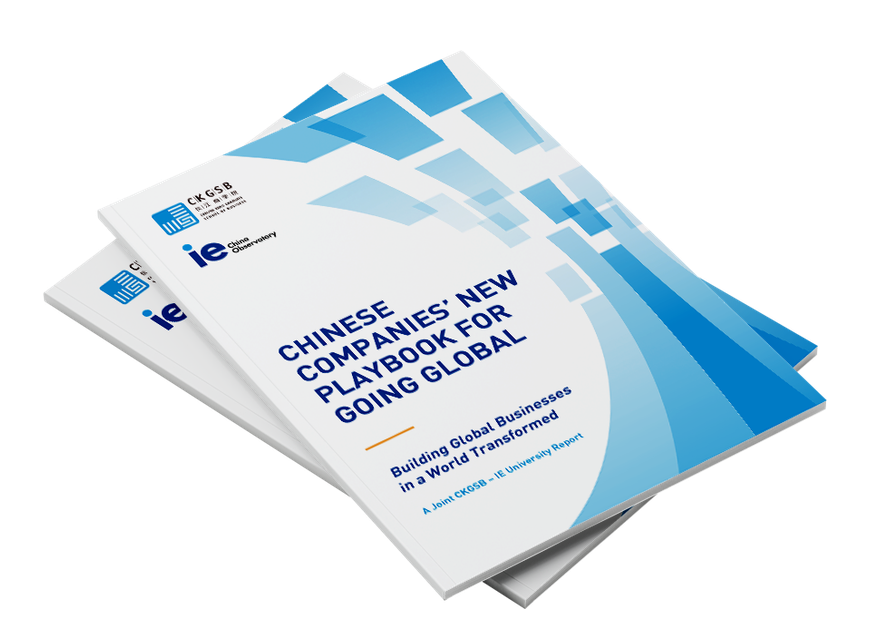
Chinese Companies’ New Playbook for Going Global
What does it now take for a Chinese company to build a business abroad rather than simply sell into it? This joint CKGSB–IE University report examines a new phase of Chinese globalization — from exporting products to exporting the capabilities behind them. Drawing on field research in Southeast Asia, it explores what separates the firms that build lasting businesses overseas from those that retreat.
A joint report by Cheung Kong Graduate School of Business (CKGSB) and IE University’s China Observatory
Cheung Kong Graduate School of Business (CKGSB), in partnership with IE University’s China Observatory, has published Chinese Companies’ New Playbook for Going Global: Building Global Businesses in a World Transformed — examining how Chinese companies are rethinking overseas expansion as geopolitical tensions, trade barriers and the restructuring of global supply chains transform the international business environment. These forces are making globalization increasingly important for Chinese companies while fundamentally changing where and how they expand.
A New Phase of Chinese Globalization
The report argues that Chinese corporate globalization has entered a third phase. The first centered on product exports, with Chinese factories supplying global markets through contract manufacturing. The second expanded into channel exports, as cross-border e-commerce connected Chinese manufacturers directly with overseas buyers. Now, a third phase is taking shape: capability export.
Chinese companies are taking not just products overseas, but the operating systems behind them — including technical standards, product development, supply-chain organization, service, branding and business models — and using these capabilities to build businesses within overseas markets, rather than simply sell into them.
Drawing on original field research in Malaysia and Indonesia — alongside analysis of Chinese companies globalizing, such as Huawei, BYD, CATL, Midea, Changan and Temu — the report maps two distinct models of overseas expansion. The first, “chain-style globalization,” refers to when large companies expand alongside their supply chains. The second, “swarm-style globalization,” refers to when smaller firms expand independently through industrial ecosystems, digital platforms, overseas warehouses, service providers and industrial parks.
It identifies the “connector economies” — Vietnam, Indonesia, Malaysia, Thailand and Mexico — best positioned to bridge a fracturing world, and the lessons emerging from early-mover Chinese SMEs in Southeast Asia, including the challenges of regulation, supply-chain efficiency, local talent, cultural differences and community integration.
At the same time, the Global South — including Southeast Asia — is becoming increasingly important to Chinese companies going global. In 2025, Global South markets collectively accounted for 46.2% of China’s exports and are evolving from destinations for Chinese products into important nodes in companies’ global supply chains, manufacturing networks and brand-building efforts.
Perspectives from CKGSB and IE University
The report brings together research and perspectives from scholars and leaders at both institutions.
Li Haitao, Dean and Dean’s Distinguished Chair Professor of Finance at CKGSB, examines how Chinese companies are rethinking globalization amid geopolitical and economic change.
Li Wei, Professor of Economics and Associate Dean at CKGSB, provides the report’s core research on the shift from product exports to capability exports and the emerging models through which large companies and SMEs are expanding internationally.
Santiago Íñiguez de Ozoño, President of IE University, examines Huawei’s globalization journey and how customer focus, local immersion, long-term investment and organizational values contributed to its resilience.
The report also features perspectives from Bin Ma, Academic Director of China Observatory and Professor at IE Business School, on the role of “boundary spanners” in Chinese companies’ overseas acquisitions, and José Félix Valdivieso, Chairman of IE University’s China Observatory, on how Chinese companies can build lasting global influence through ideas and management practices as well as products.
Why This Matters for Global Businesses
The experiences of Chinese companies in Southeast Asia show why strategies that succeed in China cannot simply be replicated overseas. Differences in regulation, supply chains, local talent, culture and consumer behaviour mean that long-term success depends on adapting capabilities to local conditions and building trust within local markets.
For Southeast Asian businesses and multinationals, this shift creates opportunities as well as new competition. As Chinese companies build deeper roots overseas, local and international businesses can bring valuable market knowledge, talent, networks and supply-chain expertise. At the same time, Chinese companies’ approaches to technology, innovation, manufacturing and business-model development offer lessons for other businesses seeking to scale across Asia.
The result is a changing business landscape in which Chinese companies, Southeast Asian businesses and multinationals increasingly meet not only as competitors, but also as partners, suppliers, customers and sources of new ideas.
Table of Contents
Foreword
The New Frontier: How Chinese Companies Are Rethinking Globalization
Li Haitao, Dean and Dean’s Distinguished Chair Professor of Finance, CKGSB
The Phoenix of Shenzhen — How Huawei Turned Sanctions into Sovereignty
Santiago Íñiguez de Ozoño, President, IE University
Preface
From Product Exports to Capability Exports: The Third Phase of Chinese Corporate Globalization
Li Wei, Professor of Economics and Associate Dean, CKGSB
Chapter 1 — Global Turbulence and China’s Changing Role
How changes in the global economy are reshaping China’s role and the environment for Chinese companies expanding internationally.
Chapter 2 — Planning the Move
Building resilience through connector economies; chain-style globalization for large companies; swarm-style globalization for smaller firms; and making domestic strengths work abroad.
Chapter 3 — Lessons From Early-Mover Chinese SMEs Expanding Into Southeast Asia
Why China’s playbook does not always transfer to Southeast Asia; recalibrating supply chains; finding and retaining local talent; integrating into local communities; and lessons from early movers.
Opinion
Beyond the Deal: Why Boundary Spanners Matter in Chinese Companies’ Acquisitions in Developed Economies
Bin Ma, Academic Director of China Observatory and Professor, IE Business School, IE University
The World Is Not a Hamburger — Nor Should It Become a Dumpling
José Félix Valdivieso, Chairman, China Observatory, IE University
Enjoying what you’re reading?
Article Subscribe (1)

Professor profile

LI Wei
Professor of Economics, Associate Dean for Asia and Oceania, Director of Case Research Department and Director of Big Data Economic Research Department, Cheung Kong Graduate School of Business (CKGSB)
PhD, University of Michigan

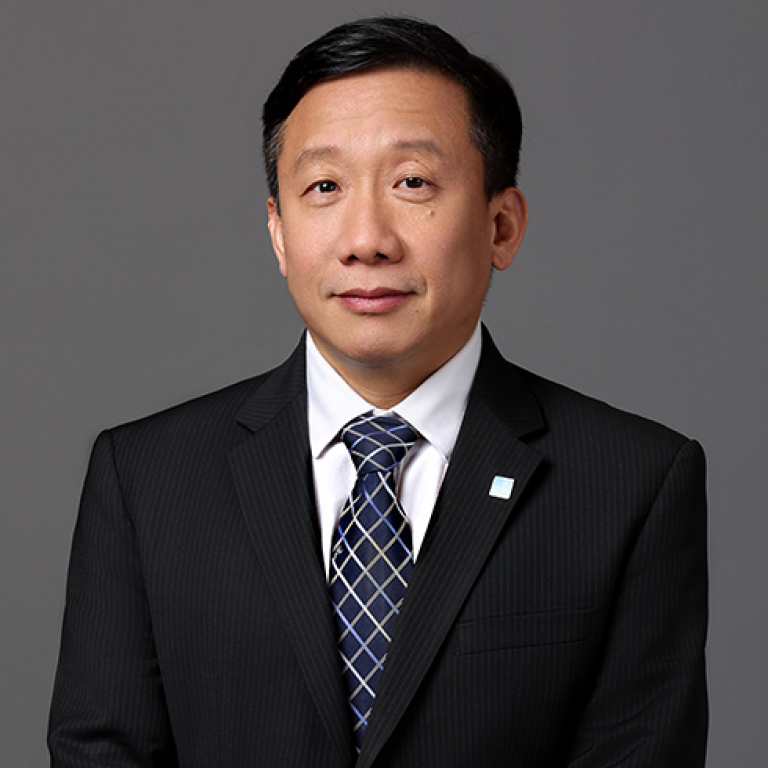
LI Haitao
Dean, Dean's Distinguished Chair Professor of Finance, and Director of Research Department on Family Business and Wealth Management, Cheung Kong Graduate School of Business (CKGSB)
PhD, Yale University

Continue reading

Brand Intelligence: Navigating the Transformation in the AI and Web3 Era
China in the New World

Business for Good: The Power to Create Change
Brand Intelligence: Navigating the Transformation in the AI and Web3 Era
China in the New World
Business for Good: The Power to Create Change
Our Programs

Scaling Innovation: AI and Digital Strategies for Business Transformation
Global Unicorn Program Series
In partnership with Columbia Engineering
This program is designed to equip senior executives with the strategic insights and tools necessary to lead in this transformative era.
LocationNew York, USA
Date27 Sep - 02 Oct, 2026
LanguageEnglish

Emerging Tech Management Week: Silicon Valley
Global Unicorn Program Series
In partnership with UC Berkeley College of Engineering
This program equips participants with proven strategies, cutting-edge research, and the best-in-class advice to fuel innovation, seize emerging tech developments, and catalyse transformation within your organization.
LocationUC Berkeley
Date01 - 06 Nov, 2026
LanguageEnglish

Asia Start: China’s AI and Digital Transformation Program
Asia Start provides entrepreneurs and executives with unparalleled access to Asia’s dynamic digital economy and its business ecosystems, offering the latest trends and insights, strategies, and connections to overcome challenges and unlock future growth for your business in Asia and beyond.
LocationChina (Beijing, Shanghai, Hangzhou & optional Shenzhen)
DateNovember 2–7, 2026 | April 19–24, 2027
LanguageEnglish

Intelligent China: AI, EVs & Smart Manufacturing
Participants may join the full 12-day series or select individual programs based on their interests and priorities.
LocationBeijing
Date12 Days
LanguageEnglish

Emerging Markets: Innovation and Scaling for Exponential Growth – ASEAN
Learn China's AI and innovation strategy from its leading thinkers — brought to you in Jakarta, with an optional immersion in China — and connect with the business leaders driving it.
LocationJakarta, Indonesia
Date2–4 December 2026
LanguageEnglish (with Chinese translation)

Stanford & Silicon Valley Immersion Program
Global Unicorn Program Series
In partnership with Stanford Engineering Center for Global & Online Education
This CKGSB program equips entrepreneurs, intrapreneurs and key stakeholders with the tools, insights, and skills necessary to lead a new generation of unicorn companies.
LocationStanford University Campus,
California, United States
Date06 - 11 Dec, 2026
LanguageEnglish with Chinese Translation