
Economic security and EU-China trade relations
October 23, 2026
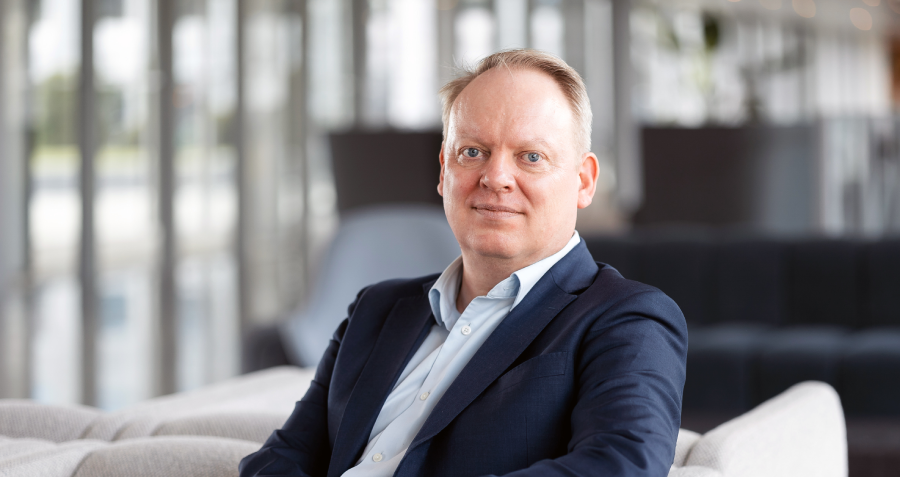
Jens Eskelund discusses Europe’s growing reliance on Chinese supply chains, trade tensions and the future of European business in China.
As economic tensions between China and the European Union continue to mount, European companies face the challenge of balancing their dependence on Chinese supply chains with growing concerns over economic security. Jens Eskelund, president of the European Union Chamber of Commerce in China, speaks with CKGSB Knowledge about the changing nature of EU-China trade, the challenges facing European businesses in China and the opportunities for cooperation between the two economies.
You have recently argued that many European companies are becoming more reliant on China. What exactly do you mean by that, and what are the consequences of greater reliance on China for Europe?
When I talk about European companies or Europe becoming more reliant on China, it is about the accelerating trend of onshoring activity into China.
Onshoring is not necessarily European investment. It could also be European companies simply deciding to source components from a Chinese vendor. We have 56% of our members increasing their onshoring, and 24% of those 56% are also offshoring part of their activities. But 56% are adding additional onshoring into China.
What attracted European companies to China in the first place was the fact that they could make good profits. It was a large, growing market, and profitability was reasonably good in many industries. That is still the case today for many companies.
But now we have a situation where, in many industries, the Chinese market is saturated. We have declining margins, overcapacity and pressure to export, what in China is called involution. Until April, China had experienced 44 consecutive months of producer price deflation.
When you have a prolonged period of deflation in China alongside inflation abroad, and as a consequence a devaluation of the RMB in real terms, Chinese competitiveness grows, for that and many other reasons.
In most industries today, and in most places around the world, you will have at least one Chinese competitor, and usually several. That means you are essentially competing with Chinese supply chains.
I think a lot of companies already feel they have significant exposure to China and perhaps do not want more. But in many cases, the cost-quality relationship in China is so compelling that, to compete globally, these companies actually need to leverage Chinese supply chains.
That is a primary motivator for European companies. If they are to maintain, let alone expand, their market share, the approach is increasingly: if you cannot beat them, join them.
We see a lot of that happening now. For many companies, onshoring more in China is a way to stay competitive.
How do you see the EU’s substantial trade deficit with China developing over the next few years, and what are the main concerns for Europe?
I think it is very important to have a clear view of the challenge. I do not think the trade balance in itself is particularly interesting.
You can argue that a trade deficit of €400 billion, which Europe is looking at for 2026, is such an astronomical amount that it becomes systemically important. But if it is €100 billion or €200 billion, perhaps it does not matter that much.
What really matters for Europe is economic security. Ultimately, it is a question of autonomy.
In this day and age, we can see the effects of Europe being dependent on non-European inputs, whether that is rare earths and magnets or access to Starlink or Starshield. There is a security element to this.
For Europe, the important consideration right now is how we can trade in ways that do not diminish European economic security, but instead enhance it. That is the main question that needs to be addressed.
For me, trade balances are secondary to addressing economic security, whether that concerns access to certain components or products, employment, or other economic security considerations.
Electric vehicles have become a major source of trade tensions between China and the EU. To what extent is the dispute representative of the broader economic relationship, rather than a sector-specific issue?
We very much welcome that initial agreement [for China to halve its hybrid car exports to Europe], and I think the European Commission has also made clear that this is only a first step. There is a lot more work to be done.
But I think this is a positive and pragmatic solution. It demonstrates that you can find a way forward by addressing specific sectoral concerns.
The automotive industry is systemically important to the European economy. There are a few industries of this kind where you can take action to protect a systemically important sector without significantly affecting overall trade.
I think the impact on trade imbalances is minimal. You address the concerns of a specific sector while remaining very widely open to Chinese products.
For China, the most important thing is retaining broad access to the European market.
If China can retain that broad access, perhaps the quid pro quo is that it also agrees to sector-specific measures that protect industries relevant to economic security.
Chinese automotive manufacturers are increasingly looking to establish production facilities in Europe. To what extent could localizing production help address European concerns?
I think it is a way forward. If you look at a European car manufactured in China, perhaps 95% of the value creation remains in China. If you import a Chinese car into Europe, very little of that production, a low-single-digit percentage, benefits Europe.
I think many Chinese automotive companies are looking at the experience of European and Japanese manufacturers. China is perhaps the best example of how, if you want to succeed in an overseas market, you also need to create value locally.
That has been key to the success of European automotive companies in China, and I think it will be key to the continued success of Chinese automotive companies in Europe. You need to ensure that a significant portion of the value created remains in the local community.
Interestingly, our standard advice at the European Chamber for as long as I have been active, more than 20 years, has been that companies need to articulate what is in it for China. What kind of value do you create for China? Experience shows that, if you do not create value for China, you are unlikely to succeed.
We have always urged our members to ask themselves what is in it for China. By the same token, I think Chinese companies should ask themselves what is in it for Europe. Creating value for your stakeholders is ultimately your license to operate.
Turning to European businesses operating in China, how would you characterize the current state of business confidence?
I think we have seen a shift. This is a generalization, but the trend used to be to operate in China for China, because China was a large and expanding market where you could make good profits.
But that model is evolving. As we discussed earlier, the value and role of China increasingly lie in what it can do for your global supply chain. I think that is quite a different proposition.
We have seen a rebound in business confidence. It is not great, but it is better than last year and on par with the year before that.
I think part of the reason is that many European companies have been able to adapt to a situation where they recognize that the domestic market is saturated and that China is increasingly being used as a base for component production for global supply chains.
What would you say are the biggest opportunities in China for European businesses at present?
There is a lot of discussion right now about European companies teaming up with Chinese companies and seeking out complementarities, where European companies bring something to the table that Chinese companies might need, and vice versa.
China has a lot of young, ambitious, tech-savvy and innovative companies, but some may struggle to reach international markets. European companies, meanwhile, have established networks, partnerships and a deep understanding of local markets internationally.
I think those strengths could complement each other, and that is a big opportunity right now.
Are there any particular European companies or sectors that stand out as performing especially well in China, or that offer significant potential over the next few years?
It is a good question. When I look at China’s trade data, China is doing pretty well across almost all parameters. But obviously, it is very much in what China itself calls the new economy where the country is doing well and where you can often find attractive returns, although there are some caveats.
We have seen overcapacity in both solar and wind, but there are other areas, perhaps related to AI, where companies have entered the market and developed healthy businesses.
I think companies closer to the forefront of technological development often have opportunities, whereas those in lower-value-added, more labor-intensive industries may increasingly be looking elsewhere, partly because of labor cost considerations.
Conversely, which sectors are European businesses struggling in the most compared with a decade ago or the pre-pandemic period?
I think it is no secret that automotive is one example of a sector facing significant challenges.
But you will see similar issues in other areas where there is overcapacity in China. When you have overcapacity, it puts everyone under pressure.
What I hear from many of our companies is that these challenges are very much related to profitability. When we look at our Business Confidence Survey, the domestic economic situation, particularly domestic demand, was the top concern across all industries.
I think involution is still something that cuts broadly across many industries.
Looking ahead over the next decade, what would a healthy EU-China economic relationship look like, and what changes would be necessary to achieve it?
First of all, I think it is important to build trust. There also needs to be an understanding, both in Europe and China, that Europe has legitimate economic security concerns, and that continued access to the European market goes hand in hand with accepting and accommodating those concerns.
We should keep in mind that economic security has been at the center of Chinese industrial policy for the past 20 years. There has been a focus on self-reliance, dual circulation and self-reliance in agriculture, technology and energy. There was Made in China 2025, and so on.
Independence, reducing dependencies, self-reliance, economic security and autonomy have always been central to Chinese economic thinking.
I think there is therefore an instinctive understanding of Europe’s concerns. I hope the discussion, and I think it ought to be, is about how we can accommodate these concerns while still finding ways to trade.
Personally, I think the vast majority of bilateral trade is completely uncontroversial.
It is a matter of separating industries where there are genuine economic security concerns from those where we should simply trade with the minimum possible restrictions.
But it takes both sides to sit down and have that conversation about what constitutes a legitimate concern and how to accommodate those concerns while still finding ways to develop trade.
I do not think this necessarily results in less trade. It is probably a relatively small percentage of trade where security concerns arise. And for most of that, it does not mean Europe does not want to trade with China. It may simply want to diversify and say that perhaps 65% of a particular product can come from China, which is still a lot, with the rest coming from another country, as we have seen in some of the proposals from the IEA.
I think pragmatism, and an acceptance that the current trajectory is not sustainable over the longer term, will be key to moving forward.
Jens Eskelund is the President of the EU Chamber of Commerce in China and was born in 1970 in Aarhus, Denmark. He holds an MA in philosophy and studied at the University of Aarhus and the University of Texas at Austin. He also studied Chinese at Renmin University in Beijing. Coming to Beijing as a student in 1998, Jens Eskelund began his career in China as a Commercial Officer at the Danish Embassy to China before taking on a position in marketing for Maersk Line in Beijing in 2000. He has since held positions as General Manager for Public Affairs for Maersk Line in China, Director of Public Affairs for North Asia and later as Managing Director of Maersk China before assuming his present role as North Asia Chief Representative for A.P. Moller - Maersk. Primary focus areas comprise engaging government entities, institutions and trade associations on matters of policy, regulatory environment and business development on behalf of the companies within the Maersk Group. Jens Eskelund is a former Chairman of the Danish Chamber of Commerce in China as well as Vice President of the EU Chamber of Commerce in China.
Enjoying what you’re reading?
Article Subscribe (1)
CKGSB Report





Related Articles

Our Programs

Emerging Tech Management Week: Silicon Valley
Global Unicorn Program Series
In partnership with UC Berkeley College of Engineering
A technology management program for leaders looking to turn emerging technologies into business opportunities.
Combining proven strategies and cutting-edge research, the program helps participants fuel innovation, seize opportunities in emerging technologies, and catalyze transformation within their organizations. Designed for managers, start-up leaders, and technology investors, it includes visits to venture capital firms and technology companies, alongside mentored group projects.
LocationUC Berkeley, California, United States
Date01 - 06 Nov, 2026
LanguageEnglish

Stanford & Silicon Valley Immersion Program
Global Unicorn Program Series
In partnership with Stanford Engineering Center for Global & Online Education
A Silicon Valley immersion for entrepreneurs, intrapreneurs, and investors leading and scaling AI-driven companies.
The program combines academic learning with visits to AI and robotics labs and Silicon Valley companies, giving participants direct exposure to emerging technologies and the businesses developing and applying them.
LocationStanford University Campus, California, United States
Date06 - 11 Dec, 2026
LanguageEnglish with Chinese Translation

Emerging Markets: Innovation and Scaling for Exponential Growth – ASEAN
A China-focused innovation program for ASEAN executives and business owners responding to the impact of AI on their industries.
Gain insights from leading Chese thinkers in Jakarta, with an optional immersion in China and opportunities to connect with the business leaders driving innovation. The program offers a closer look at how developments in China could affect your industry and business.
LocationJakarta, Indonesia
Date23–26 March 2027
LanguageEnglish (with Chinese translation)

Asia Start: AI + Digital Ecosystem China Expedition
An immersive program for entrepreneurs and executives looking to understand China's AI and digital economy firsthand.
Gain the latest trends and insights, strategies, and connections to overcome challenges and support future business growth in Asia and beyond.
LocationChina (Beijing, Shanghai, Hangzhou & optional Shenzhen)
DateApril 19–24, 2027
LanguageEnglish

Intelligent China: AI, EVs & Smart Manufacturing
A three-part program examining China’s advances in AI, electric vehicles, and smart manufacturing.
Through faculty-led sessions, company visits, and exchanges with industry leaders, gain practical insights for your organization's strategy, partnerships, and investment decisions. Join an individual four-day program or complete the full 12-day series.
LocationBeijing, Shenzhen, Shanghai, and Hangzhou
DateSummer – Winter 2027 (three 4-day programs)
LanguageEnglish