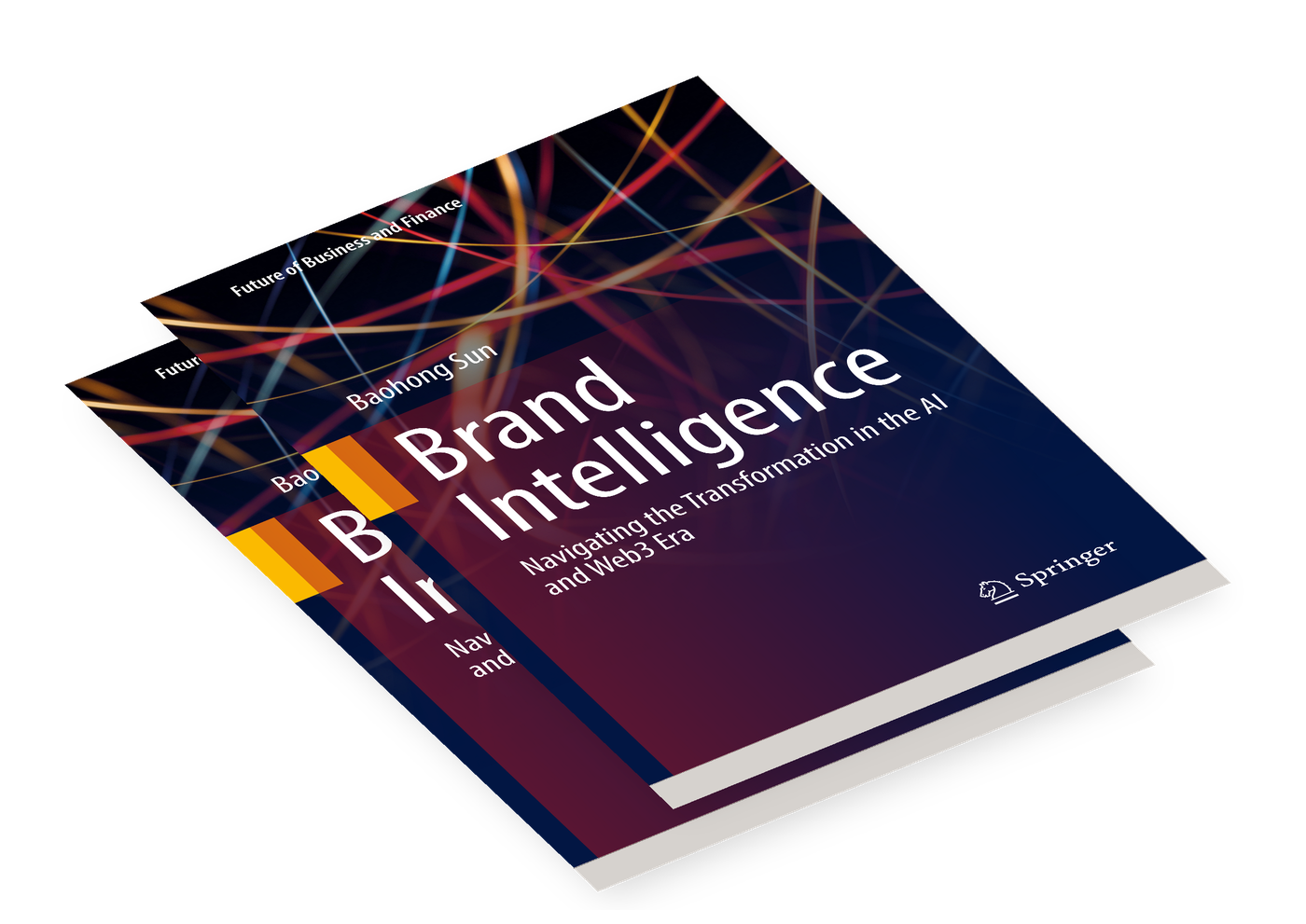
Brand Intelligence: Navigating the Transformation in the AI and Web3 Era
Who owns the relationship with your customer — you, or the platform you reach them through? In Brand Intelligence, CKGSB Professor Baohong Sun argues that brands have outsourced their most valuable asset: the ability to learn from their own users. She sets out how AI, first-party data and Web3 let companies rebuild that intelligence in-house, turning marketing into a system that compounds over time.
By Baohong Sun, Dean’s Distinguished Chair Professor of Marketing, CKGSB
Brand Intelligence: Navigating the Transformation in the AI and Web3 Era explores how AI, data and Web3 are transforming marketing — and what brands must do to build stronger, more intelligent relationships with their customers. The book is published by Springer in its Future of Business and Finance series and is available now — order it on Amazon.
Professor Baohong Sun argues that as digital platforms come to control much of the access to consumers and their data, brands face a critical turning point. Rather than chasing individual technologies, Brand Intelligence presents a framework for turning marketing into an intelligent system of growth: transforming brands into data-driven, continuously learning ecosystems built for the age of AI and decentralization.
“The most valuable asset in the digital age is not technology, but the ability to learn faster than the market. Brands that depend on third-party platforms have outsourced that learning. This book shows how to bring it back home.”
— Professor Baohong Sun
Rethinking Marketing in the Age of AI
Digital transformation has given companies unprecedented access to technology, but also created a new dependence: for many brands, marketing runs primarily through third-party search engines, social media and e-commerce marketplaces, which control much of the customer relationship and data.
Professor Sun argues that brands need to move from digital dependence to digital sovereignty — not by abandoning third-party platforms, but by combining their reach with the deeper relationships and first-party data built through brand-owned channels. The book explores this shift through four interconnected themes:
1. From Digital Transformation to Brand Intelligence
Many businesses have invested in digital transformation to automate processes and cut costs. Professor Sun argues the next step is intelligent activation: connecting customer touchpoints, then activating that data through analytics and AI to improve the User Journey, User Experience and User Lifetime Value.
2. Building Brand-Owned Ecosystems
Brands need greater control over their users, data and customer experiences — connecting communities, online stores, smart products, physical stores and apps into a continuously learning network built on connectivity, intelligence and community. In this model, brands accumulate strategic assets, such as relationships and first-party data, that grow more valuable over time.
3. AI, Algorithms and Intelligent Marketing
AI is accelerating the shift from campaign-based marketing to systems that analyze, decide and act continuously. Professor Sun describes a “Command Center” combining customer data with algorithmic decision-making to turn insight into action — and argues that as agentic AI matures, brands with proprietary data will be best positioned to compete.
4. From Consumers to Participants in the Web3 Era
Brand Intelligence also examines how Web3 could reshape brand-customer relationships, as blockchain and tokenization create new possibilities for digital ownership and shared value. Professor Sun describes a shift from communication to collaboration — combining the scale of centralized intelligence with the participation enabled by decentralized models.
Building an Intelligent System of Growth
Traditional digital marketing emphasizes reach, impressions, clicks and conversion. Brand Intelligence proposes a broader, self-reinforcing model built around Brandnetics™ — an integrative framework linking users, data, technology, algorithms and communities — and an omni-domain approach combining third-party platforms for reach with brand-owned ecosystems for deeper relationships and loyalty.
Through examples including Nike, Starbucks, Sephora, Wayfair, KFC and STEPN, Professor Sun shows how these ideas apply across communities, e-commerce, apps, smart products, physical stores and decentralized environments — arguing that success depends not on buying attention, but on building intelligence. The book is written for executives, investors and policymakers navigating this shift, as well as scholars studying how marketing is evolving.
About Professor Baohong Sun
Professor Baohong Sun is the Dean’s Distinguished Chair Professor of Marketing at CKGSB and Director of its Research Department on AI+Web3 Marketing Innovation. Previously Carnegie Bosch Professor of Marketing at Carnegie Mellon’s Tepper School of Business, she holds a PhD from USC, and her research has been cited by The Economist, The New York Times, The Wall Street Journal, Time and Bloomberg.
Table of Contents
Chapter 1: Digital Technologies and Marketing Innovation
Chapter 2: Platform Enterprises
Chapter 3: Consumer Decision-Making Process and Brand Experience
Chapter 4: Building Brand Intelligence
Chapter 5: Online Community
Chapter 6: Online Store
Chapter 7: Smart Products and Smart Stores
Chapter 8: Mobile Applications
Chapter 9: The Command Center and Intelligent Marketing
Chapter 10: Omni-Domain Marketing and Brandnetics™
Chapter 11: Web3 and Participatory Marketing
The book takes readers from the foundations of Brand Intelligence to the real-world design of brand-owned ecosystems and intelligent marketing, before looking ahead to how AI, Web3 and participatory models could reshape the future of value creation.
Get the book
Enjoying what you’re reading?
Article Subscribe (1)

Professor profile

SUN Baohong
Dean's Distinguished Chair Professor of Marketing, Cheung Kong Graduate School of Business (CKGSB)
PhD, University of Southern California


Continue reading
Chinese Companies’ New Playbook for Going Global

China in the New World

Business for Good: The Power to Create Change
Chinese Companies’ New Playbook for Going Global
China in the New World
Business for Good: The Power to Create Change
Our Programs

Emerging Tech Management Week: Silicon Valley
Global Unicorn Program Series
In partnership with UC Berkeley College of Engineering
A technology management program for leaders looking to turn emerging technologies into business opportunities.
Combining proven strategies and cutting-edge research, the program helps participants fuel innovation, seize opportunities in emerging technologies, and catalyze transformation within their organizations. Designed for managers, start-up leaders, and technology investors, it includes visits to venture capital firms and technology companies, alongside mentored group projects.
LocationUC Berkeley, California, United States
Date01 - 06 Nov, 2026
LanguageEnglish

Intelligent China: AI, EVs & Smart Manufacturing
A three-part program examining China’s advances in AI, electric vehicles, and smart manufacturing.
Through faculty-led sessions, company visits, and exchanges with industry leaders, gain practical insights for your organization's strategy, partnerships, and investment decisions. Join an individual four-day program or complete the full 12-day series.
LocationBeijing, Shenzhen, Shanghai, and Hangzhou
Date December 2026 – July 2027 (three 4-day programs)
LanguageEnglish

Emerging Markets: Innovation and Scaling for Exponential Growth – ASEAN
A China-focused innovation program for ASEAN executives and business owners responding to the impact of AI on their industries.
Gain insights from leading Chese thinkers in Jakarta, with an optional immersion in China and opportunities to connect with the business leaders driving innovation. The program offers a closer look at how developments in China could affect your industry and business.
LocationJakarta, Indonesia
Date2–4 December 2026
LanguageEnglish (with Chinese translation)

Stanford & Silicon Valley Immersion Program
Global Unicorn Program Series
In partnership with Stanford Engineering Center for Global & Online Education
A Silicon Valley immersion for entrepreneurs, intrapreneurs, and investors leading and scaling AI-driven companies.
The program combines academic learning with visits to AI and robotics labs and Silicon Valley companies, giving participants direct exposure to emerging technologies and the businesses developing and applying them.
LocationStanford University Campus, California, United States
Date06 - 11 Dec, 2026
LanguageEnglish with Chinese Translation

Asia Start: AI + Digital China Expedition
An immersive program for entrepreneurs and executives looking to understand China's AI and digital economy firsthand.
Gain the latest trends and insights, strategies, and connections to overcome challenges and support future business growth in Asia and beyond.
LocationChina (Beijing, Shanghai, Hangzhou & optional Shenzhen)
DateApril 19–24, 2027
LanguageEnglish