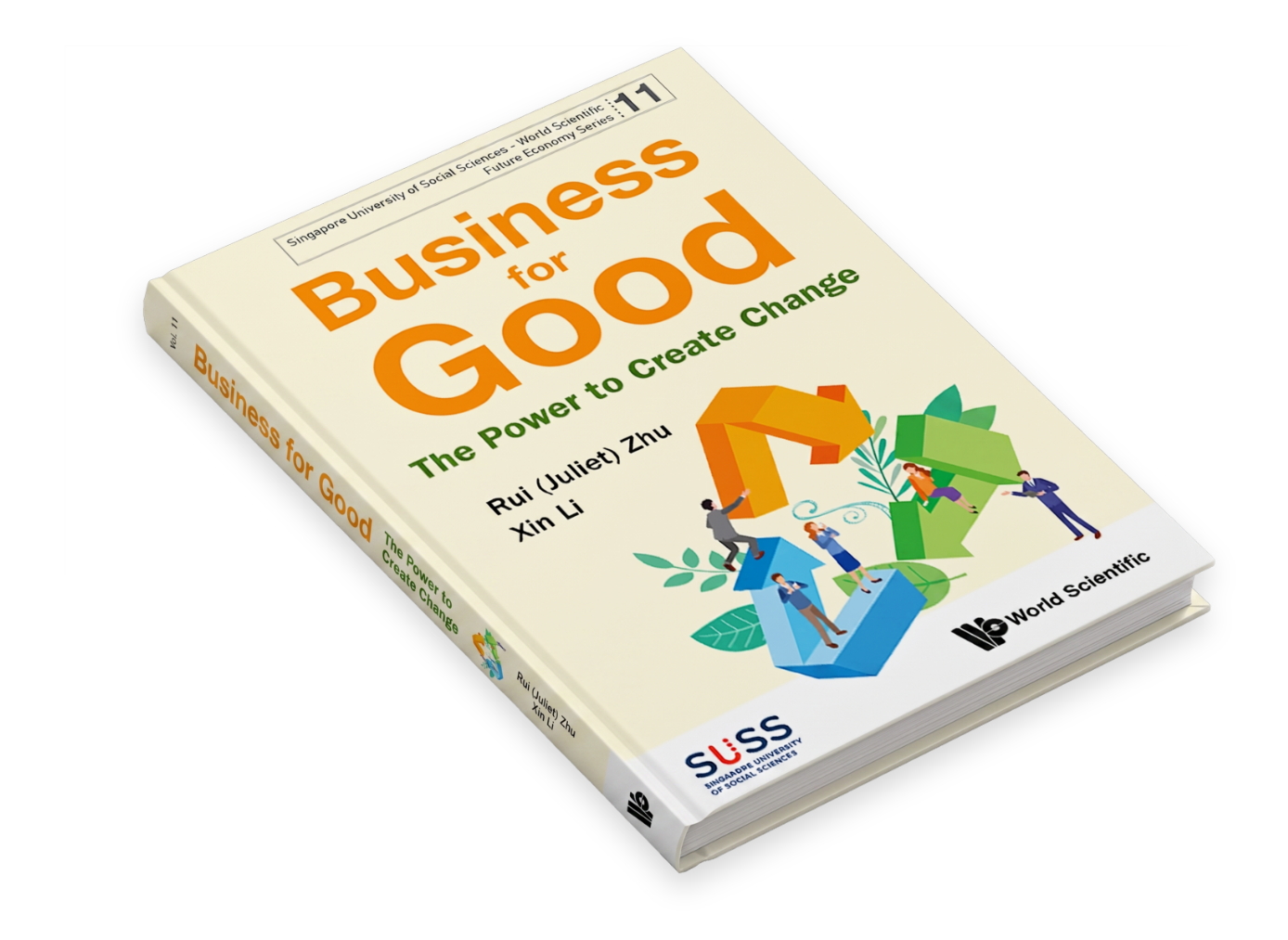
Business for Good: The Power to Create Change
Can doing good also create business value? Doing good and doing well are not in tension — done right, they can reinforce each other. In Business for Good: The Power to Create Change, CKGSB Professor Rui (Juliet) Zhu and researcher Xin Li lay out a practical framework for integrating social value into the core of how a company competes — rather than treating it as something added at the edges.
About the Book
Many companies still treat social responsibility as a cost center — a report to file, a foundation to fund or an initiative kept separate from the business that generates revenue. In Business for Good: The Power to Create Change, CKGSB Professor Rui (Juliet) Zhu and researcher Xin Li argue for a different approach. They define Business for Good as the strategic integration of social value into a company’s core competencies — the pursuit of commercial value through social progress, not alongside it.
At the heart of the book are two practical tools designed to help organisations move from intention to action.
The book’s framework, the Business for Good Triangle, rests on three pillars: a co-benefit philosophy that treats social and commercial value as mutually reinforcing rather than a trade-off; institutional safeguards that keep good intentions from drifting once incentives or circumstances change; and strategic integration that embeds social value in the core business rather than a peripheral CSR function.
Complementing the Triangle, the Business for Good Action Map identifies 35 concrete entry points across environmental, social and governance dimensions, giving organizations of different sizes and stages practical ways to begin.
Drawing on behavioral psychology, Zhu and Li show how small, well-designed interventions can trigger outsized change, using cases including Patagonia’s ownership restructuring, Haidilao’s employee empowerment model, and LEGO’s inclusive design choices to make the argument concrete rather than aspirational.
“Business for Good is not about choosing between profit and purpose. It is about integrating social value into what a company already does well, so that solving real problems can also create commercial value. The challenge for companies today is to move beyond compliance and build systems in which doing good becomes part of how the business succeeds.”Rui (Juliet) ZhuProfessor of Marketing, CKGSB — co-author, Business for Good
For international readers, the book also provides a window into Chinese approaches to business and social innovation that remain relatively underrepresented in English-language ESG and sustainability literature.
Rui (Juliet) Zhu is Professor of Marketing and Director of the Research Department on ESG and Social Innovation at CKGSB. Her research centers on behavioral science, social innovation and brand management.
Published by World Scientific in August 2026, Business for Good: The Power to Create Change is Volume 11 of the Singapore University of Social Sciences – World Scientific Future Economy Series.
Who It’s For
- MBA & EMBA candidates and business school professors teaching corporate social responsibility, ESG or strategic management.
- C-suite executives and founders looking to understand where purpose, stakeholder value and competitive strategy intersect.
- Sustainability officers, impact investors and ESG professionals seeking a practical framework for moving beyond compliance.
- Social entrepreneurs and policy researchers interested in social innovation and evolving business practices in China and Asia.
Contents
- Foreword & Preface
- 1. What is Business for Good?
Defines the core concept and introduces the Business for Good Triangle — co-benefit philosophy, institutional safeguards, and strategic integration. - 2. How to Approach Doing Business for Good?
Introduces the Business for Good Action Map — 35 actionable entry points spanning environmental, social and governance dimensions. - 3. The Case for Business for Good: Environment
Explores how the framework can be applied to environmental strategy, drawing on cases including Patagonia’s ownership restructuring. - 4. The Case for Business for Good: Social
Examines social value creation in practice, including Haidilao’s approach to employee empowerment. - 5. The Case for Business for Good: Corporate Governance
Explores the role of governance in sustaining Business for Good strategies, including LEGO’s inclusive design choices. - 6. Final Thoughts
Synthesizes the framework and its implications for leaders building a Business for Good strategy. - Afterword, Appendix & Index
Enjoying what you’re reading?
Article Subscribe (1)

Professor profile

ZHU Rui (Juliet)
Professor of Marketing, Director of Research Department on ESG and Social Innovation and Member of the Board of Supervisors of the Cheung Kong Education Development Foundation, Cheung Kong Graduate School of Business (CKGSB)
PhD, University of Minnesota


Continue reading
Chinese Companies’ New Playbook for Going Global

Brand Intelligence: Navigating the Transformation in the AI and Web3 Era
China in the New World
Chinese Companies’ New Playbook for Going Global
Brand Intelligence: Navigating the Transformation in the AI and Web3 Era
China in the New World
Our Programs

Emerging Tech Management Week: Silicon Valley
Global Unicorn Program Series
In partnership with UC Berkeley College of Engineering
A technology management program for leaders looking to turn emerging technologies into business opportunities.
Combining proven strategies and cutting-edge research, the program helps participants fuel innovation, seize opportunities in emerging technologies, and catalyze transformation within their organizations. Designed for managers, start-up leaders, and technology investors, it includes visits to venture capital firms and technology companies, alongside mentored group projects.
LocationUC Berkeley, California, United States
Date01 - 06 Nov, 2026
LanguageEnglish

Stanford & Silicon Valley Immersion Program
Global Unicorn Program Series
In partnership with Stanford Engineering Center for Global & Online Education
A Silicon Valley immersion for entrepreneurs, intrapreneurs, and investors leading and scaling AI-driven companies.
The program combines academic learning with visits to AI and robotics labs and Silicon Valley companies, giving participants direct exposure to emerging technologies and the businesses developing and applying them.
LocationStanford University Campus, California, United States
Date06 - 11 Dec, 2026
LanguageEnglish with Chinese Translation

Emerging Markets: Innovation and Scaling for Exponential Growth – ASEAN
A China-focused innovation program for ASEAN executives and business owners responding to the impact of AI on their industries.
Gain insights from leading Chese thinkers in Jakarta, with an optional immersion in China and opportunities to connect with the business leaders driving innovation. The program offers a closer look at how developments in China could affect your industry and business.
LocationJakarta, Indonesia
Date23–26 March 2027
LanguageEnglish (with Chinese translation)

Asia Start: AI + Digital Ecosystem China Expedition
An immersive program for entrepreneurs and executives looking to understand China's AI and digital economy firsthand.
Gain the latest trends and insights, strategies, and connections to overcome challenges and support future business growth in Asia and beyond.
LocationChina (Beijing, Shanghai, Hangzhou & optional Shenzhen)
DateApril 19–24, 2027
LanguageEnglish

Intelligent China: AI, EVs & Smart Manufacturing
A three-part program examining China’s advances in AI, electric vehicles, and smart manufacturing.
Through faculty-led sessions, company visits, and exchanges with industry leaders, gain practical insights for your organization's strategy, partnerships, and investment decisions. Join an individual four-day program or complete the full 12-day series.
LocationBeijing, Shenzhen, Shanghai, and Hangzhou
DateSummer – Winter 2027 (three 4-day programs)
LanguageEnglish