
The changing fortunes of China’s Hai Gui: Why overseas degrees no longer guarantee success
July 24, 2026
For years, overseas degrees were seen as the key to a promising career for Chinese graduates, but a more completive job market is changing that
Overseas degrees do not offer the same opportunities they once did
When Diana Li returned to Shanghai after completing a master’s degree at Nottingham University in the UK, she thought the hardest part of her journey was behind her. “But after several months of applying for jobs and having unsuccessful interviews, I realised employers weren’t looking at my credentials at all, and instead felt I lacked experience,” she says.
For decades, overseas returnees—known in China as hai gui, or “sea turtles”—occupied an enviable position in the country’s labor market. A degree from a respected university in Britain, the United States or Australia was often seen as proof of international vision, language ability and elite academic training. Returning home frequently meant walking straight into a prestigious position with multinational companies, financial institutions or government-backed enterprises.
But China’s graduate employment market has become much more competitive as domestic universities improve, overseas education becomes increasingly common and employers place greater emphasis on practical skills rather than academic pedigree alone. While an international education still provides important advantages in many sectors, employers are becoming far more selective about where graduates studied, what they learned and how those skills translate into China’s rapidly evolving economy.
“The halo effect has largely faded,” says Ashley Dudarenok, founder of ChoZan, a consultancy that helps global brands understand the Chinese market. “Ten years ago, an overseas degree was a golden ticket. Employers viewed hai gui as rare talent bringing advanced global perspectives. Today, that advantage is much more conditional.”
From elite advantage to mainstream qualification
China’s enthusiasm for overseas education has transformed dramatically over the past two decades. Government policies has long encouraged students to study abroad and then return home to contribute to China’s modernization. Rising household incomes, expanding scholarship opportunities and growing international university recruitment made overseas study increasingly attainable for middle-class families.
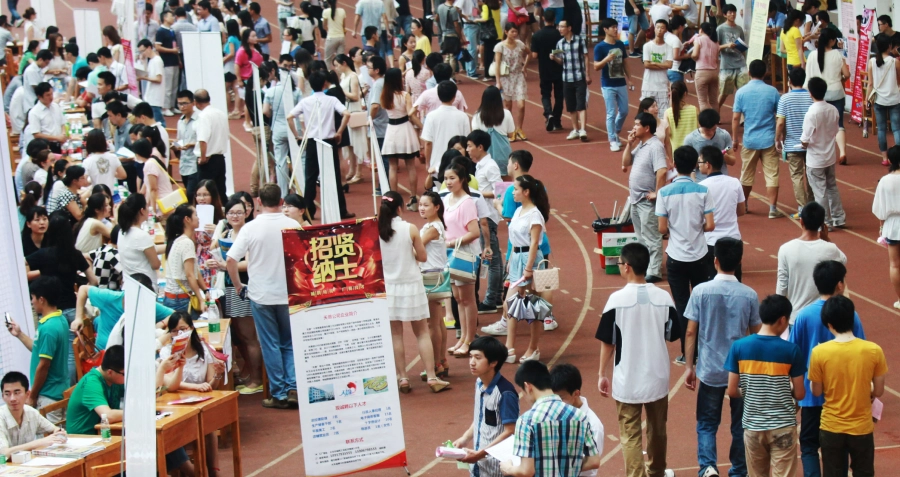
While hundreds of thousands of Chinese students continue to leave for overseas universities each year, the vast majority now return home after graduation. According to China’s Ministry of Education, more than 80% of Chinese students studying abroad now come back, compared with around 30% in the early 2000s. At the same time, China’s domestic higher education system has expanded rapidly, producing a record 12.22 million university graduates in 2025.
The result is a far more competitive labor market. China’s Ministry of Education said the number of overseas graduates returning to China in 2025 reached its highest level in eight years, meaning international graduates are no longer a scarce source of talent but are competing alongside an unprecedented number of domestic degree holders.
“The market is saturated,” Dudarenok explains. “Employers care less about the prestige of a foreign credential and more about whether a candidate understands the pace of Chinese business, has local industry connections and can contribute immediately.”
Employers are placing greater emphasis on internship experience, technical expertise and familiarity with China’s business environment than the name printed on a diploma.
Domestic universities have closed the gap
The changing perception of hai gui also reflects the rising status of China’s own universities. Institutions such as Tsinghua University, Peking University, Shanghai Jiao Tong University and Zhejiang University now consistently rank among the world’s leading universities across engineering, computer science and numerous STEM disciplines.
“The quality gap between Chinese and Western universities has narrowed significantly,” Dudarenok says. “A graduate from Tsinghua or Shanghai Jiao Tong is often preferred over someone from a mid-tier Western university because they have already demonstrated they can succeed within China’s intensely competitive education system.”
Professor Shirley Yu of the London School of Economics believes the shift extends beyond academic rankings. “Chinese universities have become globally competitive,” she says. “Students trained domestically are also more aligned with Chinese business culture. They understand the Chinese economic ecosystem more holistically.”
That alignment has become increasingly valuable to employers as China pursues greater self-sufficiency.
“In many liberal arts and business disciplines,” Yu says, “Western frameworks no longer necessarily provide an advantage. In some cases, they are viewed as less applicable to China’s current development model.”
The narrowing gap is especially visible in sectors where China has become a global leader.
Domestic universities now produce large numbers of graduates specializing in AI, robotics, advanced manufacturing and renewable energy—industries that sit at the center of China’s long-term industrial strategy.
“In AI, from DeepSeek to Manus, domestic talent has become globally competitive,” Yu says. “Overseas graduates no longer have a definitive competitive advantage.”
“The differences started to shrink rapidly around 2020,” says Dan Wang, China Director at Eurasia Group. “Chinese universities had improved significantly, while graduates trained domestically understood local demand much better. The information gap that overseas graduates once enjoyed largely disappeared.”
A different labor market

For many years, sectors such as finance, consulting, real estate and multinational corporations eagerly recruited internationally educated graduates. These industries rewarded overseas experience and often required extensive cross-border communication.
Many of these sectors have slowed down, while at the same time, China’s economic priorities have shifted toward advanced manufacturing, semiconductors, AI and other strategic technologies. At the same time, in recent years many multinational companies have trimmed down their operations in China, resulting in lower headcounts.
“The traditional sectors that absorbed overseas graduates have been contracting since around 2021,” Wang says. “Finance, IT, real estate and education have all experienced significant adjustments.”
Companies are now increasingly seeking graduates who already possess local internship experience, understand domestic regulatory systems and can begin contributing immediately.
“The biggest disadvantage is often not academic ability,” Dudarenok says. “It’s the lack of local experience.”
Many overseas graduates struggle precisely because they spent several formative years outside China while their domestic counterparts built professional networks through internships and campus recruitment programs.
Instead of viewing overseas education as a substitute for practical experience, employers increasingly expect graduates to demonstrate both. That changing mindset has produced a more nuanced labor market in which international education remains valuable—but rarely sufficient on its own.
Where overseas experience still matters
Despite the changing landscape, few experts believe overseas education has lost its value altogether. Instead, its advantages have become more specialized, rewarding graduates who possess scarce technical expertise, international business experience or genuine cross-cultural capabilities rather than simply an overseas diploma.
“Someone with a foreign degree and experience in a reputable research institution or major international company still carries great weight in the domestic job market,” Wang says. “Those people remain relatively rare because they possess technological advantages or specialized skills that China still needs.”
That is particularly true in sectors aligned with China’s industrial ambitions. Yu says that overseas graduates continue to enjoy opportunities in STEM disciplines that support China’s strategic priorities, including semiconductors, aerospace and other frontier technologies.
“In STEM majors, particularly those related to China’s New Quality Productive Forces, hai gui are still in high demand,” says Yu. “However, that window of opportunity will gradually narrow as China’s universities continue producing comparable talent themselves.”
International experience also remains valuable for Chinese companies expanding abroad.
As companies such as BYD, DJI, CATL, Shein and ByteDance continue building global operations, they increasingly require managers capable of navigating different legal systems, consumer markets and business cultures.
“Over an eight-year career horizon, hai gui still tend to outperform domestic peers in salary growth and senior management placement,” Dudarenok says. “That is particularly true in roles requiring cross-cultural communication or international expansion.”
Rather than disappearing, therefore, the premium attached to overseas education appears to be shifting away from graduate recruitment and toward later-career leadership positions where international experience delivers tangible commercial value.
Adjusting expectations
For many returning graduates, however, adapting to today’s labor market requires a significant reset of expectations.
For years, overseas education was widely viewed as a pathway to higher salaries and faster promotion. Today’s graduates are discovering that employers increasingly expect overseas study to be only one component of a much broader skillset.
“The harsh reality is that many graduates expected salary premiums that no longer exist,” says Dudarenok. “They’re becoming much more pragmatic, prioritizing job stability and accepting lower starting salaries simply to get a foot in the door.”
Many are also looking beyond China’s largest cities. As competition intensifies in Beijing, Shanghai and Shenzhen, an increasing number of returnees are exploring opportunities in smaller cities where talent shortages remain more acute and living costs are considerably lower.
Many hai gui also face what might be described as reverse culture shock after spending several years overseas.
“They often possess the right technical skills and speak excellent English,” Wang says. “But sometimes they struggle to understand what Chinese employers actually expect.”
Chinese workplaces often operate at a faster pace and place greater emphasis on flexibility, hierarchy and long working hours than many graduates experienced while studying overseas. Concepts such as 996—where employees in some Chinese companies are encouraged to be at the office from 9am to 9pm, six days a week, is one pertinent example of this.
“They may expect clearer boundaries between work and personal life,” Wang says. “That is often difficult for Chinese employers to provide.”
Geopolitics is reshaping career paths
Beyond economics, geopolitical shifts are also reshaping the role of overseas education. As competition between China and Western economies deepens, the once-fluid movement of talent between international and Chinese companies has become more constrained.
“In the past, graduates could move back and forth between China and overseas throughout their careers,” Yu says. “Today, that is becoming much more difficult.”
She says that technological and institutional divergence means career paths increasingly develop within separate ecosystems rather than across a single global labor market. “The pathway to build a career straddling China and the West is largely over,” she says.
“The separation of the technological ecosystems will continue to widen,” says Wang. “People increasingly have to choose early in their careers which system they want to develop within.”
That does not mean overseas education is becoming irrelevant. Instead, graduates are making more deliberate decisions about where to study, what subjects to pursue and how those choices fit their long-term career ambitions.
From prestige to purpose
The era when an overseas degree alone could guarantee a successful career in China appears to be drawing to a close. Employers have become more selective because they have more choice. China’s universities now produce world-class graduates, while record numbers of overseas returnees have transformed what was once an elite credential into a mainstream qualification.
For overseas graduates, that means international education is becoming less of a shortcut and more of a platform. Those relying solely on the prestige of a foreign diploma may find that the market has moved on.
“As Chinese companies expand globally, they still need talent with international perspectives, language skills and technical expertise,” says Dudarenok. “The pipeline will remain strong, but it will be much more targeted towards hard sciences, AI and advanced manufacturing, rather than general business degrees.”
Enjoying what you’re reading?
Article Subscribe (1)
CKGSB Report





Related Articles

Our Programs

Emerging Tech Management Week: Silicon Valley
Global Unicorn Program Series
In partnership with UC Berkeley College of Engineering
This program equips participants with proven strategies, cutting-edge research, and the best-in-class advice to fuel innovation, seize emerging tech developments, and catalyse transformation within your organization.
LocationUC Berkeley
Date01 - 06 Nov, 2026
LanguageEnglish
Asia Start: AI + Digital China Expedition
Asia Start provides entrepreneurs and executives with unparalleled access to Asia’s dynamic digital economy and its business ecosystems, offering the latest trends and insights, strategies, and connections to overcome challenges and unlock future growth for your business in Asia and beyond.
LocationChina (Beijing, Shanghai, Hangzhou & optional Shenzhen)
DateNovember 2–7, 2026 | April 19–24, 2027
LanguageEnglish

Intelligent China: AI, EVs & Smart Manufacturing
Explore how China is advancing AI, electric vehicles and smart manufacturing through faculty-led sessions, company visits and exchanges with industry leaders. Build practical insights for your organization’s strategy, partnerships and investment decisions, with the flexibility to join individual four-day programs or the full 12-day series.
LocationBeijing
Date12 Days
LanguageEnglish

Emerging Markets: Innovation and Scaling for Exponential Growth – ASEAN
Learn China's AI and innovation strategy from its leading thinkers — brought to you in Jakarta, with an optional immersion in China — and connect with the business leaders driving it.
LocationJakarta, Indonesia
Date2–4 December 2026
LanguageEnglish (with Chinese translation)
Stanford & Silicon Valley Immersion Program
Global Unicorn Program Series
In partnership with Stanford Engineering Center for Global & Online Education
This CKGSB program equips entrepreneurs, intrapreneurs and key stakeholders with the tools, insights, and skills necessary to lead a new generation of unicorn companies.
LocationStanford University Campus,
California, United States
Date06 - 11 Dec, 2026
LanguageEnglish with Chinese Translation