

Crypto is entering its compliance era. How is HashKey preparing?
November 24, 2026
The Hong Kong-listed digital asset group is working to diversify its recurring income, leveraging its regulatory licenses to expand beyond trading into next-generation financial infrastructure.
When HashKey Holdings listed in Hong Kong on December 17, 2025, it opened its business operations and financial performance to public scrutiny. The numbers highlighted both the scale of its ambition and the heavy investment required to build its business model. HashKey reported revenue of HK$723 million (US$93 million) for 2025. At the same time, research and development expenditure reached HK$504 million – equivalent to 70 percent of its total revenue.
These outlays reflect the high cost of developing an institutional-grade, onshore and fully licensed business. The company utilizes Nasdaq market-surveillance technology and maintains dedicated compliance teams across multiple jurisdictions. It has also secured insurance coverage for approximately US$2 billion of customer assets. Compliance-related spending reached HK$130 million in the first half of 2025, or more than HK$20 million a month.
A deliberately slower route
For much of crypto’s early history, offshore exchanges grew by moving fast: listing new tokens, offering leverage and serving customers in different countries. However, the collapse of Three Arrows Capital and FTX in 2022 fundamentally changed how offshore exchanges operated. Regulators tightened oversight, while institutional players began prioritizing custody and accountability.
HashKey chose the regulated path much earlier. In 2019, founder Xiao Feng approached the Hong Kong Securities and Futures Commission (SFC) to discuss licensing at a time when no dedicated regulatory framework existed. HashKey participated in voluntary supervision and a regulatory sandbox from 2020 through 2022. By August 2023, it secured the combination of securities and virtual asset licences necessary to operate a licensed virtual asset trading platform.
The decision stemmed from Xiao’s vision of blockchain as a foundational financial infrastructure rather than merely a vehicle for token insurance. In 2015, the Wanxiang blockchain laboratory – which he led – provided US$500,000 to the then cash-strapped Ethereum Foundation. As the team’s work expanded from research and investment into a broader digital asset business, mainland China’s 2017 ban on token fundraising and domestic cryptocurrency trading prompted them to shift operations to Hong Kong. HashKey Group was established the following year.
That early foresight paid off when the company pursued its IPO. Because its ownership structure, business lines, and fund flows had already been organized around licensed operations, HashKey avoided the need for a complex, last minute restructuring. Consequently, the listing process took just about four months.
Building beyond the exchange
HashKey centers its business through three core pillars: Transaction Facilitation, On-Chain Services and Asset Management. They are intended to reinforce one another. HashKey Capital can identifies promising projects; HashKey Cloud and HSK Chain supply the underlying infrastructure; and the exchanges provide clients and liquidity.
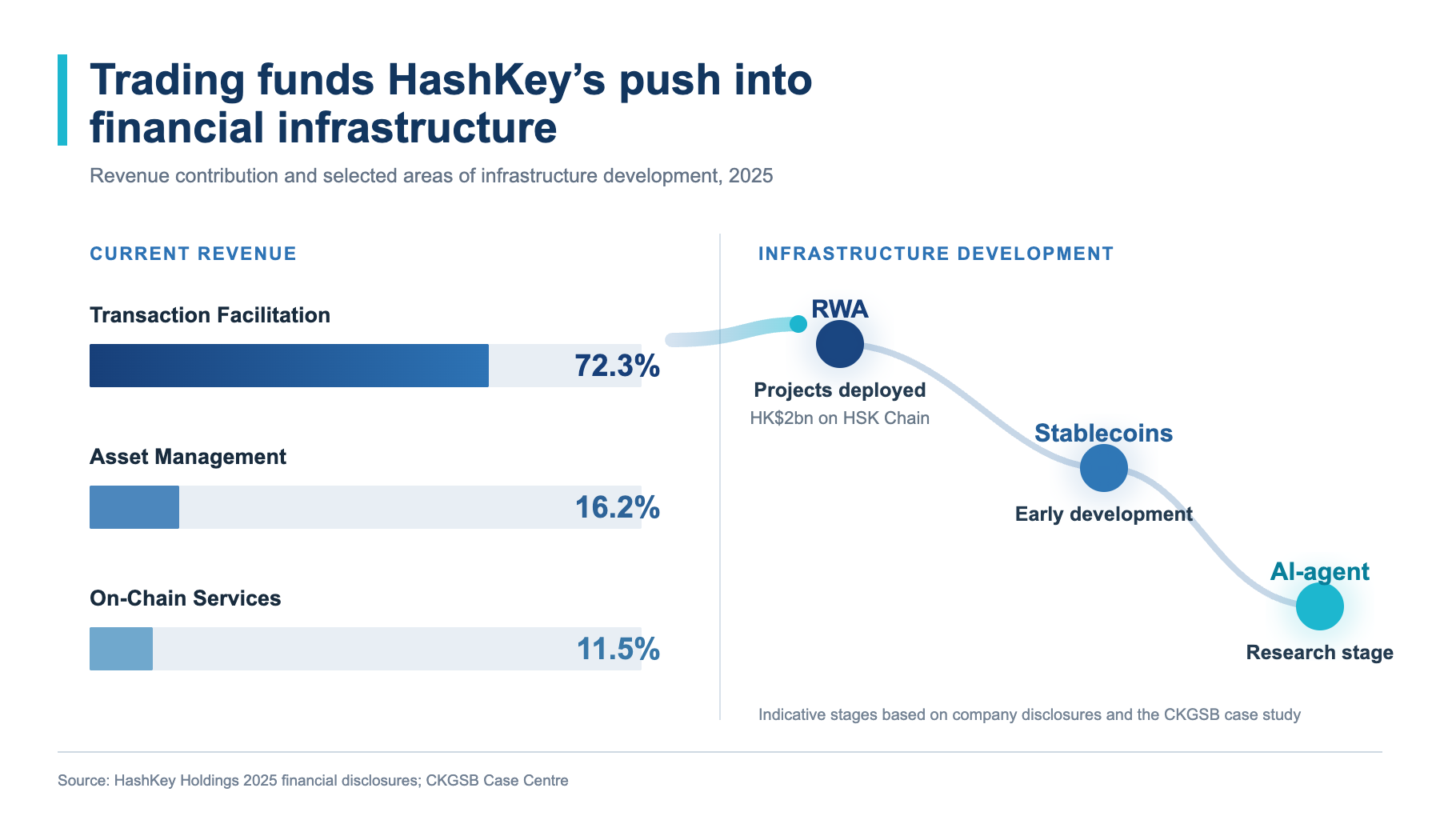
Transaction Facilitation, including licensed exchanges and over-the-counter block trading, generated 72.3 percent of group revenue in 2025. Total trading volume reached HK$590.8 billion, of which HK$530 billion was traded in Hong Kong. Institutions and broker channels accounted for over 90 percent of aggregate volume, giving the platform a far more institutional customer base than a typical retail crypto exchange.
On-Chain Services contributed 11.5 percent of revenue. HashKey Cloud provides staking and node services across more than 80 blockchain networks, managing an average of HK $22.4 billion in assets under staking in 2025. Meanwhile, HSK Chain – an Ethereum Layer 2 network – is tailored specifically for professional and institutional financial applications.
Asset Management accounted for 16.2 percent of revenue. By the end of 2025, HashKey Capital had invested in over 400 Web3 projects and managed HK$7.21 billion. This division gives HashKey early visibility into emerging technologies and business models, often leading portfolio companies to establish commercial partnerships with other parts of the group.
Scaling this broader ecosystem requires substantial capital. Research and development spending reached HK$504 million in 2025, or 69.7 percent of revenue. The IPO increased cash and cash equivalents to HK$2.81 billion while reducing the liabilities-to-assets ratio from 165.2 percent to 31.9 percent, giving HashKey ample runway to trest demand beyond pure trading.
Putting traditional assets on-chain
HashKey’s most advanced expansion effort is real-world asset (RWA) tokenization. By placing traditional financial instruments—such as investment funds, trade receivables, or commodities—within regulated legal structures, they can be represented as blockchain tokens. The primary goals are to make ownership fractionalizable and distributable while accelerating settlement.
HashKey employs a “financial-products-first” strategy. Rather than attempting to put physical property or art directly on-chain, it starts with auditable trust or fund structures backed by licensed custodians and accountants. In 2025, the firm provided tokenization solutions for Hong Kong dollar and US dollar money-market exchange-traded funds managed by Bosera International. It also partnered with GF International and other institutions on tokenized money-market funds and participated in a Hong Kong-listed tokenized gold ETF. By the end of 2025, HK$2 billion worth of RWAs had been deployed on HSK Chain.
HSK Chain reflects the necessary compromises of institutional adoption. Participants are verified, access is strictly controlled, and transactions undergo thorough auditing to satisfy know-your-customer (KYC) and anti-money-laundering (AML) mandates. Additionally, a delayed-confirmation mechanism allows transactions to be reversed if a security incident is identified in time.
Stablecoins and AI-agent payments represent earlier-stage initiatives. HashKey Exchange operates as a neutral venue capable of supporting multiple compliant stablecoins, while its research into autonomous software agent payments is just beginning. As a participant in the Agent Payments Protocol initiative—led by tech firms including Google—HashKey is actively researching the wallets, decentralized identifiers, and settlement systems that software agents will require.
Licenses need scale
HashKey has accumulated 13 financial and virtual asset licenses across six jurisdictions, including Hong Kong, Singapore, Bermuda, and Dubai. While its onshore operations cater to institutional clients via traditional financial channels, Bermuda-based HashKey Global offers an expanded product suite to customers in permitted jurisdictions.
This network also helps solve a persistent hurdle for regulated exchanges: fragmented liquidity. Because differing customer-verification rules traditionally prevent licensed venues from sharing order books, an SFC circular issued in late 2025—following discussions with regulators in Hong Kong and Dubai—began permitting cross-jurisdiction order-book sharing between recognized markets. If adopted at scale, these arrangements will allow tokenized funds issued in Hong Kong to seamlessly reach compliant investors in the Middle East.
Ultimately, HashKey’s scope stretches beyond the simplistic label of “the Coinbase of the East.” More than 40 licensed brokers connect to its spot trading system via omnibus accounts, allowing investors to trade through familiar brokerage interfaces while HashKey handles execution and custody. Its true strategic value lies in bridging Asian financial institutions, offshore capital, and tokenized assets.
Betting on rules
Regulatory licenses and institutional trust both require years of cultivation. Large-scale investors care deeply about secure custody, proper asset segregation, and clear lines of accountability when things go wrong. HashKey closed 2025 with HK$18.4 billion in customer assets held across its exchange platforms—a 60.5 percent increase year-over-year. This growth indicates that its regulated framework is successfully attracting and retaining institutional capital, turning compliance into a powerful competitive advantage.
Xiao compares blockchain infrastructure to roads and water pipes: heavy investments must precede broad adoption. While HashKey’s revenue remains primarily driven by trading, its RWA, stablecoin settlement, and autonomous payment initiatives occupy various stages of maturity. The key question following its public listing is whether its regulated infrastructure can attract enough volume and assets to generate steady, recurring income.
Over a decade ago, Xiao backed blockchain technology well before its commercial viability was proven. Today, HashKey is making a similar long-term bet on regulation. If digital finance ultimately matures within established financial systems, licenses and institutional safeguards will transform from costly overheads into productive assets. Hong Kong’s public markets will provide the ultimate testing ground for that thesis.
Source note: Drawn from the Cheung Kong Graduate School of Business (CKGSB) case study: HashKey: Compliance First and the Road for Next-Generation Financial Infrastructure. Li Wei is Professor of Economics and Associate Dean for Asia and Oceania at CKGSB. Chen Jian is Assistant Director of the Case Research Department at CKGSB.
Enjoying what you’re reading?
Article Subscribe (1)
Professor profile
LI Wei
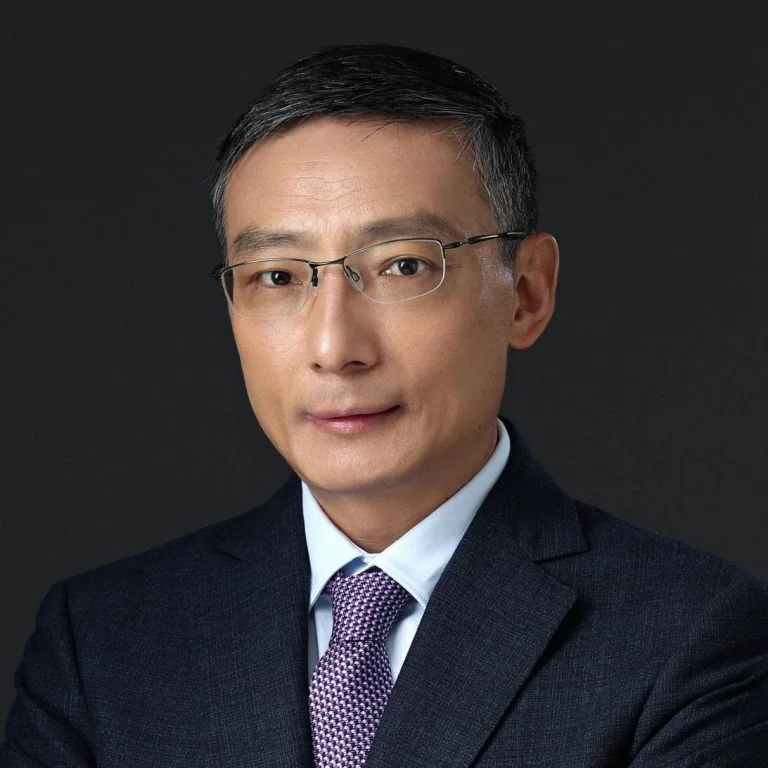
Professor of Economics, Associate Dean for Asia and Oceania, Director of Case Research Department and Director of Big Data Economic Research Department, Cheung Kong Graduate School of Business (CKGSB)
PhD, University of Michigan




Related Articles



Our Programs

Stanford & Silicon Valley Immersion Program
Global Unicorn Program Series
In partnership with Stanford Engineering Center for Global & Online Education
Visit Silicon Valley tech companies and AI and robotics labs to explore how US firms apply AI and how their approach compares with China’s.
LocationStanford University Campus, California, United States
Date6–11 Dec 2026 / 5–10 Dec 2027
LanguageEnglish with Chinese Translation

Emerging Markets: Innovation and Scaling for Exponential Growth – ASEAN
How is China’s progress in AI changing industries, and what does it mean for companies growing in ASEAN?
LocationJakarta, Indonesia
Date23–26 March 2027
LanguageEnglish (with Chinese translation)

Asia Start: AI + Digital Ecosystem China Expedition
Visit Chinese tech innovators, hear from experts, and meet the founders and engineers behind China’s AI and digital economy.
LocationChina (Beijing, Shanghai, Hangzhou & optional Shenzhen)
DateApril 19–24, 2027
LanguageEnglish

Intelligent China: AI, EVs & Smart Manufacturing
See China’s advances in AI, electric vehicles, and smart manufacturing through faculty sessions, factory visits, and meetings with industry leaders.
LocationBeijing, Shenzhen, Shanghai, and Hangzhou
DateSummer – Winter 2027 (three 4-day programs)
LanguageEnglish

Scaling Innovation: AI and Digital Strategies for Business Transformation
Global Unicorn Program Series
In partnership with Columbia Engineering
Learn from CKGSB and Columbia Engineering faculty how to apply AI and lead digital business transformation.
LocationNew York, USA
Date26 Sep - 01 Oct, 2027
LanguageEnglish

Emerging Tech Management Week: Silicon Valley
Global Unicorn Program Series
In partnership with UC Berkeley College of Engineering
Explore emerging technologies through classes, company visits, and meetings with Silicon Valley innovators to uncover new business opportunities.
LocationUC Berkeley, California, United States
Date31 Oct - 05 Nov, 2027
LanguageEnglish