
Doubling down on China: growth strategies and brand identity
May 18, 2026
Tumi’s regional head discusses the travel-inspired company’s shift to China
Premium travel and bag producer Tumi’s head of APAC and Middle East discusses the company’s strategy to pivot towards China
In this Q&A, Aris Maroulis, head of APAC and Middle East for premium travel and bag brand Tumi, discusses the company’s shift towards China and Asia, how the company has captured the market, and where the biggest opportunities lie.
Q: Overall, where do Asia and the Middle East fit within the global markets for companies such as Tumi? What is the balance worldwide?
A: In terms of regions, North America—being our home market—is number one by sales, and Asia–Middle East is number two. That gap is becoming smaller and smaller. After that comes Europe, then Latin and South America.
I expect that in the mid-term, Asia–Middle East will become the number one region in terms of sales. It is the highest-growth market, and we’ve seen that consistently over the past few years.
More than that, it is also the region where our positioning as a premium lifestyle brand is the most advanced. If you look at our product categories—travel, men’s bags, women’s bags, and accessories—the balance across these categories is most developed in this region.
In North America, for example, the business is still more heavily skewed toward travel. Our future direction is to increasingly become a travel-inspired lifestyle brand—for business use, daily use, across genders and categories—and that balance is already most advanced in Asia.
So Asia is number two in sales, the highest-growth market, and closest to where we want the global brand to be.
Q: How important is establishing brand identity in Asian markets? And what steps are luxury brands taking in terms of shaping the market?
A: One key focus has been doubling down on China. China has always been important, but over the past two years we’ve had a very consistent and deliberate focus on it, and that will continue to increase. The goal is to grow the domestic audience—when Chinese consumers buy in China and when they travel—so that we remain top of mind globally.
We’ve done this in several ways. First, last year we appointed a Chinese actor, Wei Daxun, as an APAC brand ambassador—the first time we’ve done this at that level.
Second, we reviewed our distribution in China. Rather than significantly increasing store numbers, we focused on improving quality. We closed smaller stores that didn’t deliver the right brand experience and opened larger, higher-quality locations, including a flagship in Shanghai, and regional flagships in other parts of the country.
Third, we significantly increased marketing investment. China is a very crowded market, so we need to cut through the noise—not just to build awareness, but to communicate our heritage, positioning and value proposition clearly.
Beyond China, another major theme has been taking back direct distribution in key Asian markets. After Covid, we took back operations in Singapore, Malaysia, and more recently Taiwan. Today, the vast majority of our sales come from directly operated channels.
Finally, we’ve worked to balance global consistency with local relevance. That means maintaining a strong, unified brand expression while also enhancing local relevance through local ambassadors, market-specific initiatives, and limited-edition products where appropriate.
Q: Many Western brands in Asia rely on local distribution partners. You’ve moved toward direct control—what are the benefits and downsides?
A: The main advantage of using partners is financial—lower capital expenditure and fixed costs. But if you want to take the business to the next level, you need direct control in key markets. Direct control brings you closer to the consumer. It allows for direct dialogue, customer relationship management and loyalty programs, which are fundamental for long-term success.
We still work with partners in some markets—such as the Middle East, India, Vietnam and the Philippines—and in certain channels like airport retail. But in major markets, we operate directly.
If you take a short-term view, using partners might make sense financially. But for long-term success, you need to be present, understand the market, and engage directly with consumers. In China, for example, we took back distribution in 2018–2019, and only after Covid have we been able to fully accelerate that strategy.
Q: Some say that marketing strategies in China are ahead of the rest of the world in terms of responsiveness and digitalization? And are there lessons that can be applied globally?
A: Yes, absolutely—China is leading the world. It is highly dynamic and hyper-digital. Live streaming, AI, rapidly evolving platforms—it’s an incredibly fast-moving environment. E-commerce is also a much larger share of sales than in most other markets and it functions both as a communication and a direct sales channel.
There’s also very advanced use of brand ambassadors, celebrities, KOLs (key opinion leader) and KOCs (key opinion consumer). Many of these trends—like live streaming—started in China and are now spreading globally.
Additionally, brands in China need to focus on enhancing their experiential engagement with consumers. The value proposition of each brand needs to become a “lived experience” so that it resonates with the increased expectations of consumers in China. This should be true within the store environment, pop ups and all customer touchpoints.
One key challenge is educating global teams. It’s essential to bring HQ colleagues to China so they can experience the market firsthand.
Another reality is that you need to be comfortable investing more heavily in marketing as a percentage of sales, particularly in digital and celebrity-driven channels. That investment is necessary to compete effectively.
Q: There seems to be a rise of strong domestic brands in all sectors, competing against established foreign brands. What is your view?
A: It’s a natural evolution of a maturing market, and in many ways it’s positive—it keeps everyone competitive.
At the premium level, competition becomes more complex. Domestic brands are improving in quality and may eventually compete more directly.
One advantage we have is global infrastructure. If a customer travels internationally and needs a repair, we have more than 600 stores worldwide that can provide service. That’s something domestic brands cannot easily replicate.
But ultimately, brand equity is key. Innovation, design, and the overall brand experience matter.
We can also create global experiences—for example, events that travel from New York to Tokyo to Paris to Shanghai—which bring a level of international brand storytelling that is difficult for domestic brands to match.
Q: How would you describe the Chinese consumer?
A: It’s important not to generalize too much—there are significant regional differences within China. Preferences in Shanghai, the northeast, or the south can vary quite a bit.
That said, there are some common traits. Chinese consumers are highly engaged with brands. They are either already very knowledgeable or eager to learn about what makes a brand distinctive.
They are also very value-conscious—not just in terms of price, but in understanding what they are getting. If they see the value, they are willing to pay. And they have very high expectations for quality.
Q: When making purchase decisions, do Chinese consumers focus more on product features or brand image?
A: Both. They want to understand the brand and its value proposition, but also the product—materials, craftsmanship, functionality, durability.
There is a strong practical element, but also a desire to understand what the brand represents and how it reflects on them. These two aspects are complementary, not contradictory.
For us, this aligns with what we call the “Tumi difference”—material innovation, functionality, durability, and customer service—which resonates well with Chinese consumers.
Q: Looking ahead 5–10 years, what is the future of your brand in Asia?
A: First, Asia will become our number one region.
Second, we will continue evolving into a true lifestyle brand. While some consumers still perceive us as a male, business-focused brand with darker colors, that is changing.
We want to be relevant across genders, occasions, and lifestyles—multi-gender, multi-color, multi-material, and multi-use.
At the same time, we will maintain our positioning as a “bridge to luxury”—not at the very top end, but above mass premium—and ensure that positioning is consistent globally.
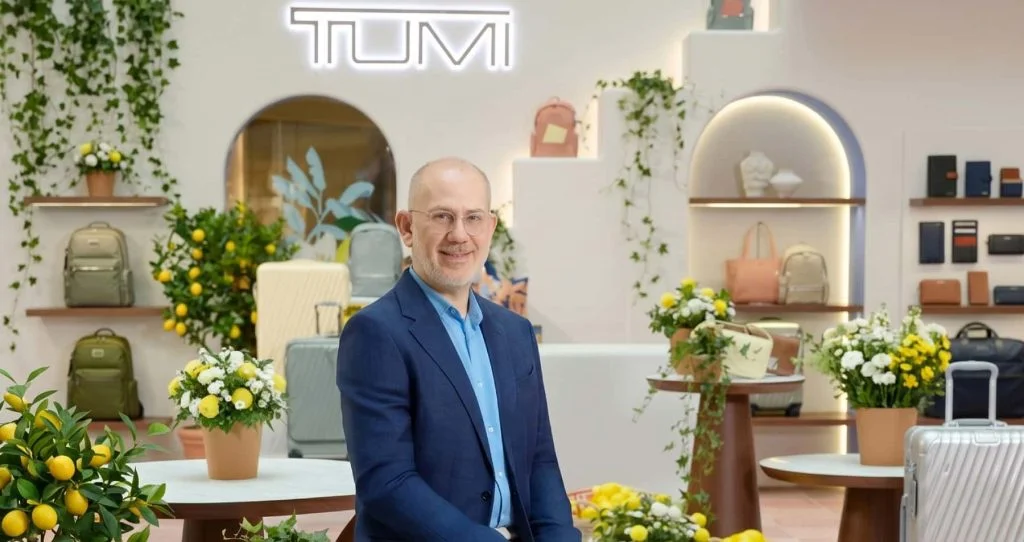
For instance, we recently launched our Spring/Summer collection, Mediterranean Escape, with a pop-up in Shanghai.
This collection is about color, vibrancy, and lifestyle. It draws inspiration from the Mediterranean—summer, joy, family, and a sense of lightness and energy.
It’s very different from the traditional perception of the brand. There are no black products—it’s about bright colors, everyday use, and a strong appeal to women, though not exclusively.
At the same time, we’re not abandoning our core. The new direction complements it. Whether it’s a business briefcase or a colorful backpack, the same principles—functionality, durability, and material innovation—remain at the core.
That authenticity is essential. The expression of the brand can evolve, but the foundation must remain consistent.
Bio: Aris Maroulis is the Head of Asia Pacific and Middle East for Tumi. He has been living and working in Asia for the past 17 years. Prior to Tumi, he worked in commercial real estate with Hang Lung Properties, overseeing several luxury shopping malls in China, as well as leading Montblanc, part of Richemont Group. Prior to his Asia experience, he was a management consultant in the US and Europe, focused on consumer products and retail industries. He holds an MBA from The Wharton School of the University of Pennsylvania.
Enjoying what you’re reading?
Article Subscribe (1)
CKGSB Report






Our Programs

Emerging Tech Management Week: Silicon Valley
Global Unicorn Program Series
In partnership with UC Berkeley College of Engineering
This program equips participants with proven strategies, cutting-edge research, and the best-in-class advice to fuel innovation, seize emerging tech developments, and catalyse transformation within your organization.
LocationUC Berkeley
Date01 - 06 Nov, 2026
LanguageEnglish
Asia Start: AI + Digital China Expedition
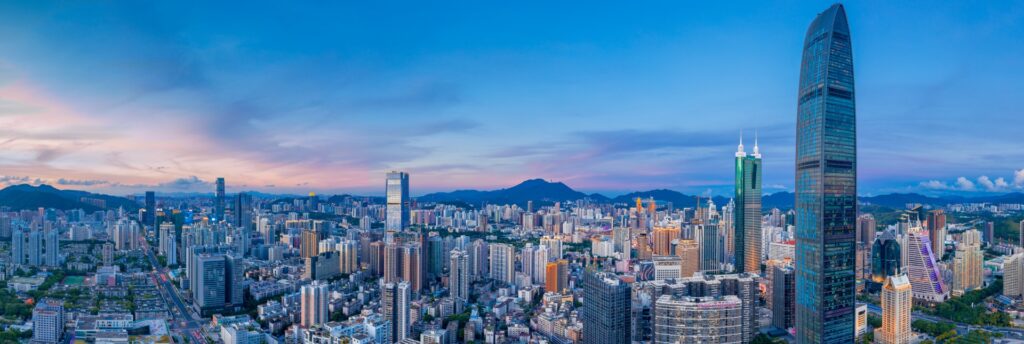
Asia Start provides entrepreneurs and executives with unparalleled access to Asia’s dynamic digital economy and its business ecosystems, offering the latest trends and insights, strategies, and connections to overcome challenges and unlock future growth for your business in Asia and beyond.
LocationChina (Beijing, Shanghai, Hangzhou & optional Shenzhen)
DateNovember 2–7, 2026 | April 19–24, 2027
LanguageEnglish

Intelligent China: AI, EVs & Smart Manufacturing
Explore how China is advancing AI, electric vehicles and smart manufacturing through faculty-led sessions, company visits and exchanges with industry leaders. Build practical insights for your organization’s strategy, partnerships and investment decisions, with the flexibility to join individual four-day programs or the full 12-day series.
LocationBeijing
Date12 Days
LanguageEnglish

Emerging Markets: Innovation and Scaling for Exponential Growth – ASEAN
Learn China's AI and innovation strategy from its leading thinkers — brought to you in Jakarta, with an optional immersion in China — and connect with the business leaders driving it.
LocationJakarta, Indonesia
Date2–4 December 2026
LanguageEnglish (with Chinese translation)
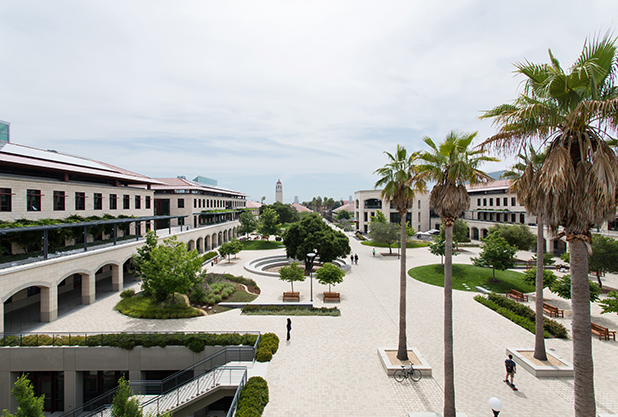
Stanford & Silicon Valley Immersion Program
Global Unicorn Program Series
In partnership with Stanford Engineering Center for Global & Online Education
This CKGSB program equips entrepreneurs, intrapreneurs and key stakeholders with the tools, insights, and skills necessary to lead a new generation of unicorn companies.
LocationStanford University Campus,
California, United States
Date06 - 11 Dec, 2026
LanguageEnglish with Chinese Translation