
Focus Media’s three crises: How China’s elevator advertising giant survived disruption
June 16, 2026
How elevator advertising giant Focus Media survived multiple crises
Focus Media has repeatedly reinvented itself by abandoning failed strategies, embracing digital transformation, and doubling down on the enduring value of elevator advertising
From a Nasdaq darling to one of the first major Chinese firms to delist in the US and relist domestically, Focus Media has spent more than two decades navigating nearly every major disruption to China’s business environment. The company has weathered the dotcom crash, the global financial crisis, the rise of mobile internet and the economic shock of the pandemic years.
Yet despite repeated predictions of its decline, the elevator advertising giant has consistently reinvented itself. Today, Focus Media remains one of China’s dominant outdoor advertising companies, with a market capitalization exceeding ¥100 billion ($13.8 billion) and a business model that has proven surprisingly resilient in the digital age. In fiscal year 2024, the company reported revenue of ¥12.26 billion ($1.7 billion) and net profit of ¥5.07 billion ($700 million), while operating cash flow exceeded net profit by 30%, highlighting its strong cash-generating ability.
At the center of that story is founder Jiang Nanchun, whose leadership philosophy increasingly revolves around organizational resilience: the ability to adapt, refocus and evolve when external conditions become uncontrollable.
Building a new advertising category
Focus Media began with a simple observation.
Jiang, a Chinese literature graduate from East China Normal University who originally dreamed of becoming a poet, entered advertising almost by accident after winning a slogan-writing competition while still at university. By around 2000, he had already built a successful advertising agency serving Shanghai’s booming IT sector.
The turning point came in 2002 after the collapse of the internet bubble. As China’s urbanization accelerated, Jiang noticed office towers and apartment blocks multiplying across major cities while advertising remained concentrated in traditional channels such as newspapers and television.
He believed elevators represented a hidden opportunity: enclosed spaces passed through daily by urban professionals with few distractions and unusually high exposure frequency.
In 2003, Jiang founded Focus Media to capitalize on that insight.
Almost immediately, however, SARS plunged China into uncertainty. Most competitors slowed expansion or retreated altogether. Jiang responded in the opposite way, aggressively securing elevator advertising locations before rivals could react.
He invested the ¥50 million ($6.9 million) he had accumulated before founding the business and, within five months, reportedly secured control over much of Shanghai’s elevator advertising space. The gamble worked. Focus Media’s first rollout covered 50 office buildings, while the payback period for each advertising screen was reportedly only three months.
Backed by investors including SoftBank and Goldman Sachs, Focus Media listed in the US in 2005, raising $172 million in what was then the largest US IPO fundraising on Nasdaq by a Chinese company. It subsequently acquired competitors including Target Media and Framedia, pushing market share above 90%.
But success created new pressures.
To satisfy Wall Street’s appetite for growth, Jiang embarked on an aggressive acquisition spree intended to transform Focus Media into a broader “lifestyle media platform.” Between 2005 and 2007, the company spent nearly $1 billion acquiring more than 60 firms spanning mobile advertising, internet advertising and retail display networks.
The strategy initially boosted revenue and valuations, but it also left the company bloated and strategically unfocused.
That weakness became painfully clear in 2008. A scandal involving spam text-message advertising linked to one of Focus Media’s businesses damaged the company’s reputation just as the global financial crisis slashed advertising budgets worldwide. The company’s valuation collapsed to less than one-tenth of its peak.
Jiang responded with a painful but decisive strategy: retreat to survive.
Beginning in 2009, Focus Media sold or shut down non-core businesses and returned its focus to elevator and cinema advertising—the areas where it possessed the strongest competitive advantages.
But another crisis soon followed.
In 2011, Muddy Waters Research—the US short-selling firm founded by Carson Block—accused Focus Media of inflating screen numbers and engaging in potential insider-linked transactions. The allegations triggered a nearly 40% collapse in the company’s stock price in a single day.
Focus Media publicly rebutted the accusations, but the episode fundamentally changed Jiang’s perception of overseas capital markets. He increasingly believed many US investors struggled to understand the value of elevator advertising within China’s dense urban environment.
The company delisted from Nasdaq in 2013 and returned to China’s A-share market in 2015 through a backdoor listing. On its first trading day after relisting, Focus Media’s market capitalization exceeded ¥140 billion ($19.4 billion).
For Jiang, the experience reinforced a core lesson: a company’s real security comes not from stock prices, but from the irreplaceability of its core business.
Reinventing itself in the smartphone era
If the earlier crises stemmed largely from strategic mistakes and financial pressure, the challenge Focus Media faced after 2015 was far more existential.
The rise of smartphones fundamentally changed how people consumed information. Instead of looking at elevator screens, commuters increasingly spent their time scrolling through WeChat, news apps and short-video platforms. Many observers questioned whether Focus Media’s business model still worked at all.
At first, Jiang attempted to compete directly.
In 2011, Focus Media launched “Q Card,” an NFC-enabled system attached to elevator screens that allowed users to receive coupons and promotions through interactive tapping. The company hoped to build an online-to-offline ecosystem capable of generating both advertising and transaction revenue.
The project failed. Hardware costs were high, while users and advertisers showed limited interest in interacting with elevator screens in that way.
The experience taught Jiang an important lesson: Focus Media’s advantage lay in controlling physical advertising spaces, not building internet technology platforms.
Instead of competing against China’s tech giants, Jiang decided it would be smarter to partner with them.
That opportunity arrived in 2018, when Alibaba invested ¥15 billion ($2.1 billion) in Focus Media and became its second-largest shareholder. The partnership gave Focus Media access not only to capital, but also to Alibaba’s technology and data infrastructure.
The transformation reshaped the company’s business model.
Previously, updating advertisements required manual hardware changes. After digitization, advertisements could be distributed instantly through cloud systems. During the 2022 Winter Olympics, for example, Luckin Coffee reportedly pushed congratulatory advertisements featuring skier Eileen Gu onto Focus Media screens nationwide within minutes of her gold medal victory.
The company also introduced more precise targeting. By analyzing building types, property values and neighborhood demographics, Focus Media could tailor campaigns to specific locations.
Most importantly, advertisers gained clearer ways to measure effectiveness. By linking elevator advertising with Alibaba’s e-commerce ecosystem, brands could track whether consumers who viewed advertisements later searched for products or made purchases online.
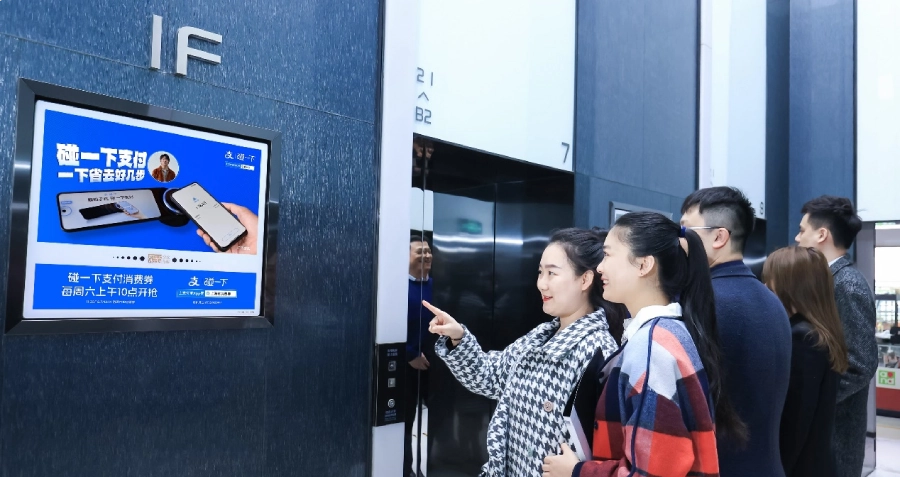
In 2025, Focus Media expanded the partnership further by integrating Alipay’s NFC “tap” technology into elevator advertising screens, allowing consumers to receive digital rewards and coupons directly through their phones.
At the same time, Focus Media was also forced to overhaul its customer base.
Around 2018, internet startups such as Ele.me, Meituan, Liepin and Luckin Coffee spent aggressively on advertising, and internet-related companies eventually accounted for nearly 40% of Focus Media’s revenue.
But tighter financial regulation and cooling venture capital investment quickly changed the environment. Many startups slashed advertising budgets almost overnight. In 2019, Focus Media’s revenue fell 16.6%, while net profit plunged 68%.
Jiang responded by pivoting toward traditional consumer brands benefiting from China’s broader consumption-upgrading trend.
Companies such as Bosideng, Feihe, Qiaqia and Joyoung possessed stable cash flow and were eager to reposition themselves as premium brands. Elevator advertising became a tool for rapidly building visibility among urban middle-class consumers.
The shift ultimately made Focus Media more resilient by reducing dependence on speculative startup spending and strengthening ties to China’s broader consumer economy.
Expanding beyond China
By the 2020s, Focus Media faced a more difficult macroeconomic environment shaped by the pandemic years, slowing urbanization and growing concern over weak consumer sentiment.
Jiang nevertheless argued that economic slowdowns do not eliminate demand for premium products. Instead, they create opportunities for what he calls “structural upgrading,” where consumers continue spending on products perceived as healthier, higher-quality, or more aspirational.
He frequently points to China’s beer industry as an example. Through intensive elevator advertising campaigns, China Resources Beer successfully repositioned products such as SuperX and expanded premium offerings including Heineken in China. Despite flat overall beer consumption, the company reportedly increased revenue by 21% and net profit by 383% between 2018 and 2024.
Meanwhile, Focus Media has continued expanding geographically.
Within China, the company has pushed deeper into lower-tier cities through franchise partnerships, building a network spanning roughly 500 cities. Overseas, it has expanded into markets including South Korea, Singapore, Indonesia and Thailand.
Jiang has described the strategy using SoftBank founder Masayoshi Son’s “time machine theory”: taking business models that succeeded in one market and replicating them in emerging economies where similar conditions are beginning to appear.
Looking ahead, Jiang sees artificial intelligence as the company’s next major transformation.
Using more than 20 years of advertising data and over 20,000 historical marketing cases, Focus Media has reportedly developed a marketing-focused large language model capable of generating branding strategies, slogans and creative concepts. The long-term goal is to equip sales teams with AI-powered assistants capable of delivering sophisticated branding advice to smaller businesses at far lower cost than traditional consulting firms.
Jiang’s ambitions remain enormous. He has said that by the time he retires, he wants Focus Media to operate 10 million advertising terminals globally, covering 2 billion people and generating 5 billion daily impressions.
The logic behind resilient leadership
Focus Media’s story is ultimately about more than advertising screens or business cycles. It is also about how organizations survive repeated disruption.
The company frames this through what it calls a “resilient leadership flywheel,” built around openness, strategic clarity and organizational trust.
Despite his reputation as one of China’s advertising pioneers, Jiang repeatedly demonstrated a willingness to abandon old assumptions. He chose to return to Chinese capital markets after realizing the company was poorly understood overseas. He acknowledged Focus Media’s technological limitations during the mobile internet era and embraced partnerships instead of insisting on self-sufficiency. And during overseas expansion, he delegated substantial authority to veteran executives.
At the same time, he maintained unusually strong strategic focus. Throughout crises ranging from economic downturns to the pandemic years, Focus Media consistently prioritized control of elevator advertising locations—the company’s core asset and deepest moat.
Internally, Jiang also encouraged employees to think of themselves not merely as advertising salespeople, but as consultants helping clients build brands and shape consumer perception.
Ultimately, the Focus Media case suggests that resilient leadership is not about controlling every variable during periods of uncertainty. It is about maintaining trust, preserving direction and giving organizations enough confidence to keep adapting when the external environment becomes unstable.
Enjoying what you’re reading?
Article Subscribe (1)
CKGSB Report







Related Articles

Our Programs

Emerging Tech Management Week: Silicon Valley
Global Unicorn Program Series
In partnership with UC Berkeley College of Engineering
A technology management program for leaders looking to turn emerging technologies into business opportunities.
Combining proven strategies and cutting-edge research, the program helps participants fuel innovation, seize opportunities in emerging technologies, and catalyze transformation within their organizations. Designed for managers, start-up leaders, and technology investors, it includes visits to venture capital firms and technology companies, alongside mentored group projects.
LocationUC Berkeley, California, United States
Date01 - 06 Nov, 2026
LanguageEnglish

Asia Start: AI + Digital China Expedition
An immersive program for entrepreneurs and executives looking to understand China's AI and digital economy firsthand.
Gain the latest trends and insights, strategies, and connections to overcome challenges and support future business growth in Asia and beyond.
LocationChina (Beijing, Shanghai, Hangzhou & optional Shenzhen)
DateNovember 2–7, 2026 | April 19–24, 2027
LanguageEnglish

Intelligent China: AI, EVs & Smart Manufacturing
A three-part program examining China’s advances in AI, electric vehicles, and smart manufacturing.
Through faculty-led sessions, company visits, and exchanges with industry leaders, gain practical insights for your organization's strategy, partnerships, and investment decisions. Join an individual four-day program or complete the full 12-day series.
LocationBeijing, Shenzhen, Shanghai, and Hangzhou
Date December 2026 – July 2027 (three 4-day programs)
LanguageEnglish

Emerging Markets: Innovation and Scaling for Exponential Growth – ASEAN
A China-focused innovation program for ASEAN executives and business owners responding to the impact of AI on their industries.
Gain insights from leading Chese thinkers in Jakarta, with an optional immersion in China and opportunities to connect with the business leaders driving innovation. The program offers a closer look at how developments in China could affect your industry and business.
LocationJakarta, Indonesia
Date2–4 December 2026
LanguageEnglish (with Chinese translation)
Stanford & Silicon Valley Immersion Program
Global Unicorn Program Series
In partnership with Stanford Engineering Center for Global & Online Education
A Silicon Valley immersion for entrepreneurs, intrapreneurs, and investors leading and scaling AI-driven companies.
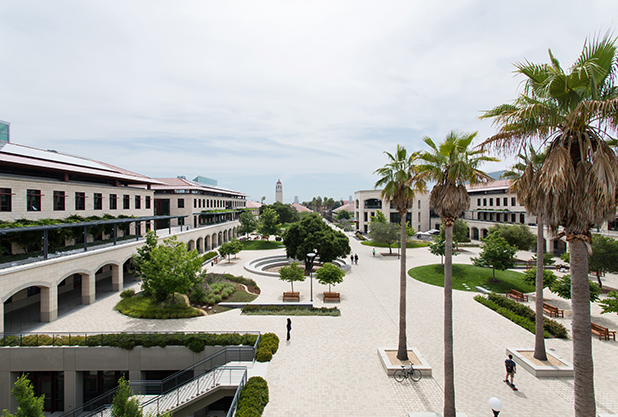
The program combines academic learning with visits to AI and robotics labs and Silicon Valley companies, giving participants direct exposure to emerging technologies and the businesses developing and applying them.
LocationStanford University Campus, California, United States
Date06 - 11 Dec, 2026
LanguageEnglish with Chinese Translation