
When AI Moves from Backstage to Center Stage
May 22, 2026
Professor Wei Xiang on how artificial intelligence is driving a new era of medical innovation — and why Australia is emerging as an unlikely leader
Professor Wei Xiang is La Trobe Distinguished Professor, Cisco Research Chair of AI and IoT (Internet of Things). He is also a special expert guest in AI for the Australian Unicorn program of CKGSB.
When a startup founder in rural northern Australia called Professor Wei Xiang out of the blue — while Xiang was sitting in a Thai restaurant in New York, waiting for his meal — the conversation that followed would lead to a commercial smart irrigation project now saving millions of liters of water across thousands of hectares of farmland near the Great Barrier Reef. The founder had remembered a presentation Xiang had given two years earlier on the Internet of Things and figured the professor could help him build something real.
That story captures something essential about Xiang’s approach to technology: it must solve real problems, and the path from research to impact need not take decades. It is also a story that illuminates a much larger transformation now underway at the intersection of artificial intelligence and healthcare — one in which Xiang, as founding Director and Chief Scientist of the Australian Centre for AI and Medical Innovation (ACAMI) at La Trobe University in Melbourne, is playing a pioneering role.
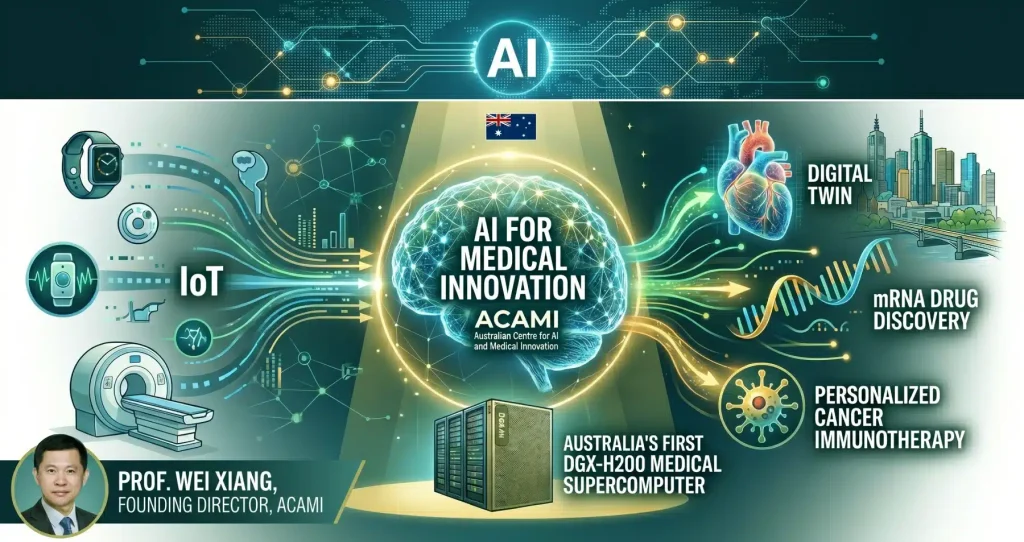
“ACAMI is a world first,” Xiang says. “It is the first center in the world using AI to actively drive medical breakthroughs. Previously, medical people used AI as one of their tools, only when it was handy. But what they didn’t realize is that AI can now dominate. It is coming from backstage to the center stage.”
Ranked among Stanford University’s Top 2% of Scientists globally, Xiang has built his career at the convergence of telecommunications, the Internet of Things, and artificial intelligence. Before founding ACAMI, he established Australia’s first accredited IoT engineering degree at James Cook University in 2016 and founded the Cisco-La Trobe Centre for AI and IoT in 2020. His trajectory from connected devices to connected healthcare, he insists, was not a pivot but a natural extension.
Professor Xiang frames his intellectual journey using a simple geometric metaphor. “Think of it as a triangle,” he explains. “AI and IoT is the horizontal layer — it applies across every industry. ACAMI is the vertical — healthcare as a specific domain. And the third side of the triangle is AI itself. That’s what powers everything.”
The logic is straightforward but powerful. IoT devices — sensors, wearables, imaging equipment, biomarkers — generate vast quantities of data. AI makes that data intelligent. And healthcare, with its combination of complexity, high stakes, and enormous datasets, is arguably the vertical where this convergence matters most.
AI and IoT: Why They Need Each Other
Professor Xiang insists that the two technologies are inseparable. “AI is nothing without data,” he says. “But where is most of the data coming from? There is only so much data on the Internet. State-of-the-art large language models are running out of training data from online sources. But there is way more data out there — security cameras, sensors on electric vehicles, medical devices — collected by sensors that hasn’t been fully utilized by AI.”
The relationship, he argues, is symbiotic: “AI can’t live without IoT, because those devices provide precious training material. And IoT can’t live without AI, because without intelligence, those machines are just dumb machines keeping send data to the cloud.”
ACAMI’s website describes AI’s potential to halve drug development times, but Xiang believes even that understates the case. “It’s way more than half,” he says. The reason, he explains in characteristically direct terms, is that traditional drug discovery relies on what scientists call wet-lab methods — painstaking, labor-intensive physical experiments conducted one hypothesis at a time.
AI transforms this process through high-throughput screening. Rather than conducting exhaustive searches through millions of molecular combinations, AI prediction engines can identify the ten most promising candidates based on historical data, allowing researchers to focus their experimental efforts where the probability of success is highest.
Xiang offers a concrete example from ACAMI’s collaboration with the Florey Institute of Neuroscience and Mental Health, Australia’s leading brain research institute. The project uses AI to optimize mRNA sequences for therapeutic applications. “Traditional methods of designing mRNA-based therapy require enormous numbers of experiments,” he explains. “If the sequence is not right, the transferability into the human body is low. Even if it gets transferred into the human body, the stability is low. The number of possible combinations runs into the billions. There is simply no way traditional methods can optimize this. But AI gives us a powerful prediction engine to do high-throughput screening.”
Digital twins: Testing drugs on virtual patients
Perhaps the most transformative strand of ACAMI’s work involves digital twins — virtual replicas of physical entities that allow researchers to simulate interventions without experimenting on human subjects. The concept has been used in advanced manufacturing for two decades, including in aircraft design, but applying it to the human body represents a frontier of extraordinary complexity.
“By building a digital replica of the human body, we can implement intervention schemes and do scenario planning without having to do physical experiments on humans,” Xiang explains. “That’s not only expensive — there are ethical barriers, regulatory barriers. But once we have a digital replica, we can do all sorts of things in the digital world.”
One current project, in partnership with the Baker Heart and Diabetes Institute, involves building a digital twin of the human heart to understand how different intervention schemes affect the risk of cardiovascular disease. Modeling the human heart, Xiang acknowledges, is among the most challenging problems in computational biology. But he is confident about the timeline: “We are not talking about decades. Within five years, we are going to start seeing significant medical breakthroughs coming out of experiments on digital twins.”
For business leaders who tend to think of AI primarily as software, Xiang offers a bracing correction. “Anyone who thinks of AI as software underestimates its tremendous potential,” he says. “It is a revolutionary technology. Many see AI in the form of software like ChatGPT, either locally installed or in the cloud. But that is only one form. In the future, we will see AI moving from cyberspace into physical space — robotics, autonomous systems — and once you equip them with powerful large language models, they can think and reason like humans.”
This is why computational infrastructure matters so profoundly. Xiang recently attended NVIDIA’s GTC conference in San Jose, where CEO Jensen Huang outlined a vision of “AI factories” — a new generation of data centers whose output is not storage or processing but tokens. “The entire world will be tokenized,” Xiang says. “Tokens will become a commodity, like electricity. Without them, nothing based on AI can run.”
It is against this backdrop that La Trobe University, with support from the Victoria state government, partnered with NVIDIA to commission Australia’s first DGX-H200 supercomputer dedicated to medical research. For Xiang, this is not a prestige acquisition but an existential investment. Without sufficient computational power, the most ambitious AI-driven medical research simply cannot proceed.
Lessons from the farm
The smart irrigation story that opened this article is more than a colorful anecdote. Xiang’s collaboration with Aglantis, the startup whose founder called him from Queensland, produced a commercial product launched in November 2024 that has been sold to 15 farmers, covered thousands of hectares, and attracted coverage from more than 15 media outlets across Australia. It stands as one of the rare cases where a university research center brought an AI-IoT product all the way to market.
The lessons, Xiang says, translate directly to healthcare — with one critical difference. “If we can do this for smart agriculture, we can definitely do it in healthcare,” he says. “But healthcare is a highly regulated environment. In agriculture, if you have a fantastic idea and a great product, you can sell it to the end user. In healthcare, you might have a brilliant product that everyone likes, but rolling it out takes much longer because of regulatory barriers.”
The fundamental lesson, however, is universal: “You have to solve the real problem.” Universities, Xiang observes with disarming honesty, are good at research but “terrible” at commercialization. Bridging that gap — by embedding industry R&D teams within university labs, as he did with Aglantis — is a model he intends to replicate in medical AI.
On the emerging frontier of agentic AI — systems that can plan and execute tasks autonomously — Xiang is more cautious than many of his peers. He cites the viral popularity of OpenClaw,¹ an open-source personal AI assistant created by Peter Steinberger that operates across messaging platforms such as WhatsApp, Telegram, and Discord, and which NVIDIA CEO Jensen Huang highlighted at the GTC conference. Yet Xiang warns that healthcare will be among the last sectors to adopt such technology safely.
“The medical industry is generally a few years behind other industries in terms of technology adoption,” he says. “Agentic AI is a double-edged sword. Traditional AI is interactive — it answers questions, extends information. But agentic AI requires you to hand over control. And the underlying technology still has limitations. There is hallucination. If you give too much control, it can hurt you.” He cites cautionary examples from everyday use — credit cards charged for enormous sums, email accounts wiped clean — and argues that if such risks exist in routine applications, the stakes in healthcare are orders of magnitude higher. His advice: proceed, but with great care.
Asked what single investment a healthcare CEO should make in AI, Xiang’s answer is immediate and emphatic: invest in people. “In my role as director of ACAMI, I’ve seen many medical companies, healthcare companies, and research institutes,” he says. “They have a FOMO mentality — fear of missing out. But they’re also scared. AI is not their strength. They know nothing about it, but they know everyone is talking about it. They know it is the future of everything.”
The solution, he argues, is not to rush into purchasing technology but to educate and upskill staff. And the most common mistake he sees is the fear that AI will eliminate jobs. “AI will never take jobs from people,” he says. “It is only people using AI who will take the jobs of people not using AI. AI can improve your productivity by five times, ten times, even a hundred times. If you don’t use AI, you only have 24 hours in a day. With AI, your day suddenly becomes 240 hours.”
The breakthrough that is closer than you think
When asked to name one AI-driven medical breakthrough that is closer than most people realize, Xiang does not hesitate: personalized cancer immunotherapy.
He traces the story through BioNTech, the company that supplied the mRNA technology behind the Pfizer-BioNTech COVID-19 vaccine. BioNTech, which operates one of the southern hemisphere’s largest mRNA manufacturing facilities on La Trobe’s campus, was originally founded to fight cancer using mRNA technology. The COVID-19 vaccine was, in Xiang’s telling, a profitable detour that generated the resources to return to the company’s original mission.
The challenge with cancer vaccines is personalization. “For any cancer vaccine to be highly effective, it needs to be personalized,” Xiang explains. “A one-size-fits-all vaccine can achieve perhaps 60% effectiveness, but improving beyond that is very difficult because every individual is different. Once you go personalized, the cost becomes enormous. It is virtually impossible using traditional wet-lab methods. You have to introduce AI.”
This logic drove BioNTech’s decision, in 2023, to acquire an AI startup for approximately AUD$1 billion — a move that seemed extraordinary for a company of 150 people with no biomedical background. But as Xiang recounts from a conversation with BioNTech’s founder, the rationale was simple: every major pharmaceutical company is now investing in AI for drug discovery. Those that do not will find their competitors bringing drugs to market faster and cheaper, driving them out of the market entirely.
In addition, Xiang is keen to challenge what he calls a widespread misconception: that AI is a two-horse race between the United States and China. “I don’t buy that concept,” he says. “Australia has its own AI strengths.”
His argument rests on a specific geographic and institutional advantage. The Victoria state government has invested significantly in biology and biomedical research over the past two decades, and Melbourne has established itself as one of the world’s three “medical capitals,” alongside Boston and London. When you combine that biomedical depth with AI capability and world-class computational infrastructure, the result is a distinctive niche that neither Silicon Valley nor Beijing can easily replicate.
“This is why the Victoria government decided to fund ACAMI two years ago,” Xiang says. “It recognized that the combination of AI and medical research pays a huge dividend. What we are doing is using AI as the primary driver of medical innovation. That is the fundamental shift.”
For business leaders accustomed to looking to Washington and Beijing for signals about the future of AI, Xiang’s message is a useful corrective. The most consequential applications of artificial intelligence may not emerge from the technology superpowers at all, but from places where deep domain expertise — in this case, biomedical science — meets computational ambition.
Melbourne, it turns out, is one of those places. And Professor Wei Xiang intends to make sure the world knows it.
Reference
¹ OpenClaw (2026) OpenClaw — Personal AI Assistant. GitHub. Available at: https://github.com/openclaw/openclaw (Accessed: 19 May 2026).
Distinguished Professor Wei Xiang is the founding Director and Chief Scientist of the Australian Centre for AI and Medical Innovation (ACAMI) at La Trobe University in Melbourne. Ranked among Stanford University’s Top 2% of Scientists globally, he previously established Australia’s first accredited IoT engineering degree at James Cook University in 2016 and founded the Cisco-La Trobe Centre for AI and IoT in 2020. His research spans telecommunications, the Internet of Things, and AI-driven healthcare innovation.
Enjoying what you’re reading?
Article Subscribe (1)
CKGSB Report






Related Articles
Our Programs

Scaling Innovation: AI and Digital Strategies for Business Transformation
Global Unicorn Program Series
In partnership with Columbia Engineering
This program is designed to equip senior executives with the strategic insights and tools necessary to lead in this transformative era.
LocationNew York, USA
Date27 Sep - 02 Oct, 2026
LanguageEnglish

Emerging Tech Management Week: Silicon Valley
Global Unicorn Program Series
In partnership with UC Berkeley College of Engineering
This program equips participants with proven strategies, cutting-edge research, and the best-in-class advice to fuel innovation, seize emerging tech developments, and catalyse transformation within your organization.
LocationUC Berkeley
Date01 - 06 Nov, 2026
LanguageEnglish

Asia Start: AI + Digital China Expedition
Asia Start provides entrepreneurs and executives with unparalleled access to Asia’s dynamic digital economy and its business ecosystems, offering the latest trends and insights, strategies, and connections to overcome challenges and unlock future growth for your business in Asia and beyond.
LocationChina (Beijing, Shanghai, Hangzhou & optional Shenzhen)
DateNovember 2-7, 2026
LanguageEnglish
Stanford & Silicon Valley Immersion Program
Global Unicorn Program Series
In partnership with Stanford Engineering Center for Global & Online Education
This CKGSB program equips entrepreneurs, intrapreneurs and key stakeholders with the tools, insights, and skills necessary to lead a new generation of unicorn companies.
LocationStanford University Campus,
California, United States
Date06 - 11 Dec, 2026
LanguageEnglish with Chinese Translation