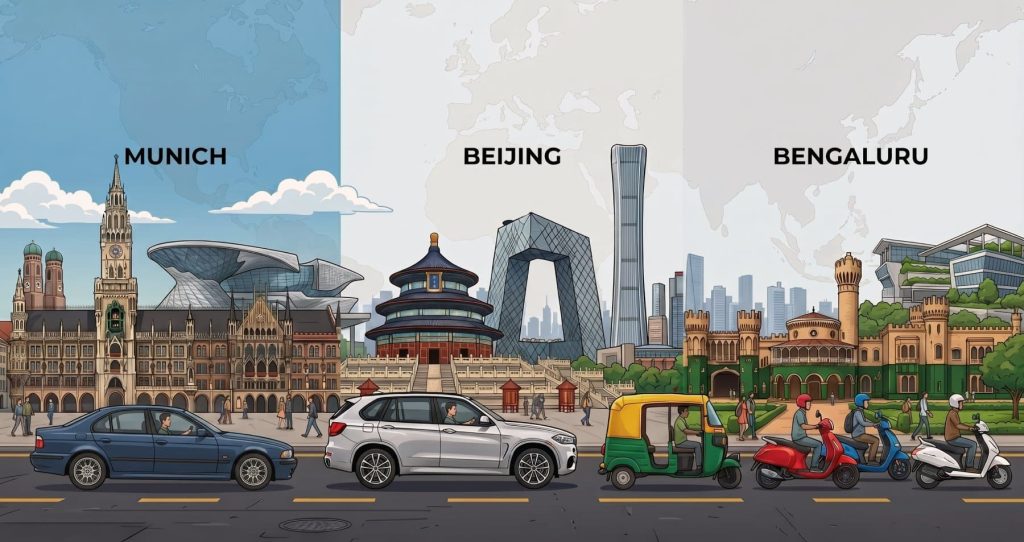

From Munich to Beijing to Bengaluru: Inside the EV Revolution’s India-China Corridor
May 13, 2026
Franco Bellillo, COO of Sun Mobility, discusses what it takes to build electric vehicle supply chains across the world’s three most consequential automotive markets
When Franco Bellillo arrived in China in the mid-2000s as a BMW purchasing executive, the country’s automotive industry was still learning the basics. Suppliers were missing processes, documentation was scarce, and the industrial infrastructure that Europeans took for granted just did not exist. What astonished him was the speed at which that changed. “It is like you put water on a sponge,” he recalls. “The so-called China speed — it is not just an expression. It is true.”
Over the next two decades, Franco, who prefers to be identified by his first name, saw his career trace an arc that few automotive executives anywhere can match. From powertrain purchasing at BMW in Munich, he moved to senior roles at BMW China and the BMW Brilliance joint venture, then spent five years as deputy general manager at Beijing Electric Vehicle Co. Franco crossed into India to lead purchasing at Ola Electric Mobility, a leading Indian electric two-wheeler manufacturer – before becoming chief operating officer of Sun Mobility, India’s largest EV charging station manufacturer, based in Bengaluru, where he oversees manufacturing, IT, quality, supply chain, and aftersales services.
That trajectory — Germany to China to India, across the entire EV value chain from components to charging infrastructure — gives Franco an unusual vantage point on what may be the most consequential industrial relationship of the coming decade: how India and China navigate their deep mutual suspicion to collaborate on the electric vehicle revolution that is reshaping the global automotive industry.
In an interview with CKGSB Knowledge, Franco shared candid observations drawn from working at the operational level in all three ecosystems — on what each country does well, what each needs to work on, and what a realistic partnership between India and China might look like.
Franco describes the differences between Europe, China, and India through the daily realities of running a manufacturing operation. In Europe, he says, everything is documented, every process has an owner, and systems are stable. “You give a task to Mr. Smith, and he will do it. There is not even a discussion.”
China, by contrast, had to invent those systems from scratch — and did so with breathtaking speed. Franco watched Chinese suppliers evolve from rudimentary operations to world-class producers in the space of a few years, driven by an extraordinary willingness to learn, a seemingly limitless appetite for investment, and generous government subsidies. “There was never a discussion about investment,” he says. “Businesses are coming, we have to invest — they invest.”
India, he notes, is different. The hunger to build and grow is palpable — Franco says he has never seen so many self-driven entrepreneurs in any country — but the financial resources are thinner, the subsidies far less generous, and the cost sensitivity intense. He invested in a laser welding machine at Sun Mobility, whose return on investment came out to 12 years. “Under European logic, there would have been no discussion; we would have done that,” he says. “When I saw the numbers in India, I was like, okay, we have good reasons to do it — improved quality, improved security, more reliability. But considering purely financial aspects, 12 years is a long time.”
One challenge Franco has seen in Indian companies is what he calls a weak “memory of the company.” People tend not to document what they do, so when a key employee leaves, institutional knowledge leaves with that person. “When Rajiv leaves, his whole knowledge is gone,” he says. “Rajiv never explained to anybody how he managed things. Everybody has to start again from zero.”
The Supplier Landscape: Strengths and Gaps
Having managed purchasing in both the Chinese and Indian EV ecosystems, Franco offers a precise comparison. In China, he says, you have a choice of not one, two, or three suppliers for any given component but 100, sometimes so many that competition becomes unhealthy. India’s supplier base is strong in mechanical work: stamping, metalworking, harness assemblies, and motorcycle frames, where labor intensity is an advantage rather than a limitation. But in advanced electronics — cells, battery management systems, power electronics, and especially printed circuit boards — India lags behind.
“When you need eight-layer PCBs, Indian suppliers say, we cannot do it in three weeks,” Franco explains. “And then you end up with a Chinese supplier because they are able to do that. It’s sometimes frustrating, even when you want to support local companies.” Yet he is not pessimistic. He points to the semiconductor ecosystem that has grown around Foxconn’s presence in India, and to emerging Indian battery manufacturers like Exide and Amara Raja that are beginning to invest. “It’s not that they are not able to,” he says. “They are building up.”
What India needs most urgently, in Franco’s view, is not technology but infrastructure. China offers industrial sites with everything built in — energy, connectivity, high-speed cables — and clusters them strategically. India’s industrial clusters exist in places like Chennai and Pune, but they are fewer, more scattered, and less well served. “Infrastructure is one of the biggest factors needed to bring the country forward,” he says.
Joint Ventures: The Trust Equation
On the politically sensitive question of Chinese investment in India’s EV sector, Franco draws a lesson from China’s own history: the joint venture model works, if it is set up correctly. India’s government rejected BYD’s direct investment proposal but approved the JSW-SAIC joint venture for MG Motors. Franco thinks this approach makes sense, noting that China itself grew its automotive capabilities through joint ventures with Western manufacturers. But he is emphatic that the partnership must be balanced. “It should not be that the Indians are doing only the assembly because they are cheap,” he says. “There should be a vision: maybe we can develop a new brand together for the Indian market. I bring in some knowledge from EV, you bring in the labor force, but the new product we develop jointly, and we share the IPs.”
Franco offers examples from his BMW China experience. Some joint venture partners, like SAIC, learned aggressively and eventually developed their own competitive strategies. Others — including BMW’s own partner, Brilliance — simply cashed the monthly checks without trying to absorb any knowledge. “They had no interest,” Franco recalls. “They were only counting the money.” Geely and SAIC, by contrast, copied at first but then invested in understanding and evolved into independent companies with their own strategies.
Franco also makes a shrewd observation about branding. MG Motors is well-received in India despite its Chinese ownership, precisely because of its English brand heritage. A Chinese-branded vehicle, he suggests, would face far more consumer resistance. This creates strategic possibilities: a jointly developed brand could be marketed under a Chinese name in markets where that carries weight, and under an Indian name in markets more receptive to Indian products.
Technology Transfer Is a Trust Story
Franco’s most passionate observations center on trust — or the lack of it — between Indian and Chinese partners. “Technology transfer is built on trust,” he notes. “At the end of the day, it’s a trust story.”
Both sides carry deep-seated suspicion, rooted in decades of geopolitical friction. Chinese companies worry that Indian partners are only interested in extracting intellectual property. Indian companies fear that Chinese partners will keep them confined to low-value assembly work. Franco, a European who has spent years in both countries, often finds himself serving as a bridge. “Chinese companies see a foreign face in an Indian company and say, okay, if he’s there, the company cannot be so bad. And the Indians say, he’s lived in China for years, so he must have trustworthy relationships with the Chinese.”
Franco recounts how one of Sun Mobility’s Chinese suppliers arrived with deep distrust born of bad past experiences in India — poor communication, undisclosed quality issues, and relationships that deteriorated into legal conflicts. By contrast, another Chinese supplier has worked with Sun Mobility for four years without a single conflict, because both sides were willing to communicate openly, acknowledge mistakes, and find compromises. “Now it is like meeting friends,” Franco says.
A BMW lawyer once gave him advice he has never forgotten: you make a contract and put it in your drawer. “Because the moment you pull it out and give it to me,” the lawyer told him, “your project is gone. Then we are talking about law, not business.” The practical barriers remain significant. India still does not grant visas easily to Chinese nationals, making it difficult to build the kind of personal relationships that underpin successful technology partnerships. “A beer in the evening is more helpful than 20 hours of meetings,” Franco observes.
Battery Swapping: A Commercial Story
As COO of Sun Mobility, Franco has a practitioner’s perspective on one of the most debated questions in the EV industry: why battery swapping has scaled so much faster in China than in India, and whether the model can work in a very different market. His answer is refreshingly unsentimental. Battery swapping, he says, is a purely commercial proposition. Private car owners who can charge at home have no reason to drive to a swapping station. “I always say, if you had your fuel station in your garage, why would you drive to an Indian Oil [gas station]?” The business case is in commercial fleets: delivery riders, logistics companies, and three-wheeler operators who cannot afford the downtime of charging.
The numbers are compelling. Amazon’s delivery fleet using Sun Mobility’s battery swapping went from 13-hour working days to 18 hours, simply because vehicles no longer sat idle during charging. “For them, it’s just a commercial story,” Franco says. “They can have an additional driver in the same period of time.”
India’s dominance in two- and three-wheelers — which account for roughly 85% of the country’s EV market — plays to Sun Mobility’s advantage. Its batteries are two kilowatt-hours, compared with the 50 to 60 kilowatt-hours needed for a passenger car. The investment per station is modest, the infrastructure requirements are light — Sun Mobility’s stations are unmanned and need little more than a power connection and a shelter — and the economics work at a scale that would be impossible for larger vehicles.
Even NIO, China’s leading battery-swapping company for passenger cars, has shifted its stations from city centers to highways, because urban drivers charge at home. The commercial two-wheeler market, Franco argues, is where swapping has its deepest and most durable advantage.
Tariffs, New Alliances, and the World Beyond America
Franco views the disruption caused by US tariffs and export controls with strategic optimism. “Donald Trump is an eye-opener,” he says. “His administration shows that new alliances should be made.”
He points to a simple but powerful arithmetic: India and China together represent more than half the world’s population and a combined GDP that rivals the United States. “Sometimes America can be happy that India and China are not cooperating so well,” he says, “because this would be by far the biggest market in the world.”
The global supply chain, he observes, is already diversifying. Companies are moving away from single-source dependence on China, spreading their supplier bases across Malaysia, Indonesia, and India. The BRICS framework offers a platform. Europe, India, and China together would represent an enormous market with complementary strengths: European standards and technology, Indian labor and entrepreneurial energy, and Chinese manufacturing scale and speed.
Yet Franco notes that Indian companies often remain instinctively local in their sourcing, reluctant to look beyond their borders. “Can we not do it locally?” he hears constantly. “I think this is deep in the culture.” As Indian companies grow and need access to technologies not yet available domestically, this inward orientation will become a constraint.
Ten Years Ahead
Looking a decade out, Franco is confident that India will become the world’s largest electrified two- and three-wheeler market, and a source of considerable innovation in that segment. Costs will rise as the country develops, and that is healthy.
The single most important thing India should learn from China, he says, is the value of standardization and ecosystem building — and the pragmatism to adopt what works rather than reinventing everything from scratch. The first time Franco drove on a Chinese highway, it felt like Germany. He later learned why: China had copied German highway regulations one-to-one, because they studied where the safest highways in the world were and simply adopted the standard. “No ego,” he says admiringly. “When it makes sense, they do it.”
What India should not copy is China’s tendency toward overcapacity. The flood of investment that propelled China’s EV industry is now creating a shakeout, with too many competitors fighting for market share and a painful wave of company failures ahead.
And India, Franco believes, has one opportunity that could be transformative: the chance to leapfrog conventional power generation entirely. With abundant sunshine and a grid infrastructure that already struggles — his generator in central Bengaluru kicks in at least once a day — India could skip the power plant era and move directly to distributed solar energy and battery storage, much as Africa leapfrogged landline telephones to go straight to mobile. “This would put the country in an incredibly independent position,” he says.
At the heart of all these possibilities, though, is the human dimension that Franco returns to again and again. Indians are extraordinarily creative and entrepreneurial, but sometimes struggle with process discipline. Chinese companies are fast and pragmatic, but can be opaque partners. Europeans have mature systems, but have lost some of their competitive hunger. The countries that learn to combine their complementary strengths, while managing their mutual suspicions, will shape the global automotive industry for a generation. “At the end of the day,” Franco says, “it’s about the people, not about anything else.”
Enjoying what you’re reading?
Article Subscribe (1)
CKGSB Report



Related Articles
Our Programs

Emerging Tech Management Week: Silicon Valley
Global Unicorn Program Series
In partnership with UC Berkeley College of Engineering
This program equips participants with proven strategies, cutting-edge research, and the best-in-class advice to fuel innovation, seize emerging tech developments, and catalyse transformation within your organization.
LocationUC Berkeley
Date01 - 06 Nov, 2026
LanguageEnglish

Asia Start: AI + Digital China Expedition
Asia Start provides entrepreneurs and executives with unparalleled access to Asia’s dynamic digital economy and its business ecosystems, offering the latest trends and insights, strategies, and connections to overcome challenges and unlock future growth for your business in Asia and beyond.
LocationChina (Beijing, Shanghai, Hangzhou & optional Shenzhen)
DateNovember 2–7, 2026 | April 19–24, 2027
LanguageEnglish

Intelligent China: AI, EVs & Smart Manufacturing
Participants may join the full 12-day series or select individual programs based on their interests and priorities.
LocationBeijing
Date12 Days
LanguageEnglish

Emerging Markets: Innovation and Scaling for Exponential Growth – ASEAN
Learn China's AI and innovation strategy from its leading thinkers — brought to you in Jakarta, with an optional immersion in China — and connect with the business leaders driving it.
LocationJakarta, Indonesia
Date2–4 December 2026
LanguageEnglish (with Chinese translation)

Stanford & Silicon Valley Immersion Program
Global Unicorn Program Series
In partnership with Stanford Engineering Center for Global & Online Education
This CKGSB program equips entrepreneurs, intrapreneurs and key stakeholders with the tools, insights, and skills necessary to lead a new generation of unicorn companies.
LocationStanford University Campus,
California, United States
Date06 - 11 Dec, 2026
LanguageEnglish with Chinese Translation