

Where Chinese Students Are Going in 2026 (It’s not the US)
May 26, 2026
Chinese students are looking beyond mere prestige when choosing to study overseas
Chinese students are no longer limiting their overseas study choices to the prestigious universities of the US and UK
The number of mainland Chinese applicants to Hong Kong universities is skyrocketing, driven by a desire to gain an international education while remaining in a familiar environment closer to home rather than the previous dream of Harvard and Oxford.
And it is not just universities, Hong Kong schools are also inundated with applications from mainland China. Oliver Kramer, Head of School at Hong Kong’s prestigious ISF Academy says they are attracted by Hong Kong’s reputation for having one of the highest education standards in Asia. “We have seen a lot of parents pivoting away from overseas destinations such as the US and UK,” he says. On top of that, Hong Kong is convenient and offers a familiar cultural environment for students. “It takes an hour by car from Hong Kong to get to mainland China, so there is this ideal compromise of an international education and a local connectivity,” he says.
This wave of students heading for Hong Kong, Singapore, Malaysia and other locations reflects a broader shift underway in China’s outbound education market. While the United States, United Kingdom, Australia and Canada still host the majority of Chinese students overseas, the numbers have been dropping dramatically, creating a huge financial pressure for educational institutions.
The shift reflects a mix of shifting attitudes towards the outside world and changing perceptions about whether expensive overseas degrees from more typical prestigious universities of the US and UK still guarantee stronger career returns.
“The era of overwhelming US dominance in Chinese outbound education is likely over,” says Henry Wang, Founder and President of the Center for China and Globalization (CCG). “We will see a more multi-destination model, with students spreading across North America, Europe, Asia and also increasingly considering joint programs, short-term exchanges and transnational education.”
From prestige to diversification
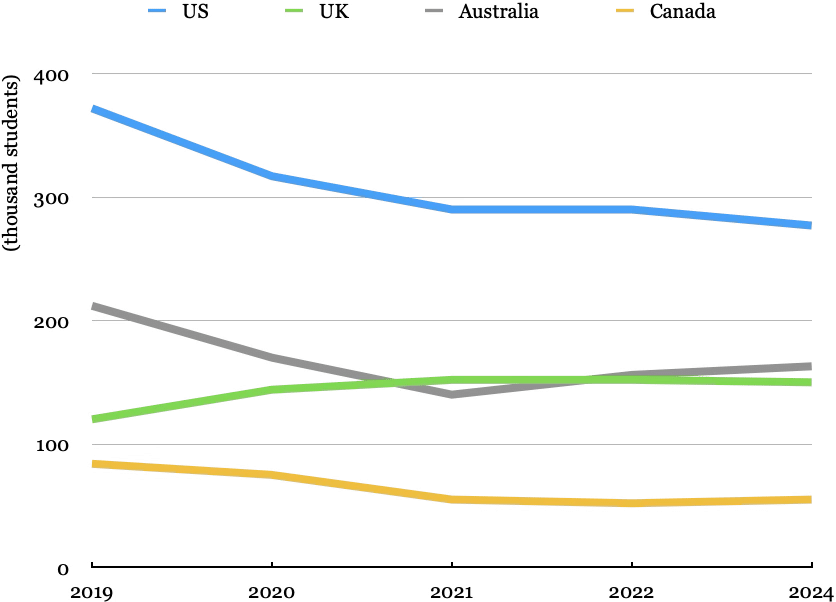
China has been the world’s largest source of international students for more than a decade. According to China’s Ministry of Education, in 2019, 703,500 Chinese students were studying abroad. However, that number dropped to 570,000 in 2025.
Despite slower growth after Covid-19, Chinese demand for overseas education remains enormous. Chinese students still represent the single largest international student cohort in several major destinations, including the United Kingdom and Australia, and remain among the top groups in the United States and Canada.
The traditional “big four” destinations—US, UK, Australia and Canada—still dominate numerically. The US alone hosted more than 270,000 Chinese students in the 2024–2025 academic year according to Open Doors data, while the UK enrolled well over 150,000 Chinese students. Australia reported roughly 160,000 Chinese enrollments in 2025, making China its largest international student market by a considerable margin.
But growth is increasingly shifting elsewhere. Hong Kong, Singapore, Malaysia, Japan and several European countries have all seen rising interest from mainland Chinese students seeking lower costs, shorter travel distances and more predictable political environments.
For much of the past two decades, the US and UK represented the gold standard for Chinese students seeking overseas education. Strong university rankings, post-study work opportunities and the enduring appeal of the “American dream” reinforced their dominance.
“International tuition fees can be up to five times higher than domestic fees,” says Franklin Allen, Professor of Finance and Economics at Imperial College London. “That is why universities are highly incentivized to recruit international students.”
Universities in traditional destinations remain deeply reliant on Chinese students. “We still rely significantly on Chinese students,” says Allen. “India is growing rapidly, but in some master’s programs, Chinese students still make up half the class.”
China’s outbound education market expanded rapidly through the 2000s and 2010s. Beyond the US and UK, countries such as Canada and Australia also saw strong growth, benefiting from comparatively welcoming immigration policies and clear post-study work pathways.
But the pandemic disrupted that model. Border closures, visa uncertainty and the rise of remote learning forced many students and families to rethink where—and whether—to study abroad.
Australia’s strict border controls during the pandemic, in particular, became a turning point for some students. At the same time, geopolitical tensions between China and Western countries began to reshape perceptions of safety, predictability and long-term opportunity.
Hangzhou high school student Laura Zhu thought Australia would be her safest path overseas. Instead, the 17-year-old is now leaning toward Malaysia—drawn by lower costs, English-language teaching and a cultural environment that feels closer to home. But what once seemed like the “budget option” for Chinese students is rapidly becoming more competitive. After University of Malaya tightened admission rules for Chinese applicants, students like Zhu are rethinking old assumptions about Southeast Asian education. “Studying abroad shouldn’t just be an escape route,” she says. “If you go overseas, you still need to prove yourself academically.”
“The shift reflects a clear ‘one-two punch’,” says Dr Rahul Choudaha, an analyst of international student mobility at DrEducation Research. “First, the pandemic disrupted global student mobility, and just as recovery began, geopolitical environment shifted.”
Emerging Asian hubs gain ground
As global mobility resumed, a wider range of countries began competing aggressively for Chinese students, offering lower costs, flexible visa policies and English-language programs.
Asian destinations such as Singapore, Malaysia, Thailand and particularly Hong Kong have benefited from geographic proximity, cultural familiarity and lower living costs.
For many mainland Chinese families, Hong Kong occupies a unique middle ground between domestic and overseas education. The city offers internationally ranked universities, English-language teaching and global academic exposure while remaining physically and culturally close to home.
“Countries such as Germany, Italy, France as well as a growing number of Belt and Road partner countries such as Malaysia, Singapore, Thailand, Belarus are becoming more attractive because of relatively lower costs, closer geographic and cultural ties, easier visa pathways, good universities and in some cases stronger post-study work opportunities,” says Wang.
Japan and South Korea have also seen strong increases in Chinese enrollments in recent years, supported by growing interest in technology industries, entertainment, design and regional business integration. In Europe, Germany and France have benefited from relatively affordable tuition compared with Anglo-American universities.
Hong Kong has emerged as one of the biggest beneficiaries of the diversification trend. Mainland Chinese students now make up a substantial share of enrollments at several of the city’s leading universities, including The University of Hong Kong, The Chinese University of Hong Kong and Hong Kong University of Science and Technology.
The city’s appeal has grown further amid geopolitical tensions between China and the West. For some students, Hong Kong provides international exposure without the uncertainty associated with Western visa systems or rising anti-China political sentiment overseas.
A more pragmatic calculation
The reasons Chinese students study abroad are also evolving.
Twenty years ago, an overseas degree often represented a direct path toward better jobs, higher salaries and potential migration opportunities. Today, many Chinese families are approaching overseas education far more pragmatically.
“There has been a noticeable change in how Chinese students perceive the US and the West more broadly,” says Wang. “Twenty or thirty years ago, studying in the West was often seen as a one-way path to advanced knowledge, better opportunities and sometimes permanent migration. Today, Chinese students are more confident, pragmatic and globally aware.”
That does not mean Western universities have lost their appeal. But students are increasingly weighing prestige against costs, career returns and quality of life.
Visa and immigration policies have become increasingly important in shaping those perceptions.
“The visa and immigration environment has clearly affected perceptions,” says Henry Wang. “For students and families, uncertainty itself is a cost.”
“Compared with other destinations, the United States still offers outstanding academic opportunities, but it is increasingly perceived as less predictable in terms of visa policy, post-graduation employment and long-term settlement prospects,” he adds.
The numbers increasingly reflect those concerns. According to Open Doors, Chinese student enrollment in the United States has fallen significantly from its 2019 peak of roughly 370,000 students. Meanwhile, growth has accelerated in parts of Asia.
Hong Kong’s universities in particular have stepped up recruitment efforts targeting mainland students and international talent. Several Hong Kong institutions climbed global rankings in recent years, reinforcing the city’s image as a high-quality regional education hub.
According to analysis by Dr Choudaha using US Department of State data, Chinese enrollment in US bachelor’s, master’s and doctoral programs declined nearly 30% between 2020 and 2026.
At the same time, some governments are becoming less enthusiastic about international students transitioning into long-term migrants.
Canada, once viewed as one of the most welcoming destinations for Chinese students, has tightened immigration policies in response to mounting domestic pressure over housing and public services.
Australia and the UK remain highly attractive, but both countries have also debated tighter immigration rules and caps on international students. That has reinforced perceptions among some Chinese families that shorter-distance Asian options may offer greater long-term stability.
For public institutions heavily dependent on international tuition revenue, the consequences are already visible. Manitoba Institute of Trades and Technology announced in January 2026 that it would wind down operations after federal permit caps contributed to a 55% drop in international student numbers.
Does overseas study still pay off?
Rising costs are also changing the equation.
“While study abroad remains an aspiration for many students and families, it is becoming an increasingly expensive proposition, driven by inflation, higher living costs, and rising tuition fees for international students,” says Dr Choudaha.
At the same time, overseas degrees no longer guarantee career success in the way they once did.
“In the early 2000s, a foreign degree often gave graduates a clear advantage in China’s job market,” says Wang. “Today, the situation is more complex.”
“A foreign degree alone is no longer a guarantee of a better job,” he adds. “Employers in China have become much more sophisticated. They look at the quality of the university, the student’s major, actual skills, work experience, adaptability and whether the candidate understands both China and the world.”
The graduate job market itself has also become increasingly competitive.
Research from Peking University’s National School of Development found that overseas master’s graduates are 16.2% less likely to receive interview invitations than comparable domestic graduates, although that gap narrows after several years of work experience.
For many students, the value of overseas education is therefore becoming less about obtaining a foreign diploma and more about developing international experience, cross-cultural communication skills and global networks.
“The deeper value lies in broadening one’s horizons, developing cross-cultural communication skills, understanding different societies from within and cultivating a truly global outlook,” Wang says.
For many Chinese students, overseas education also represents a way to temporarily step outside China’s increasingly crowded domestic job market. China is expected to produce more than 12 million university graduates in 2026, intensifying competition for white-collar employment at a time of slower economic growth and weaker hiring demand in several sectors.
The AI factor
Artificial intelligence is also beginning to shape how students think about overseas education. Indeed, universities worldwide have seen a sharp rise in enrollment for AI-related majors, with Chinese students remaining one of the largest overseas applicant groups even as Beijing simultaneously expands domestic AI education capacity.
Students are increasingly choosing majors with long-term technological relevance, including AI, robotics, semiconductors, data science and digital finance.
“Many Chinese students are becoming more strategic in selecting majors,” says Wang. “There is rising interest in AI, computer science, data science, robotics, automation, semiconductor-related fields, digital finance and intelligent manufacturing.”
At the same time, AI is reshaping traditional disciplines.
“Business students now need data and technology literacy. Law students are paying more attention to AI governance, digital regulation and intellectual property,” Wang says. “Even humanities and social science students are thinking about how AI will affect communication, education, media and cultural industries.”
For universities themselves, the rise of AI is creating pressure to adapt curricula and better prepare students for a changing labor market.
“It’s clear that AI is going to transform the world of work and will become increasingly central in all areas of life,” says Jamie Arrowsmith, Director of Universities UK International. “It’s imperative that the programs available to students adapt and reflect this reality.”
A more fragmented future
The era when Chinese students funnelled overwhelmingly into a small group of Western universities is giving way to a far more fragmented and competitive landscape.
Traditional destinations such as the US and UK are unlikely to lose their importance entirely. Their universities continue to dominate global rankings and retain enormous research strength and prestige. But they are now competing with a broader range of destinations that offer lower costs, easier visas, stronger migration pathways and greater cultural familiarity.
For students, decision-making is becoming increasingly pragmatic.
“Chinese students are increasingly aware of this,” Wang says. “They are not only asking which major is popular today, but which skills will remain valuable in ten or twenty years.”
Overall, Chinese students are not abandoning traditional Western education hubs altogether. The US, UK and Australia still account for hundreds of thousands of Chinese enrollments and continue to dominate the upper tier of global university rankings.
But the market is no longer concentrated in the way it once was. Asian education hubs—particularly Hong Kong and Singapore—are capturing a growing share of demand, while Europe is increasingly benefiting from students seeking lower costs and diversified career pathways.
The old model, where prestige alone dictated destination choices, is steadily giving way to a broader, more diversified and more strategic global education landscape.
Enjoying what you’re reading?
Article Subscribe (1)
CKGSB Report




Related Articles




Related Articles
Our Programs

Scaling Innovation: AI and Digital Strategies for Business Transformation
Global Unicorn Program Series
In partnership with Columbia Engineering
This program is designed to equip senior executives with the strategic insights and tools necessary to lead in this transformative era.
LocationNew York, USA
Date27 Sep - 02 Oct, 2026
LanguageEnglish

Emerging Tech Management Week: Silicon Valley
Global Unicorn Program Series
In partnership with UC Berkeley College of Engineering
This program equips participants with proven strategies, cutting-edge research, and the best-in-class advice to fuel innovation, seize emerging tech developments, and catalyse transformation within your organization.
LocationUC Berkeley
Date01 - 06 Nov, 2026
LanguageEnglish

Asia Start: AI + Digital China Expedition
Asia Start provides entrepreneurs and executives with unparalleled access to Asia’s dynamic digital economy and its business ecosystems, offering the latest trends and insights, strategies, and connections to overcome challenges and unlock future growth for your business in Asia and beyond.
LocationChina (Beijing, Shanghai, Hangzhou & optional Shenzhen)
DateNovember 2-7, 2026
LanguageEnglish
Stanford & Silicon Valley Immersion Program
Global Unicorn Program Series
In partnership with Stanford Engineering Center for Global & Online Education
This CKGSB program equips entrepreneurs, intrapreneurs and key stakeholders with the tools, insights, and skills necessary to lead a new generation of unicorn companies.
LocationStanford University Campus,
California, United States
Date06 - 11 Dec, 2026
LanguageEnglish with Chinese Translation