
Connecting up the country: China’s high-speed rail
May 28, 2026
China’s most iconic infrastructure project prioritizes connectivity over profitability
As China continues expanding its most iconic infrastructure project, questions arise over whether connectivity and integration can outweigh mounting debts
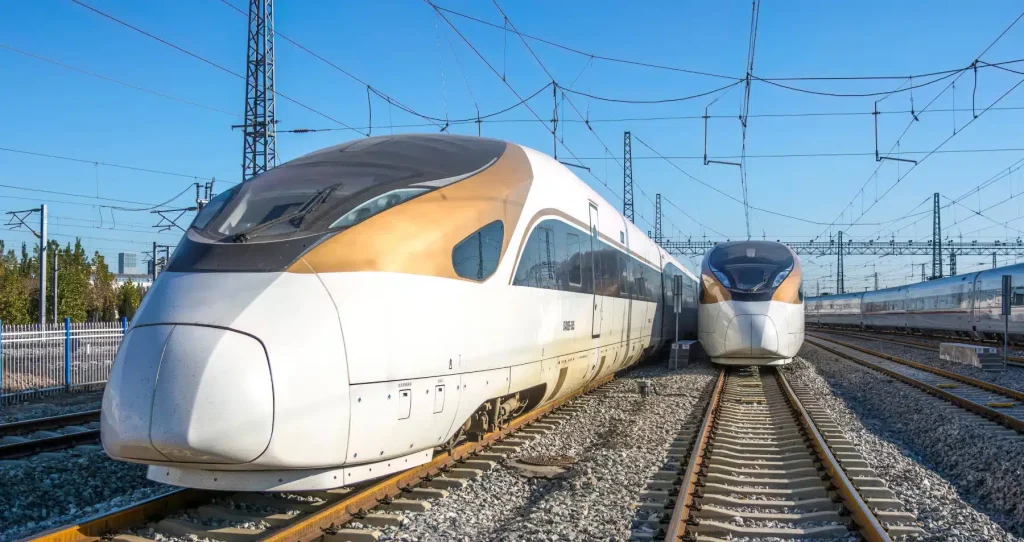
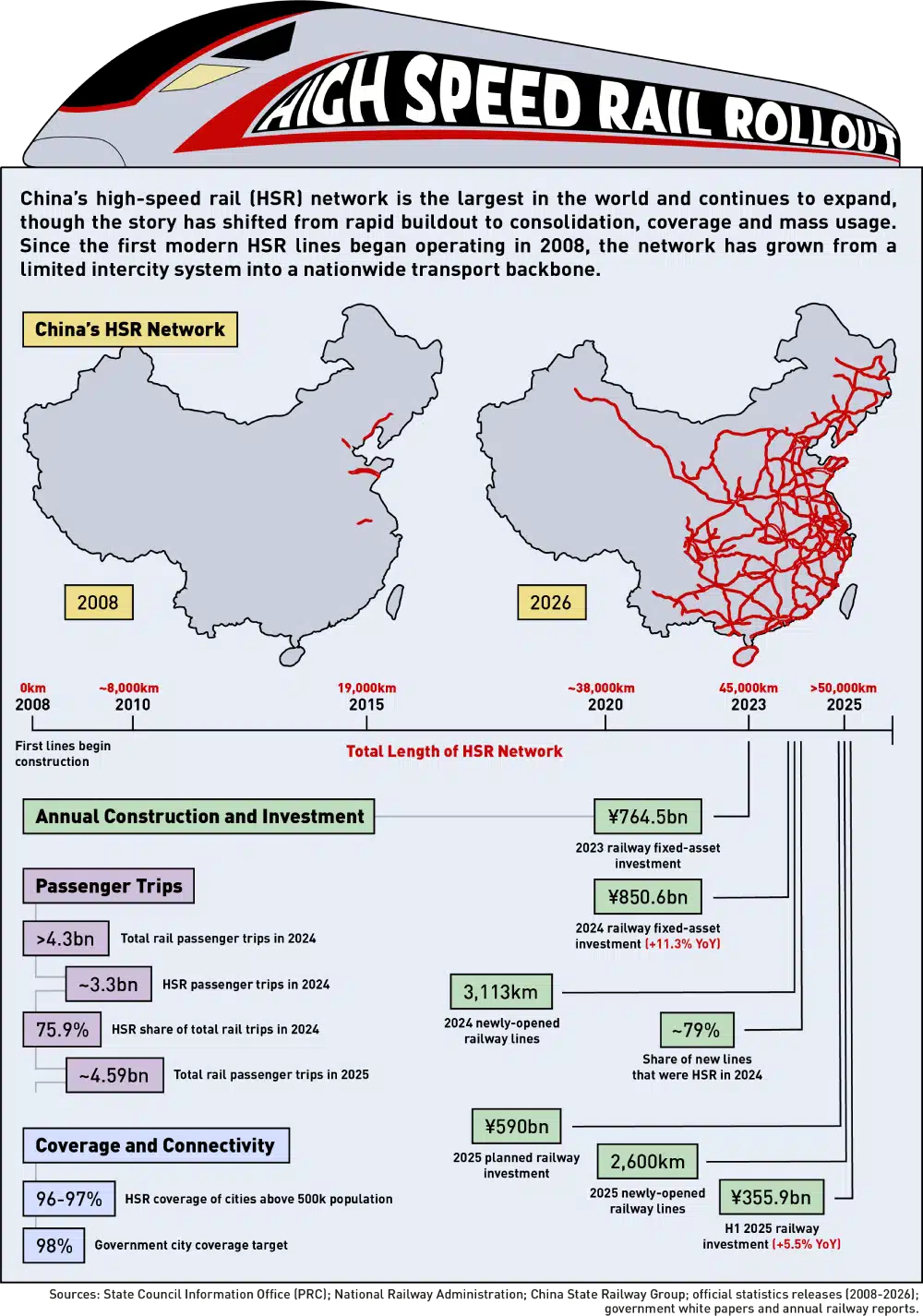
Nothing symbolizes the rise of modern China more than its high-speed rail network. More than 45,000 kilometers of track constructed in less than 20 years are already in operation—more than the rest of the world combined. The network has transformed domestic travel, turning journeys that once took days into trips of just hours, and facilitated the mobility of the population in a way never before seen.
And Beijing is not slowing down. In recent months, authorities have announced fresh expansion plans targeting inland and western provinces, regions where passenger demand is weaker and profitability far less certain. The move reflects a shift by policymakers away from purely commercial logic and toward infrastructure as a tool for regional integration and long-term development.
China’s high-speed rail (HSR) system is renowned for its scale, speed and efficiency, but the operator behind it, China State Railway Group, remains burdened with debts exceeding ¥6 trillion ($830 billion). Critics question whether the model is financially sustainable, while supporters argue its value lies not in ticket revenues, but in the broader economic ecosystems it creates.
“China’s railways are increasingly being treated as critical national infrastructure, similar to highways or power grids,” says Dylan Brady, Assistant Professor at the National University of Singapore. “The point is not necessarily that every line turns a direct profit.”
Building a national network
China’s first high-speed rail went into operation in 2008, from Beijing to Shanghai., as part of a broader infrastructure-led growth strategy designed to stimulate investment, improve productivity and bind together an increasingly urbanized economy. While also as a side benefit, it helped to bolster GDP growth.
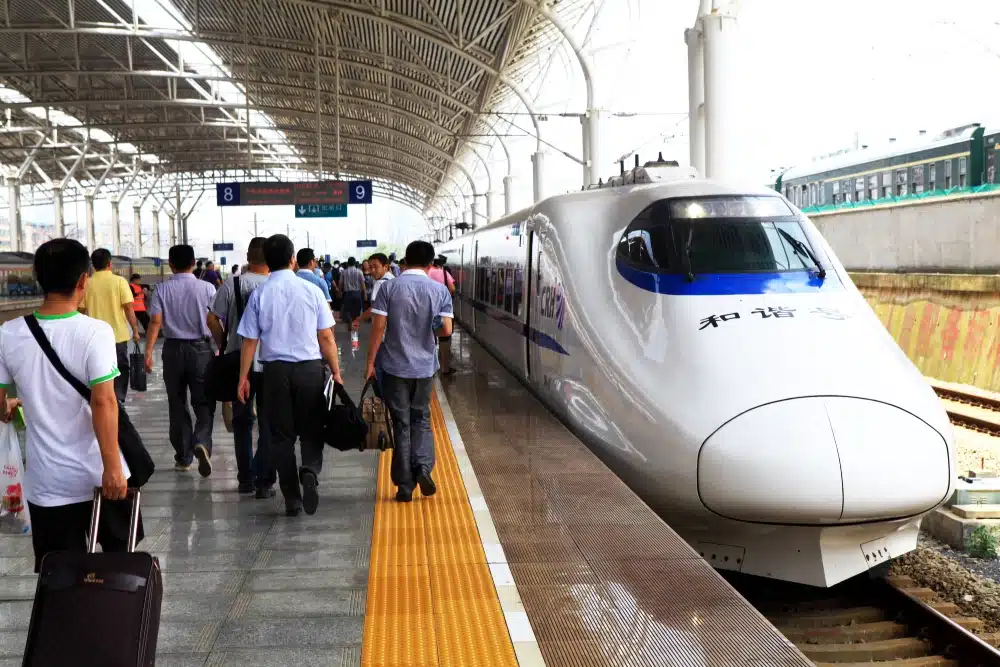
Today, the system connects nearly every major Chinese city, with trains routinely traveling at speeds between 250 and 350 kilometers per hour. The flagship Beijing-Shanghai line has become one of the busiest and most commercially successful rail corridors in the world, helping to cement HSR as one of Beijing’s most visible technological achievements.
But China’s latest phase of expansion reflects a very different logic from the early years of the network.
“The economic viability of high-speed rail depends less on engineering and more on whether there is enough concentrated demand at either end of the line,” says John Gibson, Professor of Economics at the University of Waikato, who’s research has focused on China’s rail network.
“In China’s coastal regions, HSR helps reinforce the emergence of large metropolitan areas, where dense networks of firms and workers benefit from proximity” he says. “But the same transport infrastructure has been much less successful inland, where population densities are lower and economic activity is more dispersed.”
That shift is clear from Beijing’s expansion plans. Policy makers are shifting focus to western provinces and smaller urban clusters where demand is weaker, but development needs are greater.
Officials frame the expansion as part of a regional rebalancing strategy aimed at narrowing the economic gap between coastal and inland China. The goal is not simply to move passengers more quickly, but to integrate regional economies and encourage investment into areas that have historically lagged behind.
The limits of profitability
But China’s rail network faces persistent financial challenges. Many routes struggle to cover operating costs, particularly those running through sparsely populated regions. Construction costs are enormous, often exceeding ¥100 million ($13.8 million) per kilometer depending on terrain and engineering complexity.
“HSR is fundamentally a system for moving people rather than goods, and that matters for its economics,” Gibson says.
“In lower-density regions there are simply fewer passengers to fill trains, so it is much harder for new lines and connections in those areas to generate strong economic returns.”
This issue will be further compounded by China’s demographic troubles. As the country’s workforce shrinks and automation expands, demand for passenger rail may weaken in regions already experiencing population decline.
“One part of China’s response to a shrinking workforce is increasing automation, especially industrial robots,” Gibson says. “Factories can continue operating inland, but robots do not travel because they have no family to visit during Spring Festival.”
He also warns that improved connectivity can sometimes accelerate outmigration rather than reverse it.
“Declining regions like China’s Northeast, which are already in demographic decline, may actually lose people faster once high-speed connections make it easier for residents to move to more dynamic cities,” he says. “This hollowing out can retard local economic development.”
Yet despite the weak financial returns of many lines, Beijing continues to build. That is because supporters of the network argue its value cannot be measured solely through railway profits.
Beyond ticket sales
The strongest defense of China’s HSR system lies in its indirect economic impact. High-speed rail has dramatically reduced travel times between cities, boosting labor mobility, tourism and business connectivity. It has also helped integrate some of China’s largest economic clusters, including the Yangtze River Delta and the Greater Bay Area.
The benefits of this are much harder to quantiy, but many economists view them as the real justification behind continued expansion. A World Bank analysis of China’s HSR network found that improved connectivity increased market access, boosted productivity and strengthened regional economic integration, particularly in major urban clusters.
Supporters argue that rail connectivity can attract investment, increase access to labor markets and improve economic integration between cities. In some cases, local governments view HSR stations as catalysts for entirely new urban districts.
China is not alone in grappling with the economics of high-speed rail. Internationally, only a handful of systems have consistently generated strong financial returns.
Japan’s Shinkansen network is often regarded as the global benchmark for profitability, largely because it focuses on dense routes with exceptionally strong passenger demand. South Korea’s KTX system occupies a middle ground, with core corridors performing well while regional lines rely more heavily on government support.
Meanwhile, Western Europe has developed fragmented cross-border networks that often struggle with inconsistent planning, regulatory differences and uneven passenger demand.
China’s model differs because profitability has increasingly become secondary to broader strategic goals.
Can China export the model?
Beijing has attempted to export its HSR expertise through the Belt and Road Initiative, promoting rail projects across Southeast Asia, Eastern Europe and beyond. But overseas expansion has produced mixed results.
“High-speed rail is difficult to export,” Brady says. “All technologies are, actually, but HSR even more so than most.”
He argues that HSR is not simply a piece of infrastructure, but a highly complex system involving maintenance networks, operational standards and even passenger behavior.
“Unlike most heavy machinery, everyday people walk right up to trains,” he says. “To ensure safety and efficiency, every passenger has to know how to behave properly: where to go, what to do, and how to get along.”
Brady notes that China spent decades reshaping norms and governance around railway travel domestically, replacing the overcrowded and chaotic experience associated with older “green skin” trains.
“This is a big part of why exporting high-speed rail is hard,” he says. “Even if the drivers, engineers and train attendants are exported along with the tracks and trainsets, there is still the issue of the passengers.”
Economic geography also presents a major obstacle. “High-speed rail is easy to export as infrastructure, but harder to export as an economic model because the conditions found in coastal China are not necessarily available elsewhere,” Gibson says.
He points to weakening “agglomeration economies”—the economic benefits created when firms and workers cluster together in dense urban centers—as a broader structural challenge.
“Improvements in logistics and supply chains allow production to fragment across space rather than concentrate in a few large locations,” he says. “If faster transport further reduces the need for spatial concentration, HSR could redistribute economic activity along corridors without necessarily creating the large, high-density hubs needed to sustain it financially.”
That dynamic may explain why some overseas projects have struggled to gain momentum. Many developing countries lack the dense urban corridors, financing capacity or centralized planning systems that helped underpin China’s domestic rollout. Political resistance, land acquisition issues and environmental concerns have also slowed implementation in several markets.
Indonesia’s Jakarta–Bandung “Whoosh” line, Southeast Asia’s first high-speed railway, became a warning sign for the financial risks associated with large-scale projects. Construction costs rose by roughly $1.2 billion, forcing Jakarta to provide state backing despite earlier promises the railway would operate on a purely commercial basis. By 2026, Indonesian authorities were forced to restructure billions of dollars in debt tied to the project amid continuing operating losses, while anti-corruption investigators launched probes into alleged cost inflation.
In Eastern Europe, infrastructure safety and technical compatibility have also emerged as problems. In Serbia, the collapse of a concrete canopy at Novi Sad railway station in November 2024 killed 16 people and triggered criminal investigations into officials and contractors involved in the station’s renovation. The tragedy intensified scrutiny over transparency and engineering oversight surrounding Chinese-backed rail projects in the region.
The flagship Hungary–Serbia rail corridor has meanwhile suffered repeated delays because of difficulties integrating Chinese-built systems with European signaling standards. Without full certification, sections of the line have reportedly been forced to operate at sharply reduced speeds, undermining promises of seamless high-speed connectivity between Belgrade and Budapest.
Thailand’s long-delayed Bangkok–Nakhon Ratchasima line has similarly highlighted the complexity of exporting China’s rail model. Originally expected to open in 2021, the project has been repeatedly pushed back by financing disputes, design revisions and disagreements over technology transfer and local workforce training.
Rethinking the future of travel
Despite the challenges, the HSR for Beijing is less about profitability and more an instrument of economic integration and state-building, and potentially in the future, for diplomatic relations.
At the same time, it is not a model that can be easily exported to countries which work under vastly different systems.
“I don’t see any one mode of transport as being the future of travel,” Brady says.
“Transport works best when there is a complementary set of modes which work together, compensating for each other’s weaknesses.”
That may ultimately be the broader lesson of China’s rail experiment. High-speed rail has revolutionized travel across the country and reshaped how infrastructure can support economic integration. But the system’s success depends heavily on geography, demographics and governance conditions that may not easily translate elsewhere.
China’s railways may never fully pay for themselves in a narrow financial sense. For Beijing, however, that may never have been the point.
Enjoying what you’re reading?
Article Subscribe (1)
CKGSB Report






Related Articles

Our Programs

Emerging Tech Management Week: Silicon Valley
Global Unicorn Program Series
In partnership with UC Berkeley College of Engineering
This program equips participants with proven strategies, cutting-edge research, and the best-in-class advice to fuel innovation, seize emerging tech developments, and catalyse transformation within your organization.
LocationUC Berkeley
Date01 - 06 Nov, 2026
LanguageEnglish

Asia Start: AI + Digital China Expedition
Asia Start provides entrepreneurs and executives with unparalleled access to Asia’s dynamic digital economy and its business ecosystems, offering the latest trends and insights, strategies, and connections to overcome challenges and unlock future growth for your business in Asia and beyond.
LocationChina (Beijing, Shanghai, Hangzhou & optional Shenzhen)
DateNovember 2–7, 2026 | April 19–24, 2027
LanguageEnglish

Intelligent China: AI, EVs & Smart Manufacturing
Explore how China is advancing AI, electric vehicles and smart manufacturing through faculty-led sessions, company visits and exchanges with industry leaders. Build practical insights for your organization’s strategy, partnerships and investment decisions, with the flexibility to join individual four-day programs or the full 12-day series.
LocationBeijing
Date12 Days
LanguageEnglish

Emerging Markets: Innovation and Scaling for Exponential Growth – ASEAN
Learn China's AI and innovation strategy from its leading thinkers — brought to you in Jakarta, with an optional immersion in China — and connect with the business leaders driving it.
LocationJakarta, Indonesia
Date2–4 December 2026
LanguageEnglish (with Chinese translation)

Stanford & Silicon Valley Immersion Program
Global Unicorn Program Series
In partnership with Stanford Engineering Center for Global & Online Education
This CKGSB program equips entrepreneurs, intrapreneurs and key stakeholders with the tools, insights, and skills necessary to lead a new generation of unicorn companies.
LocationStanford University Campus,
California, United States
Date06 - 11 Dec, 2026
LanguageEnglish with Chinese Translation