





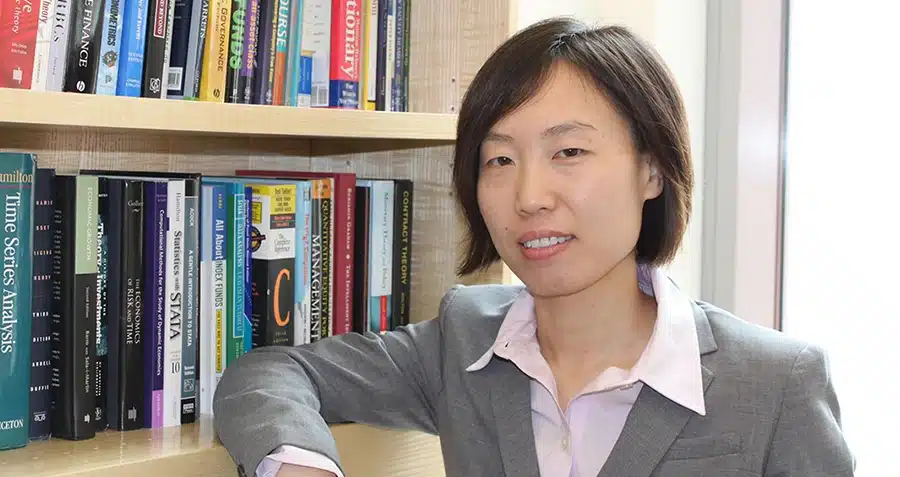

Erica Li: Role of Research and Academic Seminars for Business Schools Like CKGSB
January 23, 2026
Research is a cornerstone of CKGSB’s intellectual life. And academic seminars are platforms where good research is shared and refined. But why do they matter so much—to scholars, to the school, and ultimately to students and the broader business community?
In this Q&A, Professor Erica Li shares why CKGSB has long invested in academic seminars, how they shape a vibrant research culture, and how rigorous research thinking translates directly into impactful teaching.
Q: Why does CKGSB value research? Why is it important to host academic seminars?
Professor Erica Li: We build CKGSB as a rigorious, research-oriented business school. Therefore, from the beginning, CKGSB aimed to build a very strong academic environment. To excel in research, scholars need more than hard work and deep thinking—we also need to communicate with others, share our research, and learn what others are doing. Academic seminars are critical to maintaining a healthy academic environment.
I would say that at least half of an academic’s job is communication, and seminars are one of the most important platforms for that exchange.
When I joined CKGSB about 13 years ago, we were one of very few schools in Beijing—and possibly in China—holding weekly academic seminars. Visiting scholars quickly learned that CKGSB was deeply committed to research and willing to invest in it. This helped establish CKGSB as a serious, research-oriented, high-quality business school.
Hosting seminars is important not only for advancing research, but also for building the school’s academic reputation.
Q: Has CKGSB’s approach to inviting speakers for academic seminars changed over time?
Professor Erica Li: Our main criterion has always been the same: high-quality research on topics that interest us.
More than ten years ago, most invited speakers came from U.S. or European institutions, largely because there were fewer internationally recognized scholars in Asia at the time. Over the past decade, academic quality in Asia—including mainland China, Hong Kong, and Singapore—has risen significantly.
Today, about one-third of our invited speakers come from Asia, while we continue to host many scholars from the U.S. and Europe.
Q: How does CKGSB support its junior professors in gaining research visibility?
Professor Erica Li: CKGSB put institutional systems in place to support its academic research.
One example is our tenure-track system. At CKGSB, junior faculty have a nine-year tenure track, compared with six years at most schools, including those in the U.S. Junior faculty are free to pursue research based entirely on their own interests. This gives them the freedom to pursue important research questions rather than focusing on projects that produce results more quickly.
In addition, junior faculty receive a one-third reduction in teaching load until tenure. To my knowledge, CKGSB is the only school in China—and globally—that offers this level of teaching reduction before tenure.
We also host regular academic seminars, which are especially important for junior faculty. Many of them are newly graduated and still building visibility in the academic community. By inviting world-class scholars to CKGSB, junior faculty can learn about cutting-edge research and also introduce their own work to others. This helps junior faculty become known in the academic community. This visibility is critical for their publication and academic recognition.
Q: Beyond seminars, how does CKGSB support faculty research?
Professor Erica Li: Research is a top priority here. In addition to a nine-year tenure track and reduced teaching loads, CKGSB provides very generous research funding.
Faculty can use these funds to attend conferences, present research, purchase data, or hire research assistants. Our research budget is several times larger than what I had when I worked at the University of Michigan prior to joining CKGSB, which is already considered well funded among U.S. schools. This shows how strongly CKGSB supports research.
Q: How does academic research influence teaching at CKGSB?
Professor Erica Li: Not all research topics can be directly used in the classroom. What matters more is the way we think about problems.
The same rigorous logic and methodology we use in research are applied to real-world questions. Even if academic papers do not appear directly related to classroom content, the reasoning behind them shapes how we teach students to analyze business and life challenges.
Q: You also conduct applied research and comment on current events. How does that support your teaching?
Professor Erica Li: As a business school professor, you need to understand what is happening in the real world. Whether I am doing academic research, producing a business sentiment index, or commenting on current events, I apply the same rigorous methodology and logical thinking.
These skills are transferable. I use the same approach to analyze academic questions and real-world problems, and that is what I bring into the classroom to address students’ practical concerns. It’s the same skill set and methodology—you simply apply them to different questions.
Through sustained investment in research, open academic exchange, and global engagement, CKGSB continues to build an environment where rigorous thinking shapes both scholarship and leadership
Enjoying what you’re reading?
Professor profile
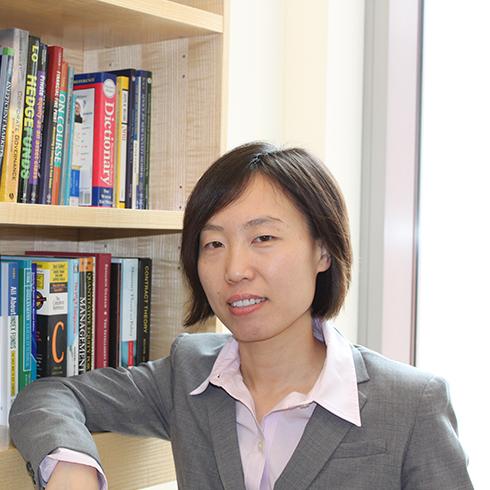
LI Xuenan (Erica)
Professor of Finance and Director of China Industrial Policy Research Center, Cheung Kong Graduate School of Business (CKGSB)
PhD's, University of Rochester and University of Massachusetts, Amherst






Related Articles



Our Programs

Opportunities in the Disruption of Traditional Industries
In partnership with The University of Sydney
Global Unicorn Program Series
The Global Unicorn Program in Disruption of Traditional Industries – presented jointly by CKGSB and University of Sydney – will emphasize Australia’s distinctive contributions.
LocationSydney, Australia
Date24 - 27 Feb, 2026
LanguageEnglish

Emerging Markets: Innovation and Scaling for Exponential Growth
Global Unicorn Program Series
A joint program by Cheung Kong Graduate School of Business and The South Africa Chamber of Commerce and Industry
LocationJohannesburg, South Africa
Date20 - 23 Apr, 2026
LanguageEnglish

AI-Driven Healthcare Innovation Program
In partnership with Johns Hopkins Carey Business School
Global Unicorn Program Series
The 2025 Artificial Intelligence (AI)-Driven Healthcare Innovation Program stands at the forefront of addressing the critical need for innovative healthcare solutions powered by artificial intelligence.
LocationJohns Hopkins University, Washington, D.C.
DateSummer 2026

Asia Start: AI + Digital China Expedition
Asia Start provides entrepreneurs and executives with unparalleled access to Asia’s dynamic digital economy and its business ecosystems, offering the latest trends and insights, strategies, and connections to overcome challenges and unlock future growth for your business in Asia and beyond.
LocationChina (Shanghai, Hangzhou, Shenzhen)
Date11 - 14 May, 2026
LanguageEnglish

Scaling Innovation: AI and Digital Strategies for Business Transformation
In partnership with Columbia Engineering
Global Unicorn Program Series
This program is designed to equip senior executives with the strategic insights and tools necessary to lead in this transformative era.
LocationNew York, USA
Date27 Sep - 02 Oct, 2026
LanguageEnglish