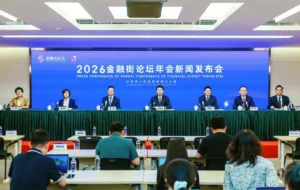
At its new Beijing campus, the school held CKGSB’s 10th Economic Symposium convening ambassadors, diplomats, business leaders and the China heads of multinationals including Merck, Siemens and Shell.
Cheung Kong Graduate School of Business (CKGSB) held its 10th Economic Symposium at its new Beijing campus, at which it also launched a new report, The New Chinese Playbook for Going Global, before an audience of ambassadors, diplomats, policymakers, Chinese business leaders and the China leadership of global companies.
The symposium drew more than 600 registrations, including executives from Fortune 500 companies such as Merck, Bayer, Johnson & Johnson, Siemens, Rolls-Royce and Samsung. Two relationships anchored the agenda: China–ASEAN, where bilateral trade passed USD 1 trillion in 2025, and China–Europe, still worth more than €700 billion in goods each year.
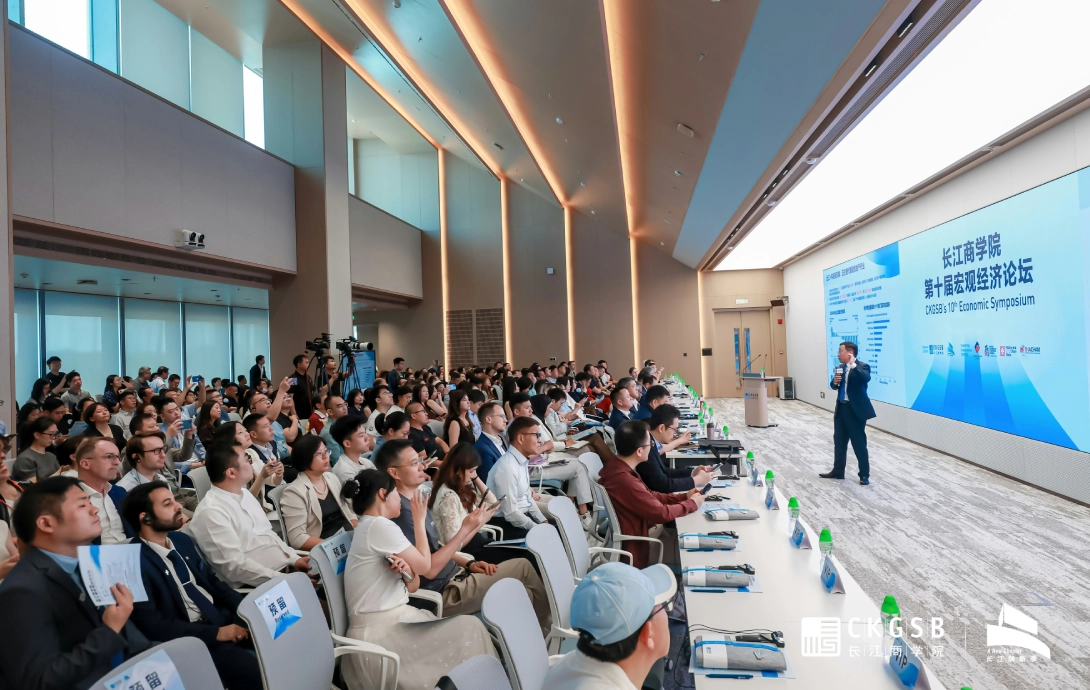
Opening the event, Li Haitao, Dean of CKGSB and Dean’s Distinguished Chair Professor of Finance, set the tone with the title of his keynote — “Setting Sail Against the Wind” — a call for Chinese companies to chart new routes against an uncertain global economic trajectory.
Dean Li argued that the engine of China’s growth has shifted. Exports and technology have replaced its earlier reliance on real estate and infrastructure, with high-technology products — electric vehicles, batteries, solar panels and wind turbines — leading export growth, and the Global South now taking more than 45% of China’s exports. He pointed to Chinese companies already succeeding abroad — BYD, the second best-selling car brand in Thailand, and Anker, which earns more than 96% of its revenue overseas — while cautioning that these markets carry their own regulatory, trade and geopolitical risks.
He believed that to go out, companies must first go in: not simply shipping products abroad, but putting down real roots and becoming genuinely global businesses, as for Chinese companies, going global is no longer an option — it is a necessity, and the ship has already set sail.
H.E. Djauhari Oratmangun, Ambassador of the Republic of Indonesia to China, focused on China–Indonesia cooperation, noting that bilateral trade reached roughly USD 168 billion in 2025. He highlighted practical steps to deepen ties — settling more trade in local currencies and linking the two countries’ QR-code payment systems — and pointed to Indonesia’s young workforce and its reserves of the strategic minerals central to the battery economy.
“The question is not whether ASEAN and China will continue to grow together. The question is how we can ensure that this growth is more innovative, more inclusive, more sustainable and more beneficial for all of our people,” said Ambassador Oratmangun. “In an increasingly fragmented world, ASEAN can serve as a bridge between developed and developing economies, between East and West, and between economic growth and sustainable development.”
At the sympsoium, Li Wei, CKGSB Professor of Economics and Associate Dean for Asia and Oceania, launched a new Chinese-language report, The New Chinese Playbook for Going Global, which draws on extensive fieldwork across Indonesia and Malaysia. He framed Chinese globalization as entering a third phase — from exporting products (1.0) and channels (2.0) to exporting capabilities (3.0) , bringing Chinese strengths in manufacturing, technology, supply-chain management and innovation into overseas markets, while building local and sustainable businesses abroad.
Professor Li distinguished large “lead firms” that take their suppliers and standards abroad in a coordinated “chain” from smaller companies that expand in “swarms” via shared digital platforms, industrial parks and overseas warehouses. Chinese competitiveness, he argued, comes not from subsidies but from the intensity of competition at home — the test that prepares companies to compete anywhere.
“Chinese companies are moving from exporting products to exporting capabilities — and that shift will define the next stage of China’s globalization,” emphasized Professor Li Wei. “The new playbook is not ‘Copy from China,’ but ‘Grow with Local.'”
He also noted that CKGSB’s Business Conditions Index (BCI), a monthly survey that gauges the business sentiment of more than 400 Chinese business leaders, marks its fifteenth anniversary in 2026. The BCI has become one of the most closely watched forward-looking indicators of China’s private businesses.
Moderated by Professor Li Wei, the first panel argued that ASEAN is becoming a complement to China rather than an alternative to it. Qu Tian, founder of ATM Capital and CKGSB alummus, cited a Singapore survey in which most Southeast Asians — and 80% of Indonesians — chose China over the United States, while WOOK founder and CKGSB alumnus Xu Longhua, a Chinese business leader who has built a business across 100,000 retail outlets in Indonesia, argued that selling products alone no longer works, and that success requires integrating Chinese capabilities with local channels. Former Chinese Ambassador to India and Kazakhstan Le Yucheng and Minister of Economic Affairs with the Embassy of Malaysia to China Unny Sankar rounded out the panel.
“What ASEAN expects is the transfer of technology and close cooperation with our small and medium-sized enterprises — it is all about shared prosperity, growing together,” explained Minister Sankar. “Given how rapidly China has grown, it matters that companies establish joint ventures with local partners, so that local firms grow alongside them.”
Moderated by Tao Zhigang, CKGSB Professor of Strategy and Economics and Associate Dean for Europe, a special ‘Dialogue with Diplomats’ weighed resilience, technology and the green transition in China-Europe relations.
Martin Matter, Counsellor and Head of the Economic, Finance and Trade Section at the Embassy of Switzerland in China, explained that “Switzerland is an open economy, and we firmly believe in free trade and fair competition.” He added that Switzerland does not have “favorite industries.” Many Swiss companies began in very small niches and eventually grew into global leaders or even “hidden champions.” “We welcome Chinese companies to take advantage of Switzerland’s openness, its geographical advantages and cultural connections to develop their European business,” urged Mr. Matter.
Finland’s Ambassador to China, H.E. Mikko Kinnunen, reflected on opportunities and challenges in relations between Finland and China as well as in the EU-China-relations.
The final panel discussion, also moderated by Professor Tao Zhigang, turned from diplomacy to the boardroom, asking why European multinationals keep investing in China despite widespread talk of “de-risking.” Merck China’s Corporate Affairs Vice President Li Ye pointed to China’s unmatched scale in clinical trials and a rapidly aging population driving demand for innovative medicine. Zhang Hong, Vice Chair of British Chamber of Commerce in China, said the force now reshaping her industry is no longer oil but electrification, as electric vehicles, data centers and AI drive electricity demand.
Across the afternoon, one thread connected the keynotes and the boardroom: as the global economy fragments, China’s next chapter of growth will be written less at home than abroad — in the markets of ASEAN and Europe. And CKGSB aspires to serve business leaders as a gateway as they navigate across China and these global markets.
The event was held with the support of the European Union Chamber of Commerce in China, the British Chamber of Commerce in China, the Swiss Chamber of Commerce in China and the Indonesian Chamber of Commerce in China.