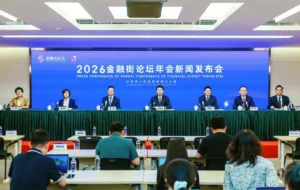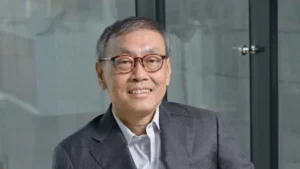
CKGSB Dean Haitao Li joins government officials and leading Chinese entrepreneurs on the forum’s main stage, while CKGSB co-hosts a dedicated New Consumption Summit exploring how brands can turn fleeting traffic into lasting customer value.
BEIJING, July 10, 2026 — Cheung Kong Graduate School of Business (CKGSB) played a key role at the 2026 Wangfujing Forum in Beijing as the only academic institution on the main stage, addressing some of the most consequential questions facing businesses today: how technological breakthroughs in emerging industries could create entirely new forms of consumer demand, and how brands can build sustainable customer relationships in a post-traffic era.
Across two days of engagement on July 9 and 10, CKGSB contributed academic insight, convened business leaders and co-hosted a dedicated summit on the forces reshaping China’s consumer economy.
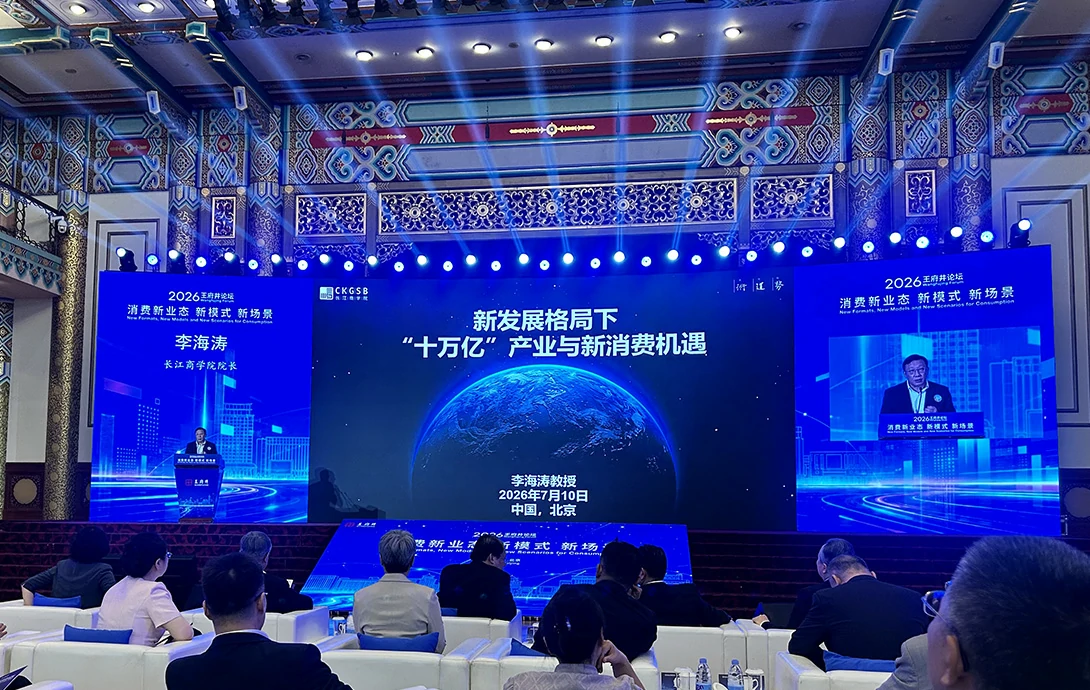
On July 10, Haitao Li, CKGSB Dean and Dean’s Distinguished Chair Professor of Finance, delivered a keynote address on the main stage of the Wangfujing Forum, joining government and public-sector representatives as well as some of China’s most prominent entrepreneurs and business leaders.
Among the featured speakers were Xingxing Wang, founder of Unitree Robotics; Yu Gong, founder and CEO of iQIYI; Dekang Gao, founder of Bosideng; and Bin Dai, President of the China Tourism Academy and Director of the Ministry of Culture and Tourism Data Center.
In his keynote speech, Dean Li examined how six emerging industries — integrated circuits, aerospace, biomedicine, the low-altitude economy, new energy storage and intelligent robotics — could interact with China’s vast domestic market to generate new consumer opportunities.
He found a fundamental shift in the relationship between industry and demand. “In the past, consumption drove industry,” said Dean Li. “In the future, industry will define consumption.”
Rather than viewing technological development and consumer growth as separate processes, Dean Li argued that high-quality industrial supply can actively create new products, experiences and services that previously did not exist. The six emerging industries, he said, have a dual role: strengthening the resilience and security of industries and supply chains while simultaneously expanding and upgrading consumption.
According to figures cited in his keynote, the combined output value of these six industries approached RMB 6 trillion in 2025, and is expected to surpass RMB 10 trillion by 2030. Dean Li described this not simply as industrial expansion, but as a broader restructuring of the relationship between supply and demand. He pointed out that under this new development pattern, high-quality industrial supply from these six industries will remove bottlenecks and stimulate people’s demands for high-quality products.
He illustrated how this transformation could unfold across multiple sectors. Advances in integrated circuits could enable smarter and more locally tailored digital products; aerospace and the low-altitude economy could turn previously inaccessible technologies into new forms of leisure and experiential consumption; biomedicine could accelerate the transition from episodic treatment to continuous health management; energy storage could make low-carbon consumption more affordable and widespread; and intelligent robots could eventually reshape services in the home, elderly care and education.
Dean Li also identified three dimensions through which industrial upgrading is transforming consumer markets: products, scenarios and people.
For companies, he argued, the opportunity lies not merely in expanding production capacity, but in translating technological capability into tangible product experiences and sustainable customer relationships.
A day earlier, on July 9, CKGSB co-hosted the New Consumption Summit with the Wangfujing Forum at The Peninsula Beijing as an important part of the wider forum. Under the theme “From Traffic to Retention: Embracing New Long-term Consumption,” the summit brought together CKGSB academics and entrepreneurs from consumer brands, the pet economy, functional foods and brain-computer interfaces to examine how companies can pursue sustainable growth as the era of easy traffic dividends recedes.
Yang Li, CKGSB Associate Professor of Marketing and Associate Dean for the MBA Program, delivered a keynote speech on building lasting brand value in a post-traffic era. He argued that brands become strong by developing deep identification and emotional connections within clearly defined communities. To become truly large-scale, however, they must move beyond those circles and translate niche cultures into broader social narratives that resonate with mainstream audiences.
The summit also featured entrepreneurs and CKGSB alumni who shared practical perspectives on building lasting customer value.
Lingli Yao, co-founder and CEO of Maishong Culture and an alumna of CKGSB’s EMBA Program, discussed how technology can connect people and music while helping consumer brands deepen engagement, activate membership and build longer-term customer relationships.
Niehan Chen, CEO of Peidi Zhichuang Pet Technology and a student of CKGSB’s MBA Program, shared the company’s journey from original design manufacturing to building its own brand, arguing that consumer companies should move from competing for traffic to creating a lasting “retention pool” that turns users into long-term brand assets.
Guangming Zhang, founder and CEO of functional food brand ffit8, introduced the company’s “5F” growth flywheel — Function, Fast, Fashion, Flavor and Feeling — as a framework for linking products, content, channels, artificial intelligence and repeat purchases.
Shuo Xiao, Vice President of BrainCo and an alumnus of CKGSB’s EMBA Program, explained how hard-technology companies can move beyond professional niches and into the mass consumer market by applying advanced technologies to genuine everyday pain points. He argued that product technology, application scenarios and delivery cost are the three core factors in this process.
Across the discussions, a common conclusion emerged: traffic may amplify a brand’s visibility, but retention provides the foundation for its long-term value. Traffic makes a brand seen; retention makes it remembered.
CKGSB’s two-day engagement at the Wangfujing Forum reflected the school’s broader role as both a source of original academic insight and a platform connecting policymakers, entrepreneurs, executives and emerging business leaders. From the main-stage keynote on the industries likely to reshape future consumption to a dedicated summit examining how brands can build lasting customer value, CKGSB brought together ideas, research and business experience across multiple dimensions of China’s evolving economy.
The discussions also highlighted how sustainable growth will increasingly depend on the ability to understand the way in which technology, industrial transformation and changing consumer needs interact.
As Dean Li noted in his remarks, new industrial opportunities and new consumer spaces ultimately depend on the dynamic alignment of supply and demand — and on platforms that can bring together policy, markets, business and ideas to turn emerging possibilities into sustainable growth.