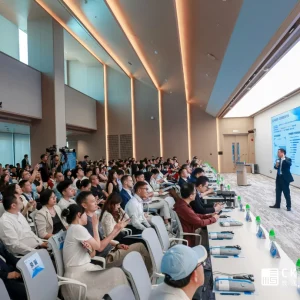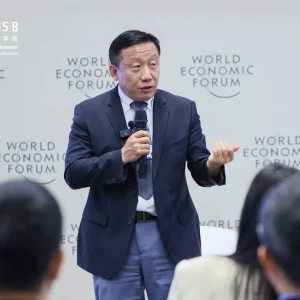
Dalian, China, 24 June 2026 — Speaking at the World Economic Forum’s Annual Meeting of the New Champions (“Summer Davos”) in Dalian, Sun Tianshu, CKGSB Dean’s Distinguished Chair Professor of Information Systems and Director of the AI and Industrial Transformation Lab, argued that the next wave of economic transformation will be driven not by individual technologies, but by their combination—and that the companies that succeed will be those that redesign business models around AI-native systems rather than simply adopting new technologies.
As artificial intelligence, robotics, advanced manufacturing, mobility, computing, and digital platforms increasingly converge, who will capture the value created by these novel combinations? Chairing the official session, Sun addressed this key question facing leaders across industries with a keynote speech on “Combining Technologies to Win.”
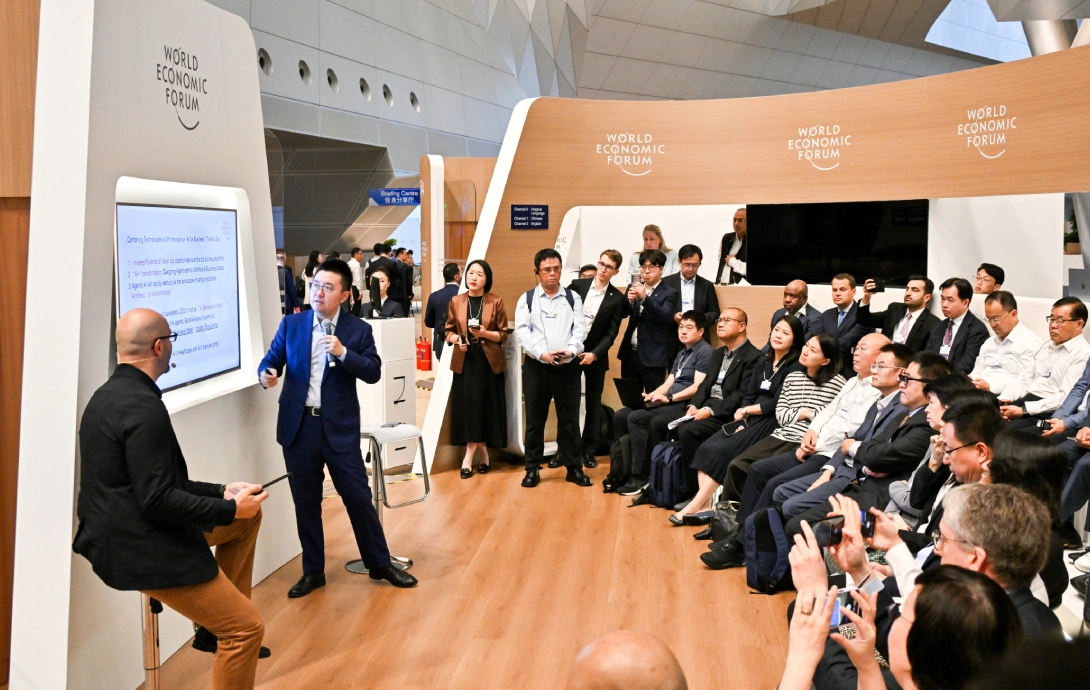
A central theme of Sun’s remarks was the rapid emergence of agentic AI, which he described as the most significant development in artificial intelligence over the past six months.
“We see AI moving from copilots to agents, and from human-centric systems to agent-centric systems,” he said.
Professor Sun argued that the emergence of agentic AI marks the beginning of the second half of AI, where attention shifts from model-building toward business transformation.
Sun proposed that agentic AI networks could become the third great global infrastructure system in human history, following the electrical grid and the Internet. In his view, these networks will serve as a new intelligence infrastructure capable of transforming every major industry.
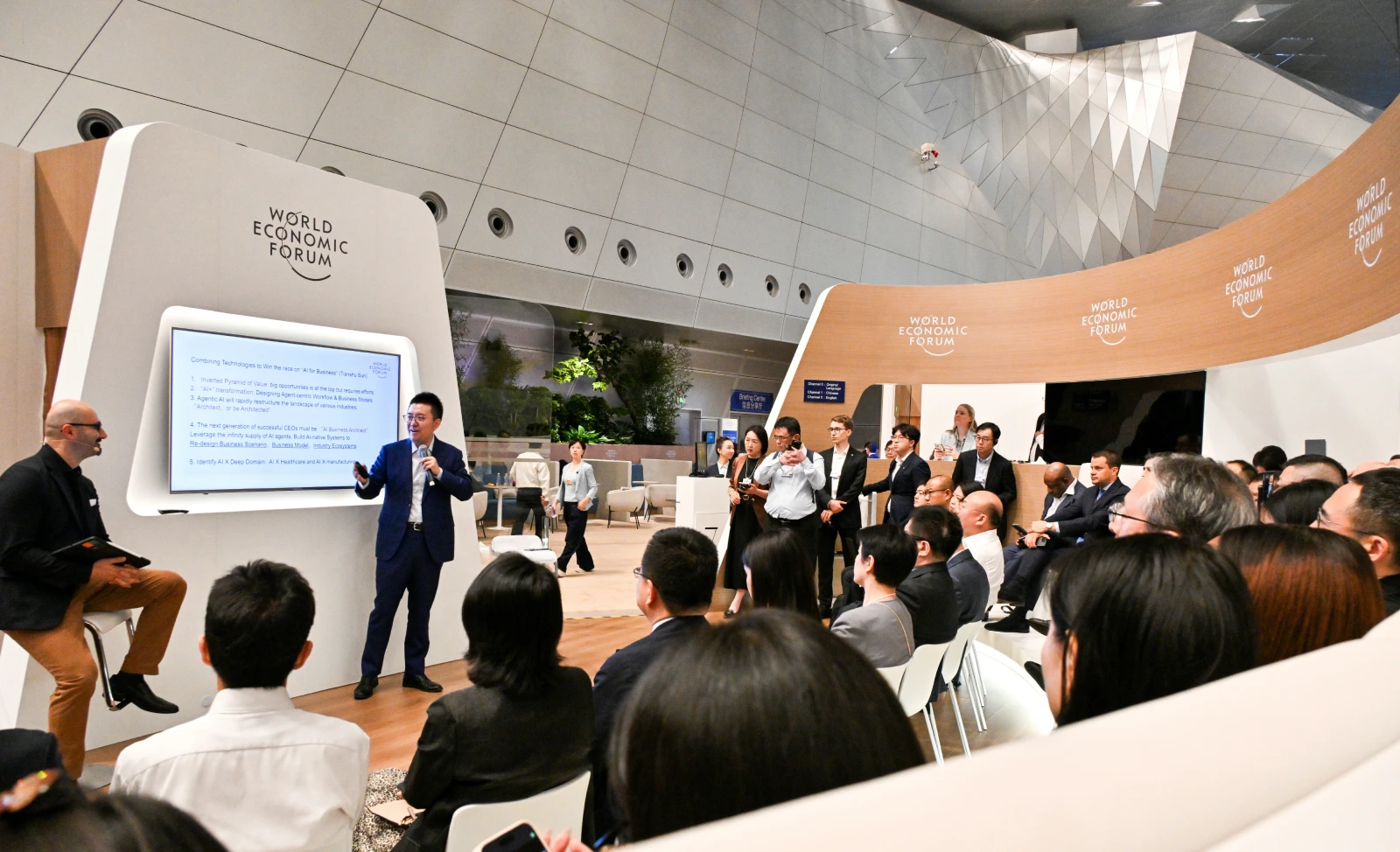
He argued that value is increasingly shifting upward through the stack of the six-layer AI value chain, from infrastructure and models toward industry transformation, where organizations can leverage deep domain knowledge, proprietary data, and agentic systems to create differentiated outcomes.
The first to fourth layers are all about the smart infrastructure, or “Business of AI”, and the fifth and sixth layers are about reshaping the industry, or “AI for Business”. Any company that wants to join this AI transformation needs to find its spot on these layers.
As AI enters its next phase, with intelligent agents evolving fast, the AI industry’s value is forming an ‘inverted pyramid’ structure.
At the bottom is the infrastructure. Above that are the tokens produced by foundational models. Higher up is industry systems, business processes, and real-world results.
Nowadays, many people remain fixated on foundational models, computing power, and token capabilities. But the real question has shifted to: How do we turn the tokens generated by models into actual industry value? This is the key challenge of AI’s next stage.
According to Professor Sun, most of the commercial value that AI can actually unlock will be at the top of the inverted pyramid – meaning the industry level. But for companies to capture that value at the top, they can’t just rely on general models or buying technology externally. They need to combine three things: business scenarios, proprietary data, and a closed-loop intelligent agent system.
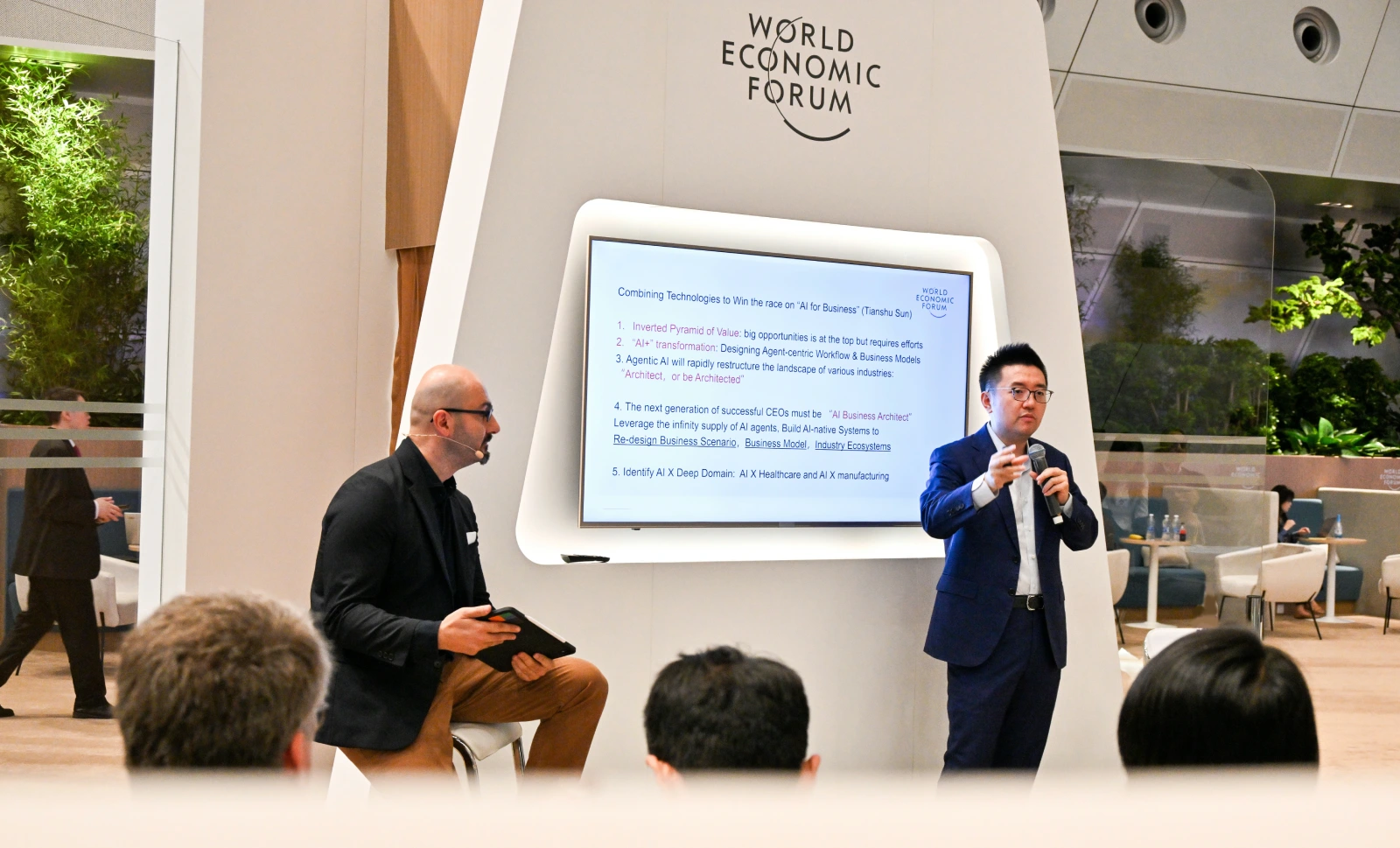
Reflecting the broader session theme of combining technologies, Sun distinguished between two approaches to innovation.
The first, which he called “+AI,” involves adding AI capabilities to existing processes and operating models. While useful, he suggested that this approach delivers only incremental benefits.
The second approach, “AI+,” requires institutions to redesign workflows, organizations, and business models around the capabilities of AI agents.
Drawing parallels with previous technology revolutions, Sun cited Henry Ford’s redesign of manufacturing around electricity and the emergence of smartphone-native companies such as Uber and TikTok. “In the second half of AI, we need one thousand Henry Fords to transform every industry in an AI-native way to really unleash the value of AI,” Sun said. “We need to think about how to design an agent-centric business model, organization model, and technology model around it.”
Professor Sun believes only CEOs and top executives can really design AI+ business models and reshape the company’s workflows, as this can’t be expected to happen from the ground up.
AI+ isn’t just an IT upgrade or a process tweak in one department. It forces a company to rethink things like how to reconstruct its business model, how to reshape organizational processes, how intelligent agents should take part in decision-making, how humans and intelligent agents should work together, and how to build future business models on intelligent agent systems. These are basically enterprise architecture questions, questions that only CEOs and top executives can address.
What companies really lack in the second half of AI isn’t more people who can use tools—it’s AI business architects, namely CEOs and top executives.
Sun encouraged executives to view AI agents as a new category of workforce participant. Like employees, agents require knowledge, access to data, tools, objectives, performance metrics, and continuous feedback.
To illustrate the concept, he presented an “Agent Grid” framework for pharmaceutical companies, where thousands of specialized agents could support functions such as inventory management, decision-making, and operational optimization. Over time, these agents could evolve into multi-agent systems serving as the intelligence layer of an organization.
Looking ahead, Sun predicted that future enterprises will increasingly be structured around three core components:
Together, these groups will perform both knowledge-based and physical work in increasingly integrated ways.
The key to deploying AI+ for companies is to build a system that’s “agent-centric,” capable of feedback, decision-making, and iteration. A truly effective agent system must meet at least three standards.
First, the agent must be embedded in a strong feedback loop with clear outcomes.
An agent isn’t a static tool; it’s a system that needs to continuously learn and calibrate within business processes. It must be able to see the results of its decisions and adjust its next actions based on those results. Without clear, measurable, end-to-end feedback, the agent can’t evolve.
Second, the agent must be built on cutting-edge foundational model capabilities.
Past machine learning systems could usually only handle localized tasks, but agents are different. They can have broad world knowledge, call tools, and complete long-term tasks. Only when a company truly becomes ‘agent-centric’ and AI+ will it fully capture the benefits of this generation of AI technology.
Third, the CEO must redesign the organizational structure, driving transformation with a dual approach and establishing an AI special zone. On one hand, CEOs should push AI transformation in existing business, and on the other hand, incubate AI-native new processes, new structures, or even new businesses outside the current organization.
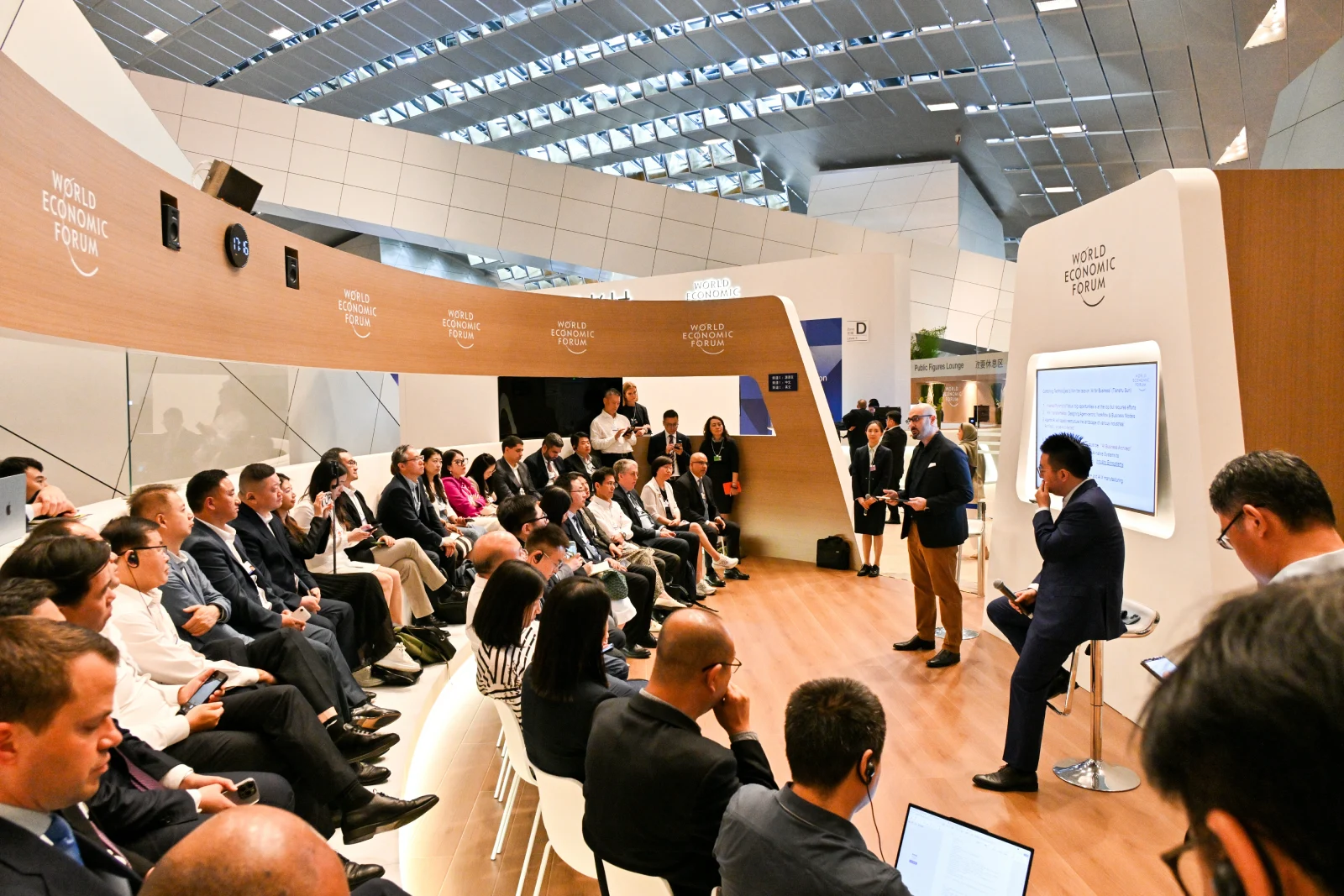
The session brought together leaders from technology and industry to examine how companies are rethinking business models, partnerships, and value-chain positions in order to turn disruption into opportunity. Chafic Nassif, Head of Ericsson Northeast Asia and Senior Vice President of Ericsson, joined Professor Sun and explored the infrastructure, connectivity, and interoperability layers required to scale convergent industries.
Earlier the same day, Professor Sun also delivered a keynote speech at the Dalian Artificial Intelligence Industry Development Forum 2026, co-organized by CKGSB and the Dalian government, offering practical pathways for enterprises embracing AI and digital transformation.
Sun Tianshu is Dean’s Distinguished Chair Professor of Information Systems at Cheung Kong Graduate School of Business (CKGSB). His research focuses on artificial intelligence, digital platforms, technology ecosystems, and industrial transformation. Professor Sun has worked closely with a variety of organizations including Alibaba, Adobe and Facebook.