

A maturing economy: signals from China’s Two Sessions
March 09, 2026
CKGSB’s Professor Erica Li says China’s economy is entering a new phase
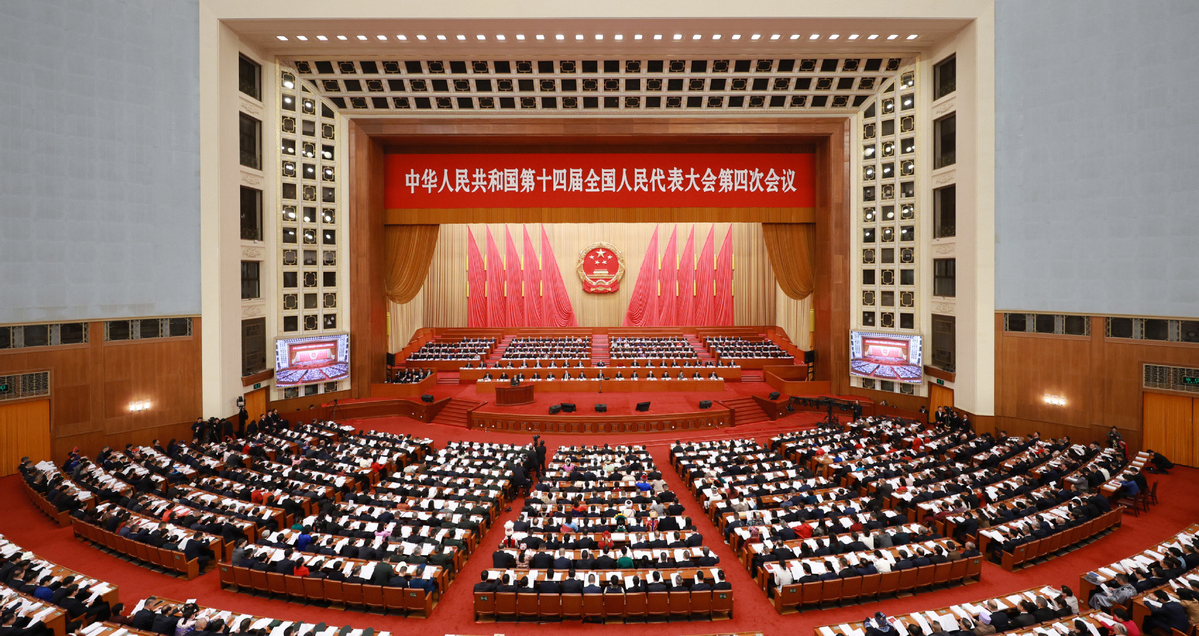
China’s leaders have gathered in Beijing for the annual Two Sessions, where they lay out their plans for the country’s economy over the next year. In this Q&A, CKGSB’s Professor Erica Li discusses why this year’s meeting signals a move towards a more mature and holistic strategy for economic growth.
Q: Beijing has set a GDP growth target of 4.5–5% for 2026, a number lower than past years. What does this shift reflect in terms of the trends in China’s economy?
In fact, a growth target of 4.5–5% is still quite high. It may look low compared to the double-digit growth China experienced a decade ago, but the country is now a very large economy. At China’s current scale, sustaining the kind of growth rates seen in the past simply isn’t realistic.
If we consider the global context, the IMF expects the world economy to grow by roughly 3.3% in 2026. Among major economies, only India is expected to grow faster, with a projected growth rate of 6.4%. If China were to continue growing at a much faster rate indefinitely, the size of its economy relative to the world would become unrealistic. China already accounts for roughly 16% of global GDP, which is already a substantial share. Slower growth, therefore, reflects the natural trajectory of a large, mature economy rather than a fundamental weakness.
Even at around 5%, China’s growth rate remains strong compared with most other countries. If China can sustain growth at roughly this level over the next decade, it would still be enough to support many of the development targets the country has set for the coming years.
Part of the challenge is psychological. Chinese people have become accustomed to extremely rapid growth, particularly generations who grew up during decades of expansion. Compared with the past, the economy may feel stagnant, but that perception largely reflects expectations shaped by earlier periods of development.
In absolute terms, living standards today are far higher than they were 30 or 40 years ago. When I was a child, nobody in my circle had a car. Today, even in relatively small towns or rural areas, many families own one. Moving from almost no car ownership to widespread ownership represents a dramatic transformation. But once that stage of development has been reached, further improvements inevitably occur at a slower pace.
The same adjustment applies to property. For many years people became used to seeing housing prices rise by 10% or more annually. Once that growth slows or stops, some people feel as though they are becoming poorer. In reality, what has changed is the expectation. The earlier pace of appreciation was never sustainable.
In that sense, the issue is partly a mental adjustment. People should not become pessimistic about China’s economy because its growth rate is slower than in the past. It simply reflects the fact that China has already achieved a much higher level of development than it had in previous decades.
Q: 2025 saw a record trade surplus of almost $1.2 trillion. What is the impact of this and what do you see as being the consequences both in terms of China and its trading partners?
A trade surplus essentially means that China produces more goods than it consumes domestically. At the same time, it reflects the fact that consumers in other countries choose Chinese products, whether because of their quality, price competitiveness, or both.
For China, this brings clear benefits. A strong export sector supports company profits and provides employment opportunities. That aspect is relatively straightforward.
The more complicated effects arise in China’s trading partners. Within those countries, different groups are affected in different ways. On one hand, consumers benefit from access to high-quality goods at relatively low prices. On the other hand, certain domestic industries may face stronger competition, which can lead to job losses or pressure on local producers.
Balancing these effects is ultimately a matter of domestic policy within each country. Governments need to consider how to distribute the benefits of cheaper goods while addressing the costs faced by displaced workers or industries. For that reason, the overall impact of China’s trade surplus on its trading partners is complex and cannot be reduced to a simple positive or negative outcome.
Q: What do you see as the underlying issues in terms of China’s low consumption?
When people say that China’s domestic consumption is low, they are often speaking in relative terms. China consumes less than it produces, which is reflected in its trade surplus. As the “factory of the world,” China’s manufacturing capacity exceeds what its own population can absorb.
However, if we look at the absolute level of consumption, it is not necessarily as weak as sometimes portrayed. Chinese consumers spend significant amounts on goods, and consumption levels remain substantial.
Another important factor is the structure of consumption. In countries such as the United States, a large share of consumption spending is directed toward services—legal services, healthcare, education and similar sectors. In China, these services are often much cheaper, which means that direct comparisons using nominal prices can be misleading. To make meaningful comparisons, we need to consider purchasing power differences.
That said, expanding domestic consumption remains an important policy goal. Improving consumption means improving people’s quality of life and the government clearly wants Chinese households to enjoy a higher standard of living.
The main area where consumption could grow further is in services. Chinese consumers already spend heavily on goods such as clothing, food and consumer products. But there is still room for expansion in service-based consumption.
At the same time, it is not obvious that higher domestic consumption would significantly reduce the trade surplus. China’s trade surplus is largely driven by merchandise exports. Even if service consumption rises domestically, it may not change the underlying structure of the surplus very much.
Q: What do you see as the prospects for the ongoing property sector slump and what would the implications be?
I do not expect the property sector to return to the growth rates seen over the past two decades. In many ways, the sector is now moving closer to what might be considered a more sustainable level.
During the previous period, property prices rose extremely quickly. While that created wealth for some, it also had negative consequences for the broader economy. Many young people struggled to afford housing, which forced them to save aggressively and limited their consumption. For businesses, rising rents also became a significant cost.
In addition, high returns in real estate attracted capital and talent away from more productive sectors such as manufacturing and technology. Many investors preferred property because it generated reliable and often rapid returns. But that type of growth is not particularly healthy for a country’s long-term economic development.
Ideally, more capital and entrepreneurial energy should flow into sectors that push technological progress and productivity improvements, rather than simply building more apartments.
From that perspective, the recent shift in the property sector may actually be positive. The government has clearly signaled that it does not intend to return to the earlier model of real estate-driven growth.
Demographics also play a role. China’s population growth has slowed and is beginning to decline, which naturally reduces demand for new housing. In many places, housing supply has already expanded significantly. In my hometown in Henan, for example, many families own more than one apartment, often purchased as an investment rather than for living.
There is also evidence that excessive investment in real estate contributed to capital misallocation in the broader economy. Some studies suggest that productivity growth slowed in part because too much investment flowed into property rather than into sectors that drive innovation and technological advancement.
For these reasons, I believe the government’s efforts to restrain the property sector are broadly appropriate. Real estate had begun absorbing more resources than it should have relative to its contribution to long-term economic development.
Q: What are the biggest takeaways from this year’s Two Sessions meetings?
One notable point is the use of a growth range rather than a single GDP target. This reflects the government’s broader effort to shift attention away from a single headline number.
In the past, local government officials were often evaluated primarily on GDP growth. As a result, achieving high growth became the central objective for many local administrations.
Recently, however, the central government has begun emphasizing a broader definition of performance. In fact, the Communist Party has launched a new education campaign for party members and local officials that will run from this month through July. One of its goals is to encourage officials to adopt a “correct view of performance.”
In practical terms, this means moving beyond GDP growth as the sole metric of success. Officials are now expected to consider a wider set of indicators, including innovation, environmental protection, and the satisfaction of local residents.
The focus is therefore shifting toward the quality of growth rather than simply the speed of expansion. A high GDP number can sometimes be achieved through activities that do not contribute to long-term productivity—such as building large amounts of real estate.
The government now wants to encourage development that improves technological capability, environmental sustainability, and living standards.
The use of a growth range also reflects the current global environment. The world economy is facing considerable uncertainty, and many factors affecting China’s growth lie beyond the government’s direct control. Setting a flexible range provides more room to manage those uncertainties.
Overall, the message coming out of the Two Sessions is consistent: the central government wants local authorities to place greater emphasis on high-quality development rather than focusing exclusively on the GDP growth figure.
Q: Looking at the bigger picture for 2026, what are your expectations for China’s economy this year?
It is difficult to predict a precise GDP number, but I would say that I feel more confident about China’s economic trajectory than I did three or five years ago.
In recent years, the country has been focusing heavily on areas where it wants to achieve technological breakthroughs, including electric vehicles, renewable energy, and semiconductors. If we look closely at these sectors, we can see that progress has been made.
Even in semiconductors—arguably the most difficult area—there have been signs of advancement. For example, companies developing artificial intelligence models have begun training their systems using domestically produced Huawei chips. While these chips are not yet as advanced as those produced by leading global firms, the fact that they can be used at all represents significant progress compared with a few years ago.
More broadly, China appears to be moving gradually toward higher value-added industries. Although some traditional sectors—particularly real estate—will no longer contribute as much to growth, the economy is undergoing a structural transformation.
This transition will not be easy. The property sector and its related supply chains once accounted for roughly 20% of China’s GDP, so the slowdown in that area inevitably weighs on overall growth. However, if new industries continue to expand and productivity improves, the long-term outlook remains positive.
For these reasons, despite the challenges, I would say that I am cautiously optimistic. China’s economic structure is evolving, and in many areas that shift appears to be moving in the right direction.
Erica Li (Li Xuenan) is a professor of finance and the director of the China Industrial Policy Research Center, Cheung Kong Graduate School of Business (CKGSB). She holds PhD's from the University of Rochester and University of Massachusetts, Amherst
Enjoying what you’re reading?
Professor profile

LI Xuenan (Erica)
Professor of Finance and Director of China Industrial Policy Research Center, Cheung Kong Graduate School of Business (CKGSB)
PhD's, University of Rochester and University of Massachusetts, Amherst




Related Articles



Our Programs

Emerging Markets: Innovation and Scaling for Exponential Growth
Global Unicorn Program Series
A joint program by Cheung Kong Graduate School of Business and The South Africa Chamber of Commerce and Industry
LocationJohannesburg, South Africa
Date20 - 23 Apr, 2026
LanguageEnglish

Asia Start: AI + Digital China Expedition
Asia Start provides entrepreneurs and executives with unparalleled access to Asia’s dynamic digital economy and its business ecosystems, offering the latest trends and insights, strategies, and connections to overcome challenges and unlock future growth for your business in Asia and beyond.
LocationChina (Shanghai, Hangzhou, Shenzhen)
Date11 - 14 May, 2026
LanguageEnglish

Scaling Innovation: AI and Digital Strategies for Business Transformation
Global Unicorn Program Series
In partnership with Columbia Engineering
This program is designed to equip senior executives with the strategic insights and tools necessary to lead in this transformative era.
LocationNew York, USA
Date27 Sep - 02 Oct, 2026
LanguageEnglish

Emerging Tech Management Week: Silicon Valley
Global Unicorn Program Series
In partnership with UC Berkeley College of Engineering
This program equips participants with proven strategies, cutting-edge research, and the best-in-class advice to fuel innovation, seize emerging tech developments, and catalyse transformation within your organization.
LocationUC Berkeley
Date01 - 06 Nov, 2026
LanguageEnglish

Stanford & Silicon Valley Immersion Program
Global Unicorn Program Series
In partnership with Stanford Engineering Center for Global & Online Education
This CKGSB program equips entrepreneurs, intrapreneurs and key stakeholders with the tools, insights, and skills necessary to lead a new generation of unicorn companies.
LocationStanford University Campus,
California, United States
Date06 - 11 Dec, 2026
LanguageEnglish with Chinese Translation