
In the age of AI, the bottleneck is the human
March 13, 2026
As AI adoption transforms the workplace making routine tasks effortless, the real bottleneck is now those who take ownership
The Excel wizards and PowerPoint masters who could synthesize a complex meeting or produce a slick deck in minutes used to be the up-and-coming in a company. No longer.
In my years overseeing leadership talent reviews for MNCs in Asia, managers tended to over-emphasize such qualities when nominating early-in-career “high potentials”, but AI has arrived and is overturning all such preconceptions.
Now, with AI, anyone can create spreadsheets, decks, summaries of long documents and perfect translations in seconds. But it has also made mediocrity effortless, and we are drowning in AI slop, overwhelmed by overly lengthy “summaries” and endlessly checking AI output for inaccuracies.
The new bottleneck
The bottleneck is no longer the ability to produce. When anyone can generate a neat deck, a fluent email or a confident summary in seconds, those outputs stop signaling quality or leadership—instead, the scarce skill is the final decision making.
Good leaders are the ones with sharper critical thinking skills and astute judgment. Critical thinking without judgment is analysis paralysis. Judgement without critical thinking is impulsive action. But a harmonious blend of the two leads to sound decision making.
Ever since foundation models put rapid analysis and drafting on free-flow tap, the bottleneck in many workflows has shifted to higher-level human capabilities. It has moved from finding and organizing information to choosing direction, making tradeoffs and taking action.
If you are strong at thinking critically and making sound judgment calls, you can open up new strategies, build new products and slash workflow inefficiencies. If you are not, you become the chokepoint, drowning in data and indecision.
The human premium
When intelligence becomes instant, abundant and cheap, the average worker stays average, but a smaller part of the population—the AI-augmented leaders—begin to scale output significantly. They aren’t working harder. They are just leveraging the available tools more effectively.
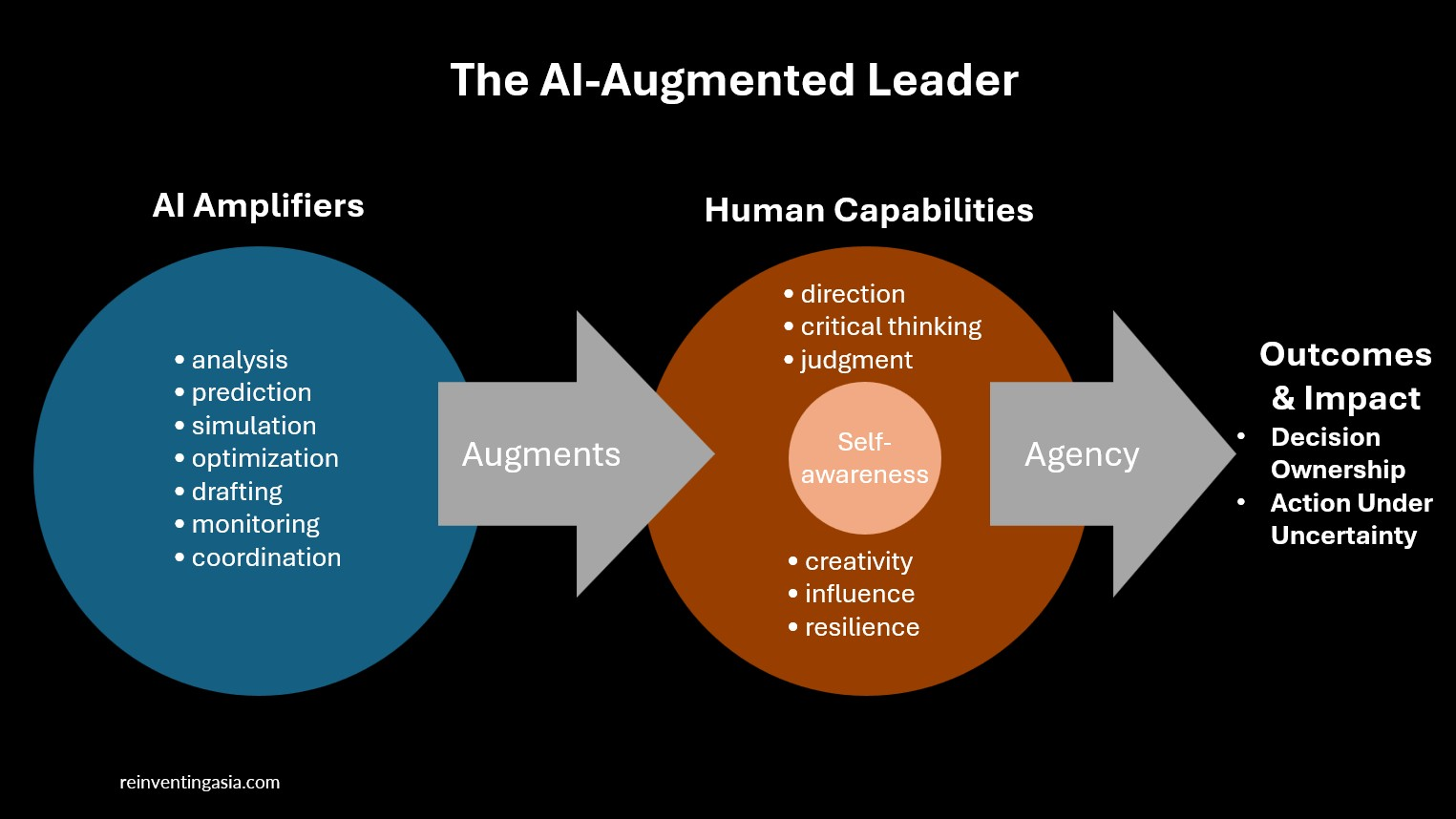
As the framework below illustrates, the AI-augmented leader uses AI as an amplifier for analysis and drafting, but differentiates on human capabilities. AI can process infinite data, but it lacks “skin in the game.” AI doesn’t feel the weight of a mistake or the heat of a crisis. Ultimately, we only trust those who share our risks and offer a level of authenticity that an algorithm does not have.
The framework identifies several core human capabilities. In addition to the previously mentioned critical thinking and judgment, three more stand out as the new bottlenecks of leadership: direction, influence and agency.
- Direction: Direction is the capability to clarify what actually matters and to commit to a long-term path when the data is ambiguous. AI can provide a map, but humans must choose the destination. And the unique, bold and especially, the unreasonable goals, are not going to be found in the AI model’s training set. Those goals are set by those Steve Jobs called “the crazy ones”—those betting against the status quo.
- Influence: AI is very skilled at persuasion techniques: active listening, non-judgmental responses, cognitive behavior therapy. But persuasion is not the same as trust. We instinctively reject personal expressions when we discover the source is an algorithm, because we know an algorithm doesn’t share our fate. Influence in the AI era goes hand-in-hand with authenticity. Humans want to be led by humans.
- Agency: Agency is the engine. It is the most critical tool in the AI-augmented leader toolkit because it is the rarest. Many people look like leaders on paper. They have the strategy, the synthesis or the spiffy slide deck. But agency is what separates the people who can explain what should happen, from the people who make it happen. It is the grit to own a decision under uncertainty, knowing the tradeoffs, and doing the unglamorous follow-through when the perfect AI plan hits the messy reality of the physical world.
Mastering these human capabilities at the corporate level can lead to competitive advantage and market differentiation.
AI-augmented leader as orchestrator
When people talk about “AI transformation,” they often imagine a tool rollout. A company buys software, trains staff and expects productivity to rise. In practice, the tool is the easy part. The hard part is changing how work moves through the organization. Without that change, AI often creates extra noise. Different teams generate different summaries of the same issue. Everyone has a different recommendation. No one is sure which answer is trustworthy. Progress is slow.
AI augmented leaders solve this by turning AI into a practical workflow. They break work into steps and decide what belongs to machines and what belongs to humans. AI does the heavy lifting where speed matters, like scanning for patterns, gathering evidence, drafting first versions or producing options.
Humans do the parts where responsibility matters. They decide which problems are priorities, choosing between imperfect options, giving the go-ahead on high-stakes actions and dealing with exception cases.
Then these leaders make the workflow work across different teams. They build shared definitions, establish rules for escalation, define how decisions get recorded and they make it clear who owns outcomes.
The impact of the AI tool or systems will vary greatly depending on whether a company is orchestrated by AI-Augmented leaders or not.
Here are two Asian corporate cases in point, where leaders in these two companies have blended AI and human capabilities in harmonious concert to ensure customer’s needs are met. Both SHEIN and Grab reached scale through disciplined orchestration of human and machine strengths.
Two cases in effective orchestration
SHEIN: Founded in China in 2008, SHEIN sells clothing directly to shoppers through its app and website. Their simple promise to customers is the latest, coolest fashions at low prices, with new styles appearing constantly. Behind the scenes, AI and data systems scan what people are paying attention to online. Then teams translate those signals into new designs and small initial production runs. If an item performs well, the supply chain ramps up quickly through a network of suppliers set up for short runs and fast reorders. If an item performs poorly, they stop early and move on.
The human part shows up in taste, what counts as cool and fashionable in the first place. Social media posts, influencer content and customer reactions shape what looks desirable, which items feel current and which designs seem worth repeating. Leaders make the calls on which signals to trust, how aggressive to be on speed versus quality, and how to manage reputation and compliance risks, while keeping the AI-enabled business model moving.
Grab: Established in Malaysia as a ride-hailing service, Grab has grown into a regional super-app offering rides, food delivery and payments across Southeast Asia. In day-to-day operations, one recurring problem is account takeover and fraud. A bad actor gains access to someone else’s account and starts doing things the real owner did not authorize, like ordering food, taking rides or changing account details.
When this happens, Grab’s operations team has to respond quickly and accurately. The data is spread across many places, including login history, AI-supported device and network signals, transaction records, GPS traces, and customer support messages. Some of these messages and notes are in different languages, because cases span multiple countries and teams. Grab has built an AI agent framework that follows a standard investigation playbook, pulls the relevant evidence from internal systems and drafts a clear case summary for the human team.
When the case reaches a point where the AI system should not decide, the process is paused while a human being approves an action (such as escalation) or routes the case to the right specialist. The AI tool enables evidence gathering, translating and summarizing at super-human speed, leaving the judgment calls, customer remediation and accountability to humans.
Three chords and the truth
In an age of instant intelligence, being in the loop is not enough. AI speeds up sensing, analysis and coordination, but humans are essential for orchestrating and leveraging our capabilities to determine what to pursue, what standards to apply, which risks to accept and how to follow through when conditions change. The SHEIN and Grab cases show the same pattern in different settings.
Someone once said that the fundamentals of Country Music are “three chords and the truth.” The AI-Augmented Leader model is similar: blending the logic and math of musical patterns with the everyday emotions and motivations of human experience, and living a life that sings.
Roy Tomizawa runs Reinventing Asia, an AI literacy and adoption consultancy focused on helping organizations build practical human capabilities for effective human-AI partnership. He has more than two decades of experience in leadership, talent and organizational development, as well as executive education across major global multinationals in Asia.
Enjoying what you’re reading?
CKGSB Report









Our Programs

Emerging Markets: Innovation and Scaling for Exponential Growth
Global Unicorn Program Series
A joint program by Cheung Kong Graduate School of Business and The South Africa Chamber of Commerce and Industry
LocationJohannesburg, South Africa
Date20 - 23 Apr, 2026
LanguageEnglish

Asia Start: AI + Digital China Expedition
Asia Start provides entrepreneurs and executives with unparalleled access to Asia’s dynamic digital economy and its business ecosystems, offering the latest trends and insights, strategies, and connections to overcome challenges and unlock future growth for your business in Asia and beyond.
LocationChina (Shanghai, Hangzhou, Shenzhen)
Date11 - 14 May, 2026
LanguageEnglish

Scaling Innovation: AI and Digital Strategies for Business Transformation
Global Unicorn Program Series
In partnership with Columbia Engineering
This program is designed to equip senior executives with the strategic insights and tools necessary to lead in this transformative era.
LocationNew York, USA
Date27 Sep - 02 Oct, 2026
LanguageEnglish

Emerging Tech Management Week: Silicon Valley
Global Unicorn Program Series
In partnership with UC Berkeley College of Engineering
This program equips participants with proven strategies, cutting-edge research, and the best-in-class advice to fuel innovation, seize emerging tech developments, and catalyse transformation within your organization.
LocationUC Berkeley
Date01 - 06 Nov, 2026
LanguageEnglish

Stanford & Silicon Valley Immersion Program
Global Unicorn Program Series
In partnership with Stanford Engineering Center for Global & Online Education
This CKGSB program equips entrepreneurs, intrapreneurs and key stakeholders with the tools, insights, and skills necessary to lead a new generation of unicorn companies.
LocationStanford University Campus,
California, United States
Date06 - 11 Dec, 2026
LanguageEnglish with Chinese Translation