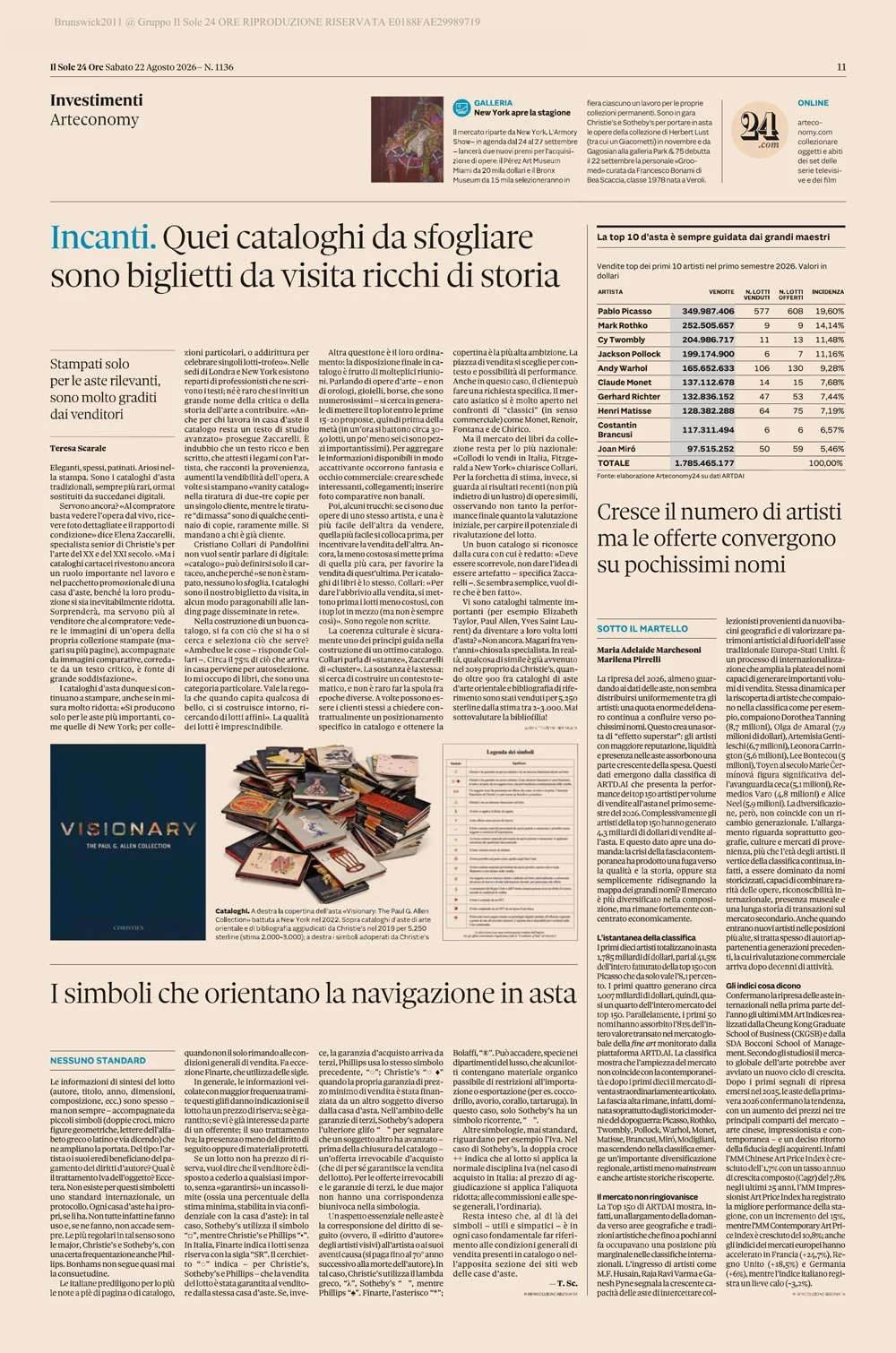
The recovery seen in 2026, at least judging by auction data, does not appear to be evenly distributed among artists: a huge share of spending continues to flow towards just a handful of names. This is creating a kind of “superstar effect”, whereby artists with the strongest reputations, greatest liquidity and highest auction presence are capturing an increasing share of expenditure.
These findings emerge from ARTD.AI’s ranking of the top 150 artists by auction sales volume in the first half of 2026. Collectively, the artists in the top 150 generated $4.3 billion in auction sales. This raises a question: has the downturn in the contemporary segment prompted a flight towards quality and established names, or is it simply redrawing the map of the market’s leading artists? The market is becoming more diverse in its composition, while remaining highly concentrated in economic terms.
The top ten artists generated $1.785 billion at auction, accounting for 41.5% of the total turnover of the top 150, with Picasso alone representing 8.1%. The top four generated approximately $1.007 billion – nearly a quarter of the entire market represented by the top 150.
At the same time, the top 50 names accounted for 81% of the total value transacted in the global fine art market monitored by the ARTD.AI platform.
The ranking shows that a broader market does not necessarily mean a more contemporary one, and beyond the top ten, the market becomes extraordinarily varied. The upper end continues to be dominated primarily by established Modern and Post-War artists – Picasso, Rothko, Twombly, Pollock, Warhol, Monet, Matisse, Brancusi, Miró and Modigliani. Further down the ranking, however, significant regional diversification emerges, alongside less mainstream artists and the rediscovery of historically important female artists.
ARTD.AI’s Top 150 also shows a broadening of demand towards geographical regions and artistic traditions that, until only a few years ago, occupied a more marginal position in international rankings.
The inclusion of artists such as M.F. Husain, Raja Ravi Varma and Ganesh Pyne points to the growing ability of auction houses to attract collectors from new geographical markets and to recognise the value of artistic traditions beyond the conventional Europe-US axis. This process of internationalisation is expanding the range of artists capable of generating significant sales volumes.
A similar dynamic can be seen in the rediscovery of female artists featured in the ranking, including Dorothea Tanning ($8.7 million), Olga de Amaral ($7.9 million), Artemisia Gentileschi ($6.7 million), Leonora Carrington ($5.6 million), Lee Bontecou ($5 million), Toyen – the pseudonym of Marie Čermínová, a significant figure in the Czech avant-garde – ($5.1 million), Remedios Varo ($4.8 million) and Alice Neel ($5.9 million).
This diversification, however, does not amount to generational renewal. The expansion is primarily taking place across geographies, cultures and markets of origin rather than in terms of the age of the artists.
The top of the ranking continues to be dominated by historically established names that combine scarcity of works, international recognition, a strong museum presence and a long track record of transactions on the secondary market. Even when new artists enter the upper reaches of the ranking, they are often from earlier generations whose commercial reappraisal has come only after decades of activity.
The latest MM Art Indices, developed by the Cheung Kong Graduate School of Business (CKGSB) and SDA Bocconi School of Management, confirm the recovery of international auctions in the first part of the year.
According to the researchers, the global art market may have entered a new growth cycle. Following the first signs of recovery that emerged in 2025, the spring 2026 auctions confirmed the trend, with prices rising across the three main market segments – Chinese, Impressionist and Contemporary art – alongside a marked return in buyer confidence.
The MM Chinese Art Price Index rose by 1.7%, with a compound annual growth rate (CAGR) of 7.8% over the past 25 years. The MM Impressionist Art Price Index recorded the strongest performance of the season, rising by 15%, while the MM Contemporary Art Price Index increased by 10.8%.
European market indices also accelerated, with France up 24.7%, the UK up 18.5% and Germany up 6%, while the Italian index recorded a slight decline of 3.2%.
*This is a translation of the original article in Italian, published in print in Plus24 by Il Sole 24 Ore on August 22, 2026.