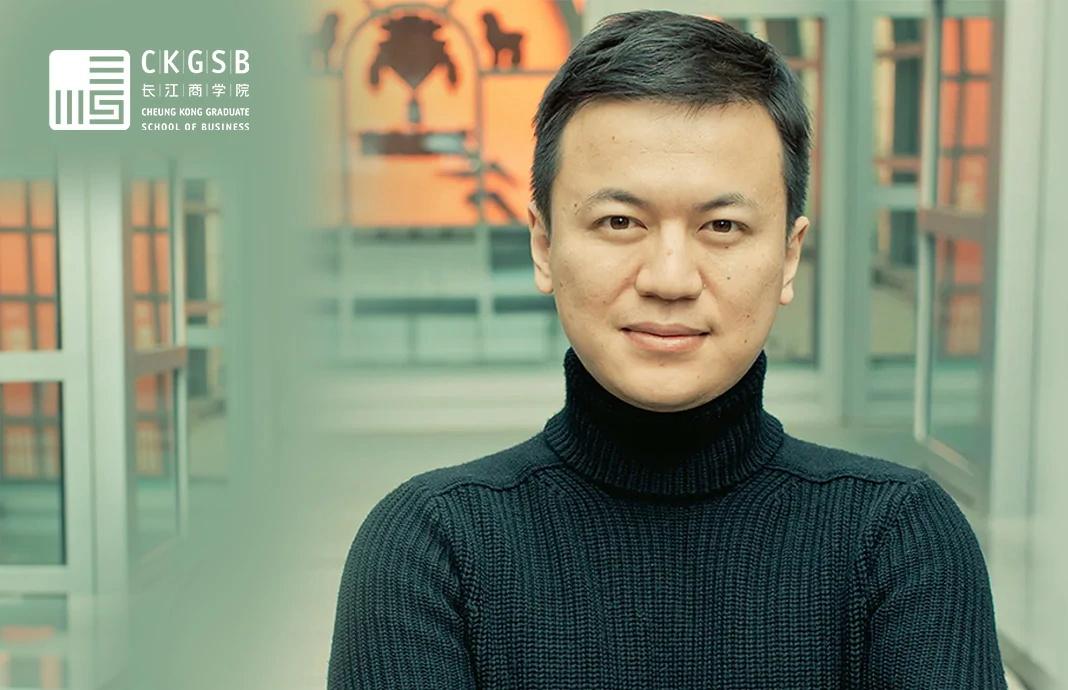
Cheung Kong Graduate School of Business (CKGSB) Associate Professor of Marketing and Associate Dean for the MBA Program, Li Yang, has co-authored a major research paper that introduces a new machine learning approach to decode how consumers organize and use digital collections—ranging from music playlists and food recipes to shopping baskets. The research provides firms and scholars with a powerful framework for delivering more accurate and personalized online recommendations.
Titled “Modeling Categorized Consumer Collections with Interlocked Hypergraph Neural Networks,” the study is the first worldwide to introduce state-of-the-art hypergraph machine learning methodologies into marketing research. The paper is published in the Journal of Marketing Research, one of the world’s leading journals in marketing scholarship.
As digital platforms increasingly shape how people consume music, videos, books, recipes, and other content, consumers are no longer just passive buyers. They actively curate collections—songs saved in libraries, videos grouped into playlists, recipes organized by themes—and further categorize these items into subsets reflecting different moods, goals, or contexts. As Li Yang notes, “Conventional network modeling approaches… struggle to capture these complex relationships.”
Professor Li Yang and his co-authors, Khaled Boughanmi (Cornell University) and Asim Ansari (Columbia University), address this challenge in their new research. “We develop a novel deep generative modeling framework that captures the network structure of consumer collections using multiple interlocked hypergraphs,” explains Li Yang.
The authors’ findings highlight three ways this research changes how we understand consumer preferences and personalization. First, rather than relying on standard graph models that focus on simple pairwise relationships, the paper leverages hypergraphs, which allow a single relationship to connect multiple entities at once. This is particularly well suited to collections, where a playlist, for example, links many songs simultaneously, and a song can belong to multiple playlists across different users. The authors construct three interconnected hypergraphs: one linking consumers to items, another linking categories (such as playlists) to items, and the third linking consumers to categories.
To model these structures, the study employs a message-passing variational autoencoder, a type of deep generative model that produces probabilistic embeddings for consumers, items, and categories in a shared latent space. These embeddings capture similarities in preferences and consumption contexts, even when data are incomplete or sparse. This is valuable in digital settings, where many items lack full descriptive information.
The authors demonstrate the power of their framework using large-scale data from digital music platforms, combining millions of user-curated playlists with rich song features such as user-generated tags and acoustic attributes. Empirical results show that the proposed model significantly outperforms a wide range of state-of-the-art benchmarks—including matrix factorization, traditional variational autoencoders, and existing hypergraph-based methods—in predicting how songs, playlists, and users are linked.
Second, the model can be applied far beyond music. The authors illustrate its broader applicability to other consumer collections, such as recipe databases or social curation platforms like Pinterest, where users organize heterogeneous content into themed boards. Noting the business implications of this research, Li Yang says, “This approach enables firms to generate novel personalized product bundles, recommend relevant items and bundles, and dynamically expand existing bundles with new items.”
Third, from an academic perspective, the paper makes a significant methodological contribution. It is among the first in marketing to apply interlocked hypergraph neural networks and message-passing architectures to model consumer data, opening new avenues for research on categorization, personalization, and contextual consumption. By integrating structured attributes with unstructured text and complex network relationships, the study pushes the frontier of how consumer behavior can be modeled at scale.
Professor Li Yang’s work reflects CKGSB’s commitment to interdisciplinary research at the intersection of marketing, data science, and artificial intelligence. As digital platforms continue to reshape consumption, insights from this research offer powerful new tools to understand—and better serve—today’s increasingly sophisticated consumers.