





Selective Partners: India and China’s Bet on De-Risked Interdependence
January 07, 2026
Despite political tensions and a $99 billion trade deficit, the world’s two most populous nations are forging a new model of engagement — one that embraces collaboration in some sectors while maintaining strict boundaries in others.
When Prime Minister Narendra Modi arrived in China in August 2025 for the Shanghai Cooperation Organisation summit — his first visit in seven years — the symbolism was unmistakable. The meeting with President Xi Jinping in Tianjin produced tangible outcomes: resumed direct passenger flights, reopened border trade passes at Lipulekh, Shipki La, and Nathu La, and facilitated business visas. Yet these confidence-building measures, welcome as they were, masked a more complex reality. India and China are not returning to the pre-2020 status quo. They are instead constructing something new — a relationship defined by what might be called “de-risked interdependence.”
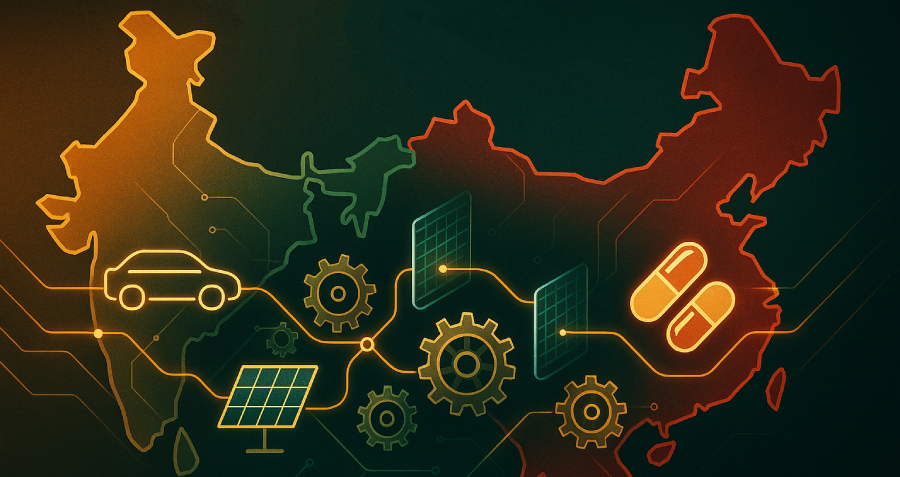
What does this term mean in practice? De-risked interdependence describes a model where two nations maintain deep economic ties in selected domains while erecting barriers in others deemed strategically sensitive. The basic rules are straightforward: joint ventures with Indian majority control can proceed; wholly-owned Chinese subsidiaries generally cannot. Component imports are welcome; consumer data platforms are not. Technology licensing is encouraged; greenfield plants competing with national champions face rejection. The approach sits between full economic integration and complete decoupling — a calibrated middle path that neither US-China relations (increasingly adversarial) nor EU-China relations (more ambivalent) have yet achieved.
The numbers tell a story of paradox. Bilateral trade reached approximately $138 billion in 2024, with China reclaiming its position as India’s largest trading partner — a relationship that has expanded fourfold over the past decade. Yet beneath these impressive figures lies a structural imbalance that has widened rather than narrowed: India’s trade deficit with China ballooned to roughly $99 billion in fiscal year 2024-25, up from $85 billion the previous year. China now accounts for 35% of India’s total trade imbalance.
The 2025 diplomatic reset was driven less by bilateral goodwill than by external pressures that made rapprochement attractive to both sides. “Given that there is a geopolitical series of US tariffs back-to-back against India and against China, it has given an opportunity for both India and China to leverage and try to have a platform where they can work together,” observes Durairaj Kumarasamy, a professor at the Manav Rachna Institute of Research and Studies in Faridabad. For India, the catalyst was unmistakable: United States tariffs of 50% on Indian exports in mid-2025 created incentives to diversify partnerships. For China, facing intensifying economic restrictions from the US and Europe, stabilizing relations with the world’s fifth-largest economy offered strategic value.
“Between 2014 to 2020, there was an enormous rush of Chinese FDI to the Indian market,” recalls Divay Pranav, who worked on the Make in India program attracting Chinese investment. “There was so much interest from Chinese companies that you would find small Chinese colonies growing up in Gurgaon, in Noida, and many other cities across India, where Chinese people would stay, observe the market, and try to understand how they can penetrate it. There was enormous excitement on the FDI front — smartphone manufacturers like Vivo, Oppo, and Xiaomi expanding their networks, component suppliers, and electric vehicle companies exploring the market.”
The 2020 Galwan Valley border clash changed everything. India implemented Press Note 3, requiring government approval for all FDI from land-bordering countries. Yet trade volumes continued their upward trajectory. India’s 2024 Economic Survey explicitly advocated for integration into Chinese supply chains. The policy elite had quietly acknowledged what manufacturers already knew: India’s industrialization depends, at least for now, on Chinese inputs.
Takeaway: External pressure from US tariffs, not bilateral warming, drove the reset. Both nations need economic alternatives to Western markets.
India’s reliance on Chinese imports spans critical sectors in ways that cannot be easily unwound. In pharmaceuticals, 70% to 72% of bulk drugs and intermediates come from China — a vulnerability that became starkly visible during the COVID-19 pandemic. In electronics, China and Hong Kong supply more than half of India’s components; 2024 imports of electrical and electronic equipment from China exceeded $47 billion. Chinese steel shipments hit record levels in fiscal year 2024-25, prompting safeguard investigations. And in renewable energy — the sector essential to India’s climate commitments — Chinese dominance in solar panels, wind turbines, and battery technology is even more pronounced.
“The trade deficit shows how dependent India is on China’s products,” notes Professor Kumarasamy. “India is not imposing tariffs on parts and components, particularly electronic and telecommunication items, and solar energy, wherever there is a sector relying on Chinese parts, which enables India to export to external markets. Because of the cost factor and the economies of scale, India is still motivated to get components from China compared to other countries.”
Takeaway: India’s $99 billion deficit reflects structural dependency, not policy failure. Chinese inputs enable Indian exports.
The EV sector: A case study in managed engagement
No sector illustrates the boundaries of acceptable collaboration more clearly than electric vehicles — and no comparison is more instructive than the contrasting fates of BYD and MG Motor. When BYD proposed a $1 billion greenfield investment in 2023 to establish manufacturing in India, the government rejected it outright. Even as diplomatic relations warmed through 2025, ministers reiterated that restrictions on Chinese EV manufacturers would remain in place.
“BYD is actually a big headache for OEMs all over the world,” explains one Indian industry analyst who has tracked Chinese investment patterns. “There is always a question about whether they are getting funding support from the Chinese government. Right now, Tata and Mahindra are the leaders of the electric vehicle revolution in the Indian four-wheeler market. There is all the more reason for the government to protect their turf and keep it reserved for their rise.”
MG Motor’s pathway, by contrast, reveals what structures can work. SAIC’s MG Motor had entered India before the 2020 watershed, acquiring General Motors’ existing factory near Vadodara in Gujarat around 2016-17. When the company needed fresh capital to expand in India’s hyper-competitive automobile market — but could not bring new Chinese FDI due to Press Note 3 restrictions — JSW Group stepped in. “JSW said, okay, I’ll come in, but you have to give me a controlling stake,” the analyst explains. “That is why the government approved it, because this would lead to some technology transfer.” The model aligns with New Delhi’s twin imperatives: localization and strategic oversight.
“If you strip down these vehicles, you’ll find that there is a lot of Chinese content sitting in there, which is a cause of concern,” notes Divay Pranav. “The local Indian OEMs in the two-wheeler and three-wheeler markets are deeply dependent on the Chinese supply chain — the battery packs and electronic components all come from China. Self-reliance on the component level is extremely critical.”
Takeaway: The BYD rejection versus JSW-MG approval defines the model: Indian control required, Chinese technology welcome.
The technology transfer question
A critical question remains underexplored: Is India demanding not just investment but capability transfer? The precedent is instructive. In the 1980s, when General Motors and Volkswagen sought access to China’s market, Beijing extracted significant concessions: joint ventures with Chinese partners, patent sharing, licensing agreements, and mandatory training of local engineers. Four decades later, the apprentice has cornered its former masters — Chinese automakers now outcompete GM and VW globally.
Has India learned from its northern neighbor? The evidence is mixed. The JSW-MG joint venture was approved partly because it promised technology transfer, but recent reports suggest MG has limited actual knowledge sharing. “JSW has now decided to tie up with another Chinese car manufacturer,” the industry analyst notes, “because MG is no longer interested in investing more and is limiting the tech transfer.” India’s Production Linked Incentive schemes encourage localization, but they focus more on manufacturing presence than deep capability building.
“Through joint ventures, Chinese companies can identify and initiate initiatives where they can invest,” observes Professor Kumarasamy. “India will not oppose that, as long as you have less shareholding from the Chinese side. On parts and components, India is very open — there are no issues. But technology sharing — they should come forward strategically.” The question is whether India will insist on the kind of systematic capability transfer that transformed China from assembler to innovator.
Takeaway: India welcomes Chinese investment but has not yet demanded the systematic technology transfer that enabled China’s own industrial rise.
A roadmap for Chinese companies
For Chinese companies seeking to establish or expand operations in India, the policy environment demands a fundamental reorientation of market entry strategy. The era of wholly-owned subsidiaries and greenfield investments — which characterized the 2014-2020 period when Chinese smartphone manufacturers, component suppliers, and venture capital funds flooded into India — has given way to a more constrained but still navigable landscape.
Garima Arora, who helped establish Bank of China’s operations in India and previously led India-China trade engagement at the Confederation of Indian Industry, offers a perspective from both sides of the relationship. “The business community is getting more dependent on China for cost and quality,” she notes. “Their trust in quality has improved. China is producing the same or better quality at a very affordable price for Indian customers. So business-wise, we are getting more inclined towards China.”
What works: Joint ventures with Indian majority ownership. Component and B2B manufacturing. Technology licensing with training commitments. Renewable energy equipment — India’s 500 gigawatt target by 2030 creates massive demand. Pharmaceutical intermediates under quality-assured regimes. Contract manufacturing that builds Indian capabilities.
What doesn’t: Greenfield plants competing with Indian champions. Consumer data platforms. Telecommunications infrastructure. Wholly-owned subsidiaries in strategic sectors. Any arrangement perceived as market capture without capability building.
“Given India’s vision of 500 gigawatts of renewable energy by 2030, that is a potential sector where both India and China can work together,” suggests Professor Kumarasamy. “At least in terms of green financing under BRICS or the Shanghai Cooperation Organisation, they can create initiatives through multilateral forums.”
Takeaway: Enter through Indian-controlled structures, prioritize B2B over consumer markets, and commit visibly to building local capabilities.
The fundamental question is whether this calibrated engagement can prove durable. The unresolved border dispute along the 3,488-kilometer Line of Actual Control remains the most significant impediment to normalized relations. Yet the economic logic of collaboration is compelling for both sides. China’s economy faces serious challenges — real estate sector troubles, Western sanctions, and slowing growth — making stable access to India’s consumer market increasingly valuable. India’s economy, despite robust growth, requires the kind of manufacturing foreign direct investment and technology transfer that China can provide. The persistent expansion of trade volumes despite five years of border tensions — from $71.66 billion in 2015 to $138 billion in 2024 — shows that commercial logic can coexist with strategic competition.
What emerges is a relationship where both nations leverage their respective strengths — China’s manufacturing sophistication and scale economies, India’s market size and demographic dividend — while maintaining strategic autonomy in domains deemed essential to national security. The model requires constant calibration: too much opening risks dependency and political backlash; too much restriction sacrifices the industrial inputs India needs for its growth ambitions.
For global leaders watching this relationship, the lesson is instructive. In an era of great power competition, full decoupling is often economically unworkable, while full integration is frequently politically unacceptable. The India-China relationship suggests a third path — between the increasingly adversarial US-China dynamic and the more ambivalent EU-China engagement. It is selective partnership with managed risks, calibrated sector by sector and deal by deal. Neither the partnership that optimists once envisioned nor the rupture that pessimists predicted — it is what both nations have concluded they can a.
Alan Chen is Assistant Dean of Global Programs at CKGSB. Garima Arora is an international business leader who studied Chinese at Nanjing University, led India-China trade engagement at the Confederation of Indian Industry, and served as Assistant Vice President at the Bank of China in Mumbai. Mukul Pandya is the former Executive Director and Editor in Chief of Knowledge@Wharton.
Enjoying what you’re reading?
CKGSB Report








Related Articles
Our Programs

Opportunities in the Disruption of Traditional Industries
In partnership with The University of Sydney
Global Unicorn Program Series
The Global Unicorn Program in Disruption of Traditional Industries – presented jointly by CKGSB and University of Sydney – will emphasize Australia’s distinctive contributions.
LocationSydney, Australia
Date24 - 27 Feb, 2026
LanguageEnglish

Emerging Markets: Innovation and Scaling for Exponential Growth
Global Unicorn Program Series
A joint program by Cheung Kong Graduate School of Business and The South Africa Chamber of Commerce and Industry
LocationJohannesburg, South Africa
Date20 - 23 Apr, 2026
LanguageEnglish

AI-Driven Healthcare Innovation Program
In partnership with Johns Hopkins Carey Business School
Global Unicorn Program Series
The 2025 Artificial Intelligence (AI)-Driven Healthcare Innovation Program stands at the forefront of addressing the critical need for innovative healthcare solutions powered by artificial intelligence.
LocationJohns Hopkins University, Washington, D.C.
DateSummer 2026
Asia Start: AI + Digital China Expedition
Asia Start provides entrepreneurs and executives with unparalleled access to Asia’s dynamic digital economy and its business ecosystems, offering the latest trends and insights, strategies, and connections to overcome challenges and unlock future growth for your business in Asia and beyond.
LocationChina (Shanghai, Hangzhou, Shenzhen)
Date11 - 14 May, 2026
LanguageEnglish

Scaling Innovation: AI and Digital Strategies for Business Transformation
In partnership with Columbia Engineering
Global Unicorn Program Series
This program is designed to equip senior executives with the strategic insights and tools necessary to lead in this transformative era.
LocationNew York, USA
Date27 Sep - 02 Oct, 2026
LanguageEnglish