





China’s power grid: leading the world and barely keeping up
January 04, 2026
China’s power grid occupies a paradoxical position: it boasts world-leading supply and distribution technologies, but at the same time, it is barely keeping pace with demand
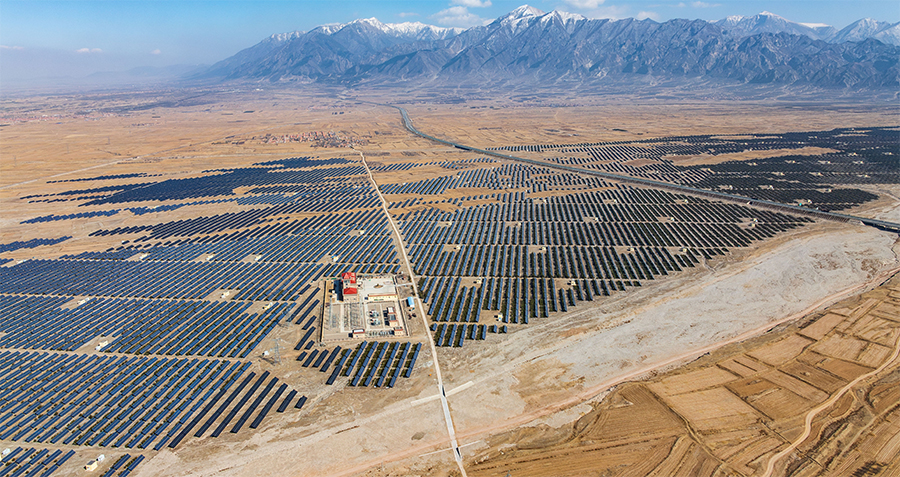
Between 2025 and 2030, China plans to install 253 gigawatts (GW) of solar capacity across roughly 7,000 square kilometers of desert—an area four times the size of Greater London. These installations form part of a sweeping national effort to rehabilitate degraded land, decarbonize energy supply, and most importantly, meet rising industrial and urban consumption.
China’s power grid has perhaps one of the most challenging jobs in the world: to both fulfill the needs of “the world’s factory” and, at the same time also ensure that 17% of the world’s population (1.4 billion people) have access to power. The challenge is not simply producing enough, and cleaner electricity—it’s getting that power from the remote regions where it is generated to the industrial coast and populated cities in the east where it is most needed.
At the same time, distribution issues are compounded by supply fluctuations. China is deploying renewables faster than any other nation, but coal remains indispensable for grid stability during periods of peak demand and weather-related disruption.
“China has the biggest power grid in the world, and the infrastructure might be the most advanced as well because China has invested heavily over the past decade,” says Xinyi Shen, a researcher at the Centre for Research on Energy and Clean Air. “Today, over 99% of the population has access to electricity, which is tremendous compared to many other countries, but the rapid rise of wind and solar has created new stability challenges because these sources fluctuate across seasons and even within a day.”
China’s power production
China’s electricity demand is growing rapidly, reaching a massive 9,852 TWh of energy consumed in 2024, a 6.8% year-on-year increase according to official statistics. Fossil-fuel thermal power accounted for 62% of the country’s electricity generation in 2024, but the country’s energy mix is shifting as renewable deployment accelerates.
By mid-2025, renewables accounted for about 59% of total installed power capacity, driven by the large-scale buildout of solar and wind, but because coal plants still operate for more hours and regional curtailment (reduction of the electric generator output made to maintain grid stability) persists, renewables supplied a smaller share of actual generation in 2024—around 38% low-carbon electricity according to independent trackers. At the same time, in 2025, 67% of China’s power was still generated from fossil fuels.
The divergence between capacity and generation highlights both the speed of China’s clean-energy expansion and the system-integration challenges that still limit renewable utilization.
“The best word to describe China’s grid might be ‘whiplash,’” says Daan Walter, Principal at global energy think tank Ember. “Thirty years ago, it was almost non-existent, then it became a rapidly expanding coal system, and before that system could even settle, it was pushed again into a full-scale renewable transformation. It changes a lot, and fast, but that dynamism can also be an advantage because the operators are used to constant change.”
New renewable additions in 2025 have been exceptionally strong: in just the first three quarters of the year, the National Energy Administration (NEA) reported around 310 GW of new renewable capacity, with solar contributing more than 200 GW in H1. This pace already surpasses the government’s earlier expectations for the year and aligns with forecasts from organizations such as the International Energy Agency (IEA) and Global Energy Monitor, which project that China will remain the dominant driver of global clean-energy growth through to 2030. Additionally, clean-energy sectors contributed 10% of China’s GDP in 2024, according to CarbonBrief.
“China’s power grid is a world-leading example of how the world must embrace electrification and decarbonisation at speed and scale,” says Tim Buckley, Founder and Director of Australian think tank Climate Energy Finance. “What China is doing is well beyond what anyone thought remotely possible even five or ten years ago, and they have blown past all forecasts.”
Looking ahead, China’s pipeline of wind and solar projects—estimated at well over a terawatt, which would double capacity—suggests continued large annual additions in the coming years, even as grid upgrades, storage deployment and market reforms become increasingly important to translate capacity growth into higher renewable generation.
Differing demand
Electricity consumption in China has long served as a proxy for economic activity, and over the past two decades, the country’s growing industrial base has consistently accounted for more than 60% of total electricity demand. Cities contribute significantly as well, but it is the vast machinery of Chinese industry that has driven growth in power use.
Distribution offers the biggest challenge for China’s grid. Most of the country’s solar and wind potential is concentrated in western and northern regions—Xinjiang, Gansu, Qinghai and Inner Mongolia—where land is abundant and population density is low. By contrast, the country’s largest consumers of electricity—Guangdong, Shanghai, Zhejiang, Jiangsu and Beijing—sit thousands of kilometers to the east along the coast.
“In terms of transmission, all the most attractive power generation resources, regardless of whether they are coal or hydropower or renewables, are all too far away from the load centers on the east and the south,” says David Fishman, Senior Manager at professional services firm The Lantau Group.
Complicating the picture are environmental pressures. A series of intense heatwaves across northern China in recent summers has pushed electricity demand to record highs, especially given the increased penetration of air conditioning units in areas that previously did not have them. At the same time, drought conditions have lowered water levels in major river basins, particularly in the southwest, reducing the output of hydropower stations that serve as a key stabilizing resource.
In 2022 and 2023, Sichuan and parts of Chongqing experienced rolling blackouts as low hydropower coincided with extreme heat. These events have underscored the vulnerability of traditional baseload sources and the rising complexity of managing regional grids.
“There is a squeeze on distribution capacity due to hotter summers driving cooling demand, particularly with a wealthier population and smaller villages now installing AC units or refrigerators that weren’t there before,” says Fishman. “This means the distribution grid needs to be more robust than it was before, especially with the increasing installation of rooftop solar, which needs to be aggregated and sent back up into the main trunk of lines.”
Digital infrastructure is another fast-growing source of demand. Estimates of China’s data center electricity consumption place it roughly in the 1.5–3% range of national power use, though figures vary thanks to different definitions of ‘data-center energy’ (some include only server facilities, others add networks and digital infrastructure). Forward-looking analyses by the Rocky Mountain Institute (RMI) project a potential rise to 3–5% by 2025–2030 as cloud computing, AI and 5G continue to expand.
“The data centre and AI industry is increasing very rapidly in China,” says Shen. “Their power consumption is becoming significant, although still small compared to heavy industry. By 2025, total power use for data centers will reach around 100 to 200 terawatt-hours, and it will continue rising sharply toward 2030.”
But data centers also pose more than just a future demand issue.
“Globally, AI data centers are not yet a volume problem, for example, total electricity use for ChatGPT is only about 5% of what Americans use for televisions,” says Walter. “The power density is the current challenge: a single data centre can consume a gigawatt of electricity in a very small footprint. It can be like trying to get a ball of string through the eye of a needle in one go. It is forcing grid operators to make rapid, complex upgrades that would normally take decades.”
Grid modernization
China’s solution to these coordination and transmission problems is an ambitious modernization effort that parallels the development of its high-speed rail network. In both cases, the central government identified a strategic bottleneck—transportation in the early 2000s, electricity transmission today—and mobilized state-owned enterprises to build at unprecedented speed and scale.
The State Grid Corporation of China (SGCC) and China Southern Power Grid (CSPG), among others, are driving massive investments into ultra-high-voltage (UHV) transmission, smart substations, digital load balancing and real-time monitoring systems. These projects feature prominently in the 14th and 15th Five-Year Plans, which emphasize energy security, resilience and decarbonization alongside digital infrastructure and automated grid management.
“The scale of these institutions allows China to deploy world-leading technology in grid management, automation and smart infrastructure,” says Buckley. “This is nation-building infrastructure of a kind no other country is delivering today.”
One solution has been to utilize ultra-high-voltage (UHV) lines, each capable of transmitting up to 12 gigawatts (GW)—high-voltage lines can only carry up to 1 GW. These arteries have become essential infrastructure for the “West-to-East Power Transfer,” a national strategy that moves power from inland hubs to coastal megacities.
“China spends around $100 billion every year on expanding and modernizing the grid,” says Buckley. “They lead the world in ultra-high-voltage technology, with around 35 of the 37 largest HVDC cable systems on the planet. These are 1,500-kilometre lines that no other country has built at such a scale.”
Digitalization of the grid is also a central pillar of strategy. AI-driven systems increasingly forecast demand, optimize load flows and coordinate fluctuating renewable output. Smart substations equipped with sensors provide granular visibility into usage patterns and stress points.
“Where they can, they’re building UHV lines to bring it across the country, where that’s not feasible, maybe you can leapfrog it around with high voltage lines, or at least get it out of where it is and to where the loads are instead,” says Fishman. “It is just constantly work in progress, and they are sprinting as fast as they can to barely stay ahead.”
Even with UHV transmission and digital tools, the variability of wind and solar requires solutions that can store electricity at scale. China has begun deploying multiple forms of storage, most prominently pumped hydropower and utility-scale batteries. Pumped hydro remains the backbone of national storage capacity, offering large-scale, long-duration flexibility. But geographic constraints limit its expansion.
As a result, China has rapidly become the world’s largest market for grid-scale lithium-ion batteries, driven by domestic producers such as CATL, which dominate global supply chains. These batteries help manage short-term fluctuations in renewable output and support peak shaving—leveling out peaks by reducing power consumption quickly and for a short time to avoid peaks—in urban centers.
“Battery systems are now reaching turnkey prices of $60–$70 per kilowatt-hour, and possibly $40 in the near future, and that fundamentally changes how the grid transports energy because power can now be shifted through time, not just space,” says Walter.
“If you place storage on both sides of a transmission line, you can send electricity during off-peak times and smooth out congestion dramatically,” he adds. “It’s similar to how refrigeration eliminated the morning ‘milk train’ rush in New York—once you can store the product, you no longer need massive peak infrastructure. Cheap batteries give China a strategic advantage because it can simply manufacture more storage whenever local grids become strained.”
But storage development does still lag behind the pace of renewable installations, and curtailment—where wind or solar power is wasted because the grid cannot absorb it—remains a persistent issue in some regions. This is another example of rapid and remarkable progress, coupled with a consistent need for more.
An alternative to moving the power itself is to shift demand closer to supply, and this is happening increasingly often, particularly with new data centers. In regions such as Inner Mongolia and Ningxia, operators have increasingly been pushed to locate these new builds near renewable resources to ease burdens on the grid.
“Data centers can be built almost anywhere because they only need internet connectivity, so many are now being located in western provinces where electricity is cheaper,” says Shen. “Previously, this was because coal was cheap; increasingly, it’s because renewable power is cheap. The government also wants to guide these centers toward greener development because their electricity use is so high.”
Alongside physical upgrades, China is experimenting with market reforms designed to improve efficiency and manage provincial fragmentation. Power trading schemes now allow electricity to be bought and sold more flexibly across provinces, with some areas implementing day-ahead and intraday markets. Distributed generation pilots enable businesses to export surplus energy, shifting China incrementally toward a more dynamic, responsive grid.
“China is shifting from a planned power system to a more market-based electricity market,” says Shen. “The share of long-term contracts is decreasing while the share of spot market trading is increasing. This is necessary because both supply and demand fluctuate far more frequently now than ten years ago.”
Challenges ahead
Despite adding record levels of capacity and making progress in grid modernization, China faces significant hurdles in reshaping its power system. The sheer scale and speed of renewable deployment put continuous pressure on transmission networks. The absence of sufficient long-duration storage complicates the integration of variable power sources. Climate volatility—heatwaves, droughts, extreme storms—adds new layers of unpredictability.
In addition, entrenched interests continue to present challenges. Many state-owned generators and local governments depend heavily on coal revenues and the employment it brings, and entrenched pricing structures can limit incentives to adopt cleaner resources.
“These provinces must think seriously about what industries can replace coal over the next decade,” says Shen. “They are starting to build solar farms on former coal mining land and experimenting with green hydrogen production. But this shift takes time, and the cost of emerging technologies is still high.”
There are also those with vested interests investing in new coal-fired power capacity, impacting China’s progress towards its carbon reduction targets.
“Inner Mongolia presents a particular challenge as we’re talking about hundreds of new gigawatts of coal over the last five years, with much of it invested in by coal miners,” says Fishman. “They can guarantee their own custom for the next 20 or 30 years and also will be operating at very low costs because of self-supply.”
At the same time, some new coal power capacity is being added next to renewable installations to help even out supply, and coal plants are becoming more modern, and utilization rates are often dropping.
“China is still building new coal plants, but they’re modern, flexible peaking plants—not the old inflexible ones from 25 years ago,” says Buckley. “The average coal plant in China is running at just 45% utilization, an all-time low. An idle coal plant emits nothing, and the data shows that thermal generation is actually falling as more renewable capacity is added.”
Leading the world, but barely getting by
China’s energy grid today occupies a paradoxical position: it is simultaneously the most advanced, most ambitious power-transmission network in the world and a system under constant pressure from breakneck demand growth. The pace of this growth is so rapid that each wave of new capacity is quickly absorbed, forcing planners into continuous expansion mode.
China’s grid is, therefore, world-leading not because it has solved its energy challenges, but because it must innovate at an enormous scale to continue to function.
“China’s grid is the largest in the world, it’s the most robust in the world, and it is also constantly not enough,” says Fishman. “This goes for pretty much all of China’s power sector: it is already huge and continuing to grow, but insufficient at the same time. They are in a constant race to keep up.”
Enjoying what you’re reading?
CKGSB Report




Related Articles




Related Articles

Our Programs

Opportunities in the Disruption of Traditional Industries
In partnership with The University of Sydney
Global Unicorn Program Series
The Global Unicorn Program in Disruption of Traditional Industries – presented jointly by CKGSB and University of Sydney – will emphasize Australia’s distinctive contributions.
LocationSydney, Australia
Date24 - 27 Feb, 2026
LanguageEnglish

Emerging Markets: Innovation and Scaling for Exponential Growth
Global Unicorn Program Series
A joint program by Cheung Kong Graduate School of Business and The South Africa Chamber of Commerce and Industry
LocationJohannesburg, South Africa
Date20 - 23 Apr, 2026
LanguageEnglish

AI-Driven Healthcare Innovation Program
In partnership with Johns Hopkins Carey Business School
Global Unicorn Program Series
The 2025 Artificial Intelligence (AI)-Driven Healthcare Innovation Program stands at the forefront of addressing the critical need for innovative healthcare solutions powered by artificial intelligence.
LocationJohns Hopkins University, Washington, D.C.
DateSummer 2026
Asia Start: AI + Digital China Expedition
Asia Start provides entrepreneurs and executives with unparalleled access to Asia’s dynamic digital economy and its business ecosystems, offering the latest trends and insights, strategies, and connections to overcome challenges and unlock future growth for your business in Asia and beyond.
LocationChina (Shanghai, Hangzhou, Shenzhen)
Date11 - 14 May, 2026
LanguageEnglish

Scaling Innovation: AI and Digital Strategies for Business Transformation
In partnership with Columbia Engineering
Global Unicorn Program Series
This program is designed to equip senior executives with the strategic insights and tools necessary to lead in this transformative era.
LocationNew York, USA
Date27 Sep - 02 Oct, 2026
LanguageEnglish