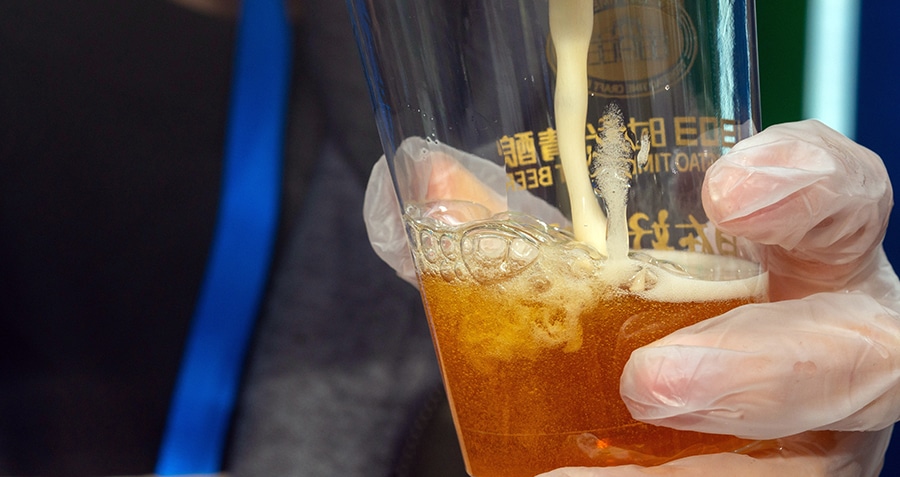

Shanghai’s “foreigner street” (Laowai Jie) was once a staple of Shanghai’s nightlife, but while it’s been mostly quiet since the pandemic, there is one thing that is bringing people in—craft beer.
On one particular night recently, a craft beer festival saw visitors moving from stall to stall with plastic cups in hand, sampling various ales, wheat beers and fruit sours, all brewed in various cities across China.
Over the past two decades, the Chinese beer industry has changed from being mass-produced Tsingtao and low alcohol level lookalikes to a wide range of craft beers with complex aromas and flavor profiles that come close to matching what you’d find in cities like Chicago or Los Angeles.
Nick Johnson, a regular of the craft beer scene since it took off in Shanghai in the mid-2010s, sips a hazy IPA as he recalls his first encounter with craft beer. “It was one of the Mad Dragon beers at Shanghai Brewery, a really nice balance of bitterness and aroma.”
China’s larger alcohol market has struggled in recent years, with sales of native Baijiu liquor, such as the giant Moutai, and imported grape wines and liquors falling due to changing tastes and other factors. Craft beer, with its wide range of complex flavors and yet still being affordable, has been expanding.
Darren Guo, Managing Director of event company NürnbergMesse China and organizer of the Craft Beer China Conference and Exhibition, says that one of the reasons craft beer has gained traction in the country is that it resonates strongly with younger Chinese consumers. “Compared with traditional spirits such as Baijiu, where consumption has long been associated with social obligation and competitive drinking, younger consumers increasingly prioritize self-enjoyment, moderation and personal experience,” he says.
The origins of craft beer in China
Craft beer typically refers to small-batch beer produced with an emphasis on flavor, experimentation and brewing technique, rather than on scale. Globally, the term is associated with independent breweries and varieties that include various pale ales—Indian Pale Ale (IPA), American Pale Ale (APA)—stouts and sours. In China, the trend tends to be looser, referring more to style and branding than independent ownership or production volume.
China’s modern beer industry traces its roots to the early 20th century, with the Tsingtao brewery being founded in the German-occupied city of Qingdao in 1903. However, it was not until the market opening changes of the 1980s that beer consumption became widespread. This period saw a rise of what is locally termed “green bottles”—light, affordable lagers suited to the large social banquets typical in China. Around this same time, the sales of other alcoholic beverages, mostly imported, including grape wine, whisky and cognac, also began to grow strongly.
In the 2000s, as China’s bigger cities saw a larger influx of foreign nationals, small craft breweries began to appear in places like Beijing and Shanghai—many of them opened by expats wanting to provide a taste of home and a social meeting spot for their communities.
Many of these original craft breweries grew out of expats making homebrews for their friends, as Neil Playfoot, a former brewmaster who now runs Changsha-based craft beer consultancy Asian Beer Network, explains. “Getting access to the correct yeast and hops back then was very difficult and so it started out as a real labor of love,” he says. One of the first of these was Great Leap Brewing, which expanded to multiple locations across Beijing.
Byron Jones, an expat who has been living in Beijing since 2010, still remembers the first time he visited Great Leap Brewing. “It was really amazing, you’d have all these different beers and you had to make multiple trips to try all the beers they offered,” he says.
At that time in Beijing, early pioneers such as Great Leap, Jing-A and Slowboat were some of the only places where you could get, as Jones describes, “a decent beer that tastes good.”
In those days, the bar scene was considered somewhat dingy, and many bars focused on providing cheap alcohol in large volumes. Jones says that one of the main attractions to craft breweries was that they were a place you could sit and enjoy good-tasting beers while conversing with friends. “It was about the actual beer and food, and about getting together with friends for some good conversation… A very different environment,” he says.
Expansion and disruption
It was around this time that the craft beer scene expanded rapidly. Brewpubs, taprooms, and beer festivals became an increasingly important part of the nightlife in Chinese cities and were no longer limited to the expat community.
Vince Zhang, a customer service manager in Shanghai, says he first tried craft beer around 2018. “It was so different to the Asahi I usually drank. There’s so much flavor, and it’s not just something to have with a meal, but to actually enjoy by itself.” He says since then, he will go with his friends to taprooms near his office, mostly on Friday nights after work.
And with expansion came a wave of innovation. Many brewmasters began experimenting with localizing the beers—adding uniquely Chinese ingredients, such as Sichuan peppercorns, green tea and jasmine.
Playfoot says that this period also saw a rise in beers with a lower alcohol percentage and also ones with fruit flavors. “Many breweries were looking to develop recipes that would appeal to a wider market of drinkers, including younger drinkers,” he says.
The COVID pandemic put a wedge in all of this. As life ground to a halt and many cities went into some form of social distancing—if not full lockdowns—people did not go out.
“This hit the craft brewing industry hard,” says Playfoot. “A lot of the craft brewers were based around their taprooms…. actually being on site and drinking at their locations.”
Many closed down, but the ones that survived were generally the ones that adapted and made the move on to e-commerce platforms. Playfoot thinks that pivot had its advantages. “Sadly, a lot of brewers didn’t make it, but those that made the pivot [to e-commerce platforms] are going to be stronger in the long term and there is even space for them to grow their reach,” he says.
With restrictions in Shanghai being particularly harsh, Johnson remembers many of his favorite venues closing down. “Many places seriously struggled during COVID due to the stay-at-home orders, movement bans and the ban on indoor dining,” he says. “By the time the light at the tunnel emerged in 2023, it was too late for many of the breweries I knew. Kaiba and Shanghai Brewery had already closed, and Boxing Cat and Liquid Laundry closed permanently in 2025,” he adds.
That period also marked a reduction in the size of the foreign community, which included many of the original craft brewers.
Revival of craft beer
That shift left a void to be filled, and after the pandemic ended in 2023, it wasn’t long before more local craft brewers moved onto the scene.
The changing demographic also meant a changing market, as it became much more focused on domestic customers. At the same time, a slowing economy and the resulting lack of consumer confidence has seen the market shift towards more affordable options.
Supermarkets and large retail chains have become involved in this transition. In the past few years, ‘craft-style’ beers that are designed to mimic the flavor profiles and branding of traditional craft breweries have begun to fill supermarket shelves at a much more affordable price. Supermarket chain Hippo Fresh, in particular, has launched its own range of beers featuring tea infusions, fruit flavors and German stylings.
Zhang’s colleague, Maria Xu says she only started drinking craft beer recently. “It was too bitter and also expensive,” she says, “but nowadays there are more fruit beers and even jasmine tea flavored beers that I enjoy.”
Purists, such as long-time craft beer enthusiasts Jones and Johnson, may question whether these are truly ‘craft beers’, but as Johnson points out, there is no denying their rise in popularity.
“One big trend I’ve seen, is the availability of what are marketed as ‘fresh’ craft beers in one litre bottles through the supermarkets, including wheat beers, IPAs, and novelties like Longjing-flavour or Lychee-flavour beers,” he says, adding, “It is certainly debatable whether these even meet the definition of craft beer, but it’s undeniable that they have won a substantial portion of the domestic market share for home drinking over the last few years.”
Established beer giants have also moved into the craft beer scene. Tsingtao, for example, has launched its own range of specialty beers, including IPA, stout, wheat beer and several fruit beers, which it distributes to restaurants and venues to be sold on tap in a craft brewery-type setting.
Guo says the post-pandemic era has seen a more mature and structured phase of development, with more consistency in quality across the board. He also points out the pivot towards e-commerce. “Beyond traditional on-trade and retail channels, new retail formats—such as instant retail, online platforms and warehouse membership stores—have developed rapidly, reshaping how craft beer reaches consumers and creating new growth opportunities for the industry,” he says.
Baijiu’s overall market size still dwarfs craft beer and always will, but the changing trend is clear. Baijiu sales were estimated to have fallen by around 15% in 2025 and production was down roughly 12% year-on-year. Likewise, sales of imported wine dropped about 26% in 2025. By contrast, craft beer has continued to expand, with industry estimates putting it around RMB 35-45 billion in 2023, up from RMB 30 billion pre-pandemic.
From niche to premium
China’s craft beer scene has grown from a small niche industry appealing mainly to the expat communities of China’s big cities to a more mainstream part of Chinese drinking culture. As trends in China move away from traditional high-end liquors mainly consumed in banquet settings, drinkers also wish for more variety than mass-produced lagers. Craft beer sits in that perfect middle ground—affordable and approachable, but still with a premium feel.
It stands as a rare example of a sector that, despite the challenges of the pandemic, has adapted to circumstances and thus seen growth.
Playfoot says that while craft beer in China still only holds a small share of the market, it is continuously gaining traction. “A lot of good quality craft beer is coming out of China and starting to be recognized on the international stage—we’re seeing Chinese breweries already winning international medals,” he says.
Enjoying what you’re reading?
CKGSB Report








Related Articles
Our Programs

Asia Start: AI + Digital China Expedition
Asia Start provides entrepreneurs and executives with unparalleled access to Asia’s dynamic digital economy and its business ecosystems, offering the latest trends and insights, strategies, and connections to overcome challenges and unlock future growth for your business in Asia and beyond.
LocationChina (Shanghai, Hangzhou, Shenzhen)
Date11 - 14 May, 2026
LanguageEnglish

Scaling Innovation: AI and Digital Strategies for Business Transformation
Global Unicorn Program Series
In partnership with Columbia Engineering
This program is designed to equip senior executives with the strategic insights and tools necessary to lead in this transformative era.
LocationNew York, USA
Date27 Sep - 02 Oct, 2026
LanguageEnglish

Emerging Tech Management Week: Silicon Valley
Global Unicorn Program Series
In partnership with UC Berkeley College of Engineering
This program equips participants with proven strategies, cutting-edge research, and the best-in-class advice to fuel innovation, seize emerging tech developments, and catalyse transformation within your organization.
LocationUC Berkeley
Date01 - 06 Nov, 2026
LanguageEnglish

Stanford & Silicon Valley Immersion Program
Global Unicorn Program Series
In partnership with Stanford Engineering Center for Global & Online Education
This CKGSB program equips entrepreneurs, intrapreneurs and key stakeholders with the tools, insights, and skills necessary to lead a new generation of unicorn companies.
LocationStanford University Campus,
California, United States
Date06 - 11 Dec, 2026
LanguageEnglish with Chinese Translation