On January 8, Cheung Kong Graduate School of Business (CKGSB) welcomed Pengfei Wang, Boya Distinguished Professor and Dean of HSBC Business School at Peking University, for an academic seminar, where he presented his latest paper to CKGSB faculty, followed by an interview with CKGSB exploring the enduring role of business schools.
Professor Wang’s paper, “A Reference-Dependent Fiscal Theory of Self-Fulfilling Price Levels,” offers a novel framework for understanding how inflation can emerge from expectations alone, even in the absence of changes in economic fundamentals.
The study shows that households’ concerns about fluctuations in the real value of government debt can trigger what the authors describe as “inflation panics,” leading to higher current inflation and increased volatility in government bond markets.
Presenting to CKGSB faculty in Beijing and online, Professor Wang emphasized that inflation expectations—particularly expectations about future inflation volatility—can become self-fulfilling. “When market participants expect higher inflation volatility in the future, inflation today tends to rise,” he explained during the seminar. “That expectation feeds directly into higher required returns on government bonds, lowering bond prices and amplifying fiscal pressure”.
The research is highly relevant in an era of elevated sovereign debt levels worldwide. As Professor Wang noted, most countries now face historically high government debt-to-GDP ratios, making bond markets especially sensitive to shifts in sentiment. Even small changes in expectations can lead to outsized market reactions, a phenomenon the paper helps explain through a rigorous theoretical lens.
Importantly, the study also offers policy implications. It finds that a fiscal policy which adjusts the nominal stock of government bonds inversely with inflation uncertainty can effectively eliminate inflation panics, stabilizing both prices and debt sustainability. This insight contributes to ongoing debates about the interaction between fiscal policy, monetary credibility, and financial market stability.
“We are honored to have invited Pengfei to give a seminar today,” said Professor Li Xuenan (Erica). “Hosting seminars like the one today is very critical for creating a healthy academic environment. By actively engaging with global scholars, we gradually establish CKGSB’s reputation as a research-oriented and first-class business school.”
The seminar prompted lively discussion, with CKGSB faculty offering feedback on both the theoretical framework and its broader implications. Professor Wang noted that the exchange was especially valuable given that the paper is still at an early stage. He emphasized that input from scholars with different research backgrounds helps sharpen ideas and challenge embedded assumptions.
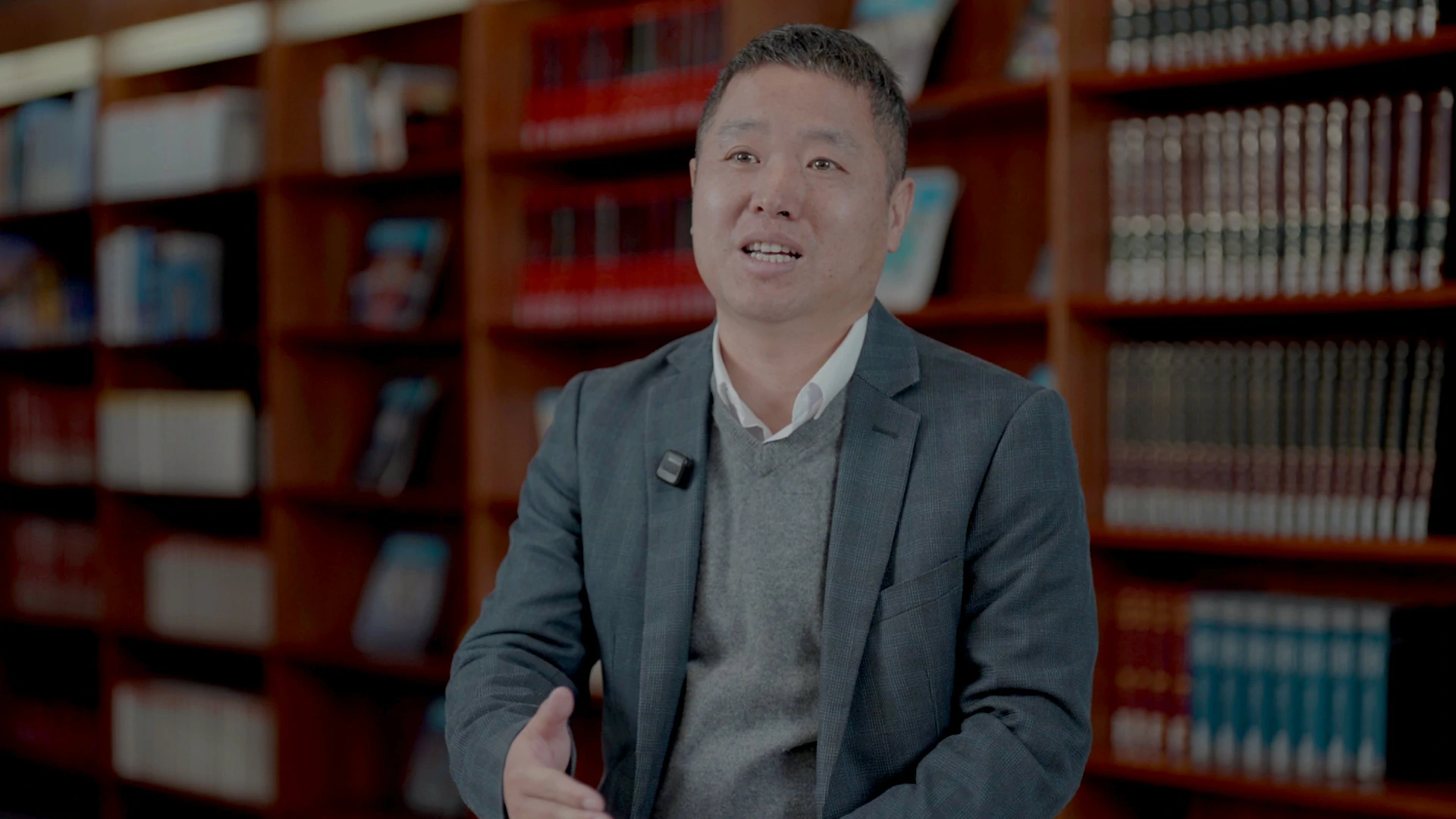
In the subsequent interview with CKGSB following the seminar, Professor Wang emphasized the importance of academic exchanges like these. Scholars, he observed, often develop habitual ways of thinking shaped by their own training and fields. Engaging with peers from other institutions helps break those patterns and encourages more comprehensive thinking. Such exchanges, he noted, are a defining characteristic of leading business schools worldwide.
Professor Wang acknowledged that AI will profoundly affect how business schools teach and conduct research going forward, but argued that it does not change the fundamental purpose of education. At its core, he said, education is about helping individuals grow, form aspirations, and develop the capacity to think independently and responsibly.
In this sense, AI is best understood as an enabling tool rather than a replacement—one that can personalize learning, enrich classroom content, and enhance research productivity, while preserving the fundamentally human core of education.
Professor Wang also reflected on entrepreneurship education, noting that business schools cultivate entrepreneurial spirit not only through coursework, but through community, shared experience, and engagement beyond the classroom. He highlighted the importance of helping students translate management principles into practice—an ability that becomes increasingly valuable in uncertain and rapidly evolving environments.
Addressing the perceived gap between academic research and real-world practice, Professor Wang offered a simple perspective: research identifies general patterns and principles, but their impact depends on how they are used. Scholars excel at uncovering these principles; entrepreneurs and executives bring them to life through application.
Professor Wang praised CKGSB’s pioneering role in China’s business education landscape, particularly in entrepreneurial and executive education, as well as its strong research faculty and global orientation. He expressed confidence that CKGSB is well positioned to continue building academic standing while remaining closely engaged with real economic and managerial challenges.
By combining a rigorous academic seminar with a dialogue on education, Professor Wang’s visit highlighted CKGSB’s commitment: advancing frontier research while thoughtfully engaging with the evolving role of business schools in a global context.